Biltmore Estate in Asheville: Tickets, Tours and What to See
Biltmore Estate is America's largest privately owned home — 250 rooms on 8,000 acres in
Asheville, North Carolina, still owned by George Vanderbilt's descendants. It sits about 9 miles
south of downtown. Admission is timed, the entrance is 3 miles from the house, and a full visit
takes a day.
Facts checked 30 July 2026
Plan your visit
Biltmore Estate sits nine miles south of downtown Asheville at 1 Lodge St. Daytime
tickets started at $80 on 29 July 2026, the entrance is three miles from the house, and Biltmore
recommends at least one full day. January to March is the quietest stretch of the year.
Where it is
Asheville, North Carolina, immediately south of downtown. Use 1 Lodge St, Asheville,
NC 28803 for satellite navigation — other addresses can route you to the wrong
entrance.
From downtown
Roughly 9–10 miles, about a 10–25 minute drive outside peak traffic. Then a further
3 miles of estate road from the entrance to the house.
Tickets from
$80 Daytime House & Grounds, $50 Grounds Only, as
published 29 July 2026. Prices move with the date and season. Buying online saves $10 against the
gate price.
How long to allow
1.5–2 hours for the house, 2.5–4 hours with the gardens, a full day for the whole
estate. Biltmore recommends two days for a complete visit.
Best time to go
January to March is genuinely quiet, at the cost of bare gardens and cold. On any day, take the
first house entry at gate-open or a 2pm–3:30pm slot. Saturdays are busiest; 11am–2pm is
the crush inside the house.
Timed entry
Required every day for every guest entering Biltmore House. You choose your entry time when you
buy, and Biltmore asks you to be at the Admissions Gate at least 30 minutes beforehand.
Is it open right now?
Yes. The estate is open 365 days a year and reopened on 2 November 2024 after closing for roughly
five weeks for Hurricane Helene. Biltmore reports that the house, Conservatory, Winery and gardens
“received minimal or no damage.” Biltmore House itself has no fixed opening
hours — your entry time is whatever is printed on your ticket, and hours vary daily with
demand. On the day we checked, 29 July 2026, the Admissions Gate ran 9am–5pm,
the gardens 9am–6pm and the Winery noon–7pm. Any page quoting you a fixed
“9am to 5pm” for the house is inventing a number the Estate does not publish.
What makes Biltmore worth the trip
Biltmore is the largest privately owned house in America: 250 rooms, roughly four acres of floor space, finished in 1895 on an estate that once ran to 125,000 acres. The size is not what earns the visit. What earns it is that a house this old could already do things most American homes could not do for another forty years.
Almost everything you have heard about Biltmore is a number. Rooms, acres, fireplaces. Numbers are the least interesting part.
The interesting part is that in 1895, when most American homes had no electricity and no indoor plumbing, this one had 288 electric light fixtures, 43 bathrooms, two electric elevators, a house-wide fire alarm, synchronised clocks in every room, and walk-in refrigerators cooled by ammonia gas. It had a heated indoor swimming pool in the basement and a two-lane bowling alley next to it. It was, functionally, a small municipality with a roof.
The second interesting part is what the estate did to the country around it. George Vanderbilt hired a forester before he had a finished house. That decision produced the first working plan for sustainable forest management in the United States, the first forestry school in North America, and eventually 86,700 acres of the estate becoming the nucleus of Pisgah National Forest. American conservation has a birthplace, and you can buy a ticket to it.
The entrance gate is three miles from the front door, and Frederick Law Olmsted meant every one of them.
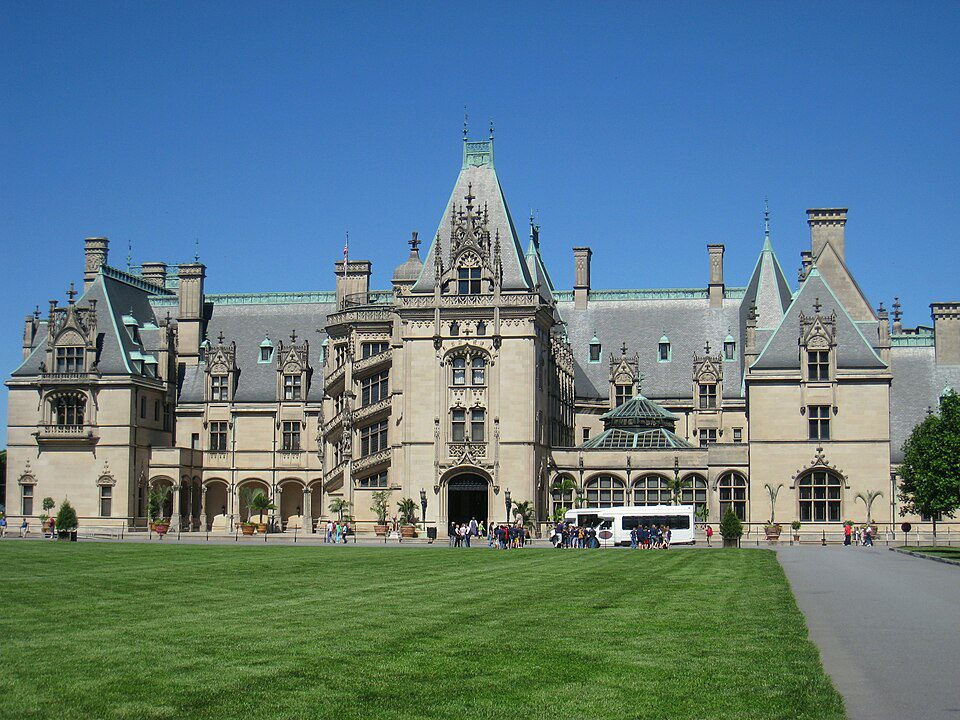
Which brings up the third thing. You do not drive up to Biltmore House. You are routed to it. Olmsted's Approach Road climbs about three miles from 1,980 feet to 2,230 feet through rhododendron, hemlock and white pine, crossing a series of bridges, deliberately screening every long view. There is no glimpse of the house until there is all of it at once. It was his last major commission, and the road is the argument for why he was worth hiring.
The end of Olmsted's three-mile reveal: the whole front of the house, all at once, with nothing to prepare you for it.
Photo: Daderot / Wikimedia Commons, public domain.
A president came to stay
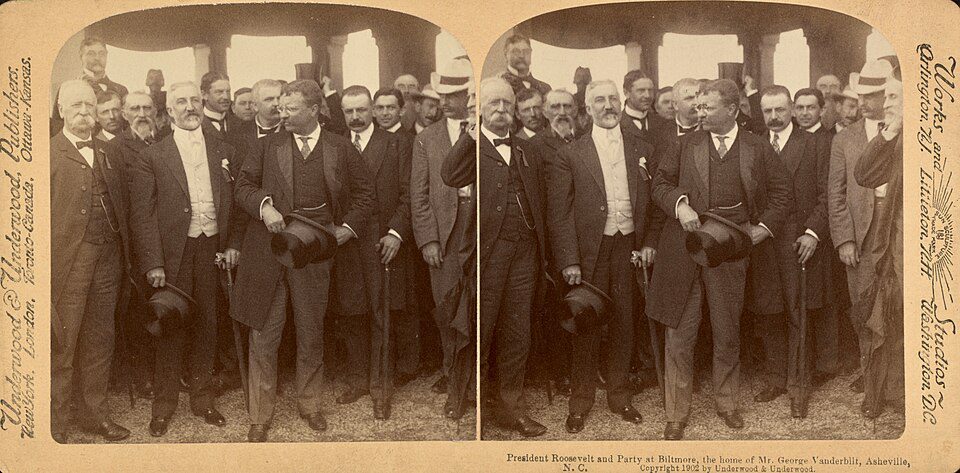
Theodore Roosevelt visited the house in September 1902, while George Vanderbilt was still living in it and thirty years before the public was ever let inside. Photographs of the party on the steps survive.
Plan on more time than you think. The house alone is a couple of hours if you do not linger, and the gardens, the Conservatory, the farm and the winery are separate destinations on the same 8,000 acres. People routinely arrive expecting a house tour and leave having seen a third of the place.
Where it is and how to get there
Biltmore Estate is in Asheville, North Carolina, immediately south of downtown —
roughly nine to ten miles, a 10 to 25 minute drive outside peak traffic. Use 1 Lodge St for satellite
navigation. The critical fact: Reception and Ticketing at the entrance is a further three miles from
Biltmore House.
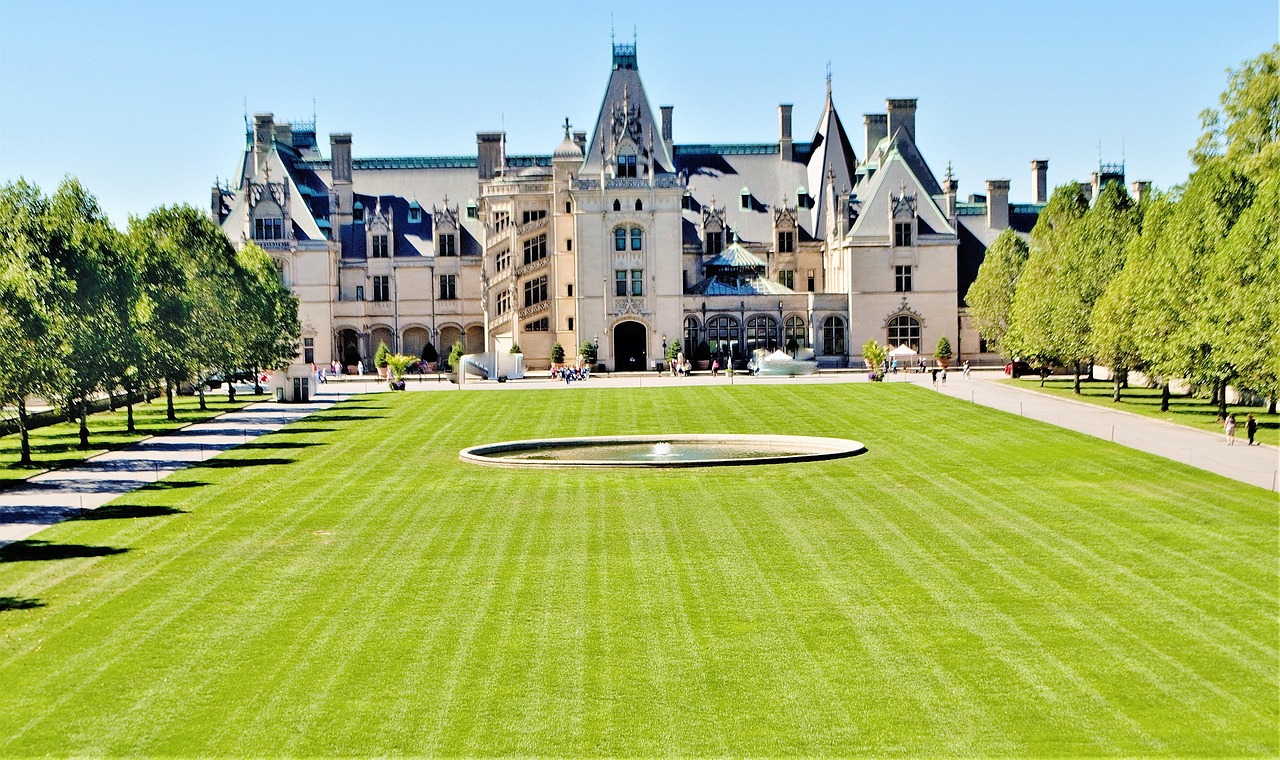
The Esplanade, at the end of the approach road. This is where the drive from Reception finally puts you — three miles after the entrance gate.
Photo: Warren LeMay / Wikimedia Commons, CC0.
The entrance is not the house
Reception & Ticketing sits 3 miles from Biltmore House, with a long approach
road between them. Budget only the drive from downtown and you will miss a timed house entry.
Biltmore asks you to arrive at the Admissions Gate at least 30 minutes before your first
activity, and advises allowing about 30 minutes for travel and parking between any
two areas of the estate. It publishes no minute figure for the approach drive itself.
Navigation address
1 Lodge St, Asheville, NC 28803. Biltmore warns that any other address can route you to the wrong
entrance.
Estate driving distances
Reception & Ticketing to Biltmore House, 3 miles. House to Antler Hill Village and the Winery,
5 miles. House to Deerpark, 2 miles. Antler Hill Village to Deerpark, 2 miles. Reception to The Inn,
2 miles. The Inn to Biltmore House, 4 miles. These are Biltmore's own published legs.
Parking
Included with admission. Lots A and B are the “park and walk” lots for the house, an
8–10 minute walk away. Lots C and E are “park and ride”: Lot C takes RVs and buses
with a complimentary shuttle, Lot E is accessible parking with a free ADA shuttle. There is
accessible parking beside the Conservatory at the Walled Garden lot, and separate parking at The Inn
and at Antler Hill Village.
Getting between areas
Not on foot. In Biltmore's words, “Estate roads do not have sidewalks, and walking
between different areas of the estate is not recommended due to travel distances.” The
free shuttles cover lot-to-house, house-to-Conservatory and overnight guests. The estate-wide
Biltmore Connect shuttle costs $15 per person per day — parking is free, but
the shuttle that links the estate is not.
Rideshare and taxi
They do not reach the house. Uber, Lyft and taxis drop off and pick up only at the designated
Rideshare Lane by the Park & Ride building, 79 Old Shiloh Rd, Asheville, NC 28803 — which
Biltmore describes as drop-off and pick-up only, not transport between estate locations.
City bus
Asheville Rides Transit routes S1, S5 and S6 serve the Biltmore Village area along the Biltmore
Avenue and Hendersonville Road corridor. No route enters the estate, so from a bus stop you still
face the gate and then the 3-mile no-sidewalk gap to the house.
Groups and coaches
Biltmore runs a group-ticketing programme, and Lot C has dedicated RV and bus parking with a
complimentary shuttle. It publishes no minimum group size, no advance-notice window and no vehicle
height or length limit — all group logistics route through Group Sales on 828-225-1400. The
“20 or more” threshold quoted elsewhere is not confirmed by anything Biltmore
publishes.
On arrival
You are handed a printed guide and map. For parking, shuttle routes and points of interest,
Biltmore's own interactive
estate map is the live version.
One caution that is worth a plan rather than a worry: visitors have reported patchy mobile signal in
the parking areas, which makes arranging a ride home awkward. That comes from a single visitor report
and Biltmore publishes nothing on it, so treat it as anecdote.
A visitor's practical run-through of arrival, parking and pacing on the estate. Video: Travel With Wes on YouTube.
The entrance is not the house
There is one public gate, and Biltmore House is still three miles past it — with the winery another five miles beyond that, which is why an hour of your day disappears into driving before you plan a single thing.
You arrive hereLodge Gate & Reception & Ticketing1 Lodge St — the estate's only public entrance, and the address Biltmore tells you to give a GPS. Tickets are bought or scanned here. Nothing you came to see is here.
3 milesup the Approach Road
Biltmore HouseThe house, the gardens and the Conservatory. Entry is timed, and Biltmore's own advice is to allow at least 30 minutes for travel and parking between estate locations.
5 milesthe longest run on the estate
Antler Hill Village & WineryIncluded with admission, and far enough away that it is a decision, not a detour. The paid Biltmore Connect shuttle links it to the House and to Reception.
The other legs Biltmore publishes
Reception & Ticketing → The Inn on Biltmore Estate2 miles
The Inn on Biltmore Estate → Biltmore House4 miles
Biltmore House → Deerpark2 miles
Antler Hill Village & Winery → Deerpark2 miles
Drawn as a straight run for clarity — the estate roads wind, and the drawing is not to scale. Only distances Biltmore itself publishes appear here. You cannot walk between these places: the estate roads have no sidewalks, and Biltmore advises against it.
Published distances between estate locations
From
To
Distance
How you cover it
Reception & Ticketing
Biltmore House
3 miles
Drive, or the paid Biltmore Connect shuttle
Biltmore House
Antler Hill Village & Winery
5 miles
Drive, or the paid Biltmore Connect shuttle
Reception & Ticketing
The Inn on Biltmore Estate
2 miles
Drive
The Inn on Biltmore Estate
Biltmore House
4 miles
Drive, or the complimentary shuttle for overnight guests
Biltmore House
Deerpark
2 miles
Drive
Antler Hill Village & Winery
Deerpark
2 miles
Drive
Tickets and what they include
Biltmore sells every ticket itself and the prices move with the date, the season and
how far ahead you buy. On 29 July 2026 a Daytime House and Grounds ticket started at $80 and Grounds
Only at $50. Buying online saves $10 against the same-day gate price.
Daytime House & Grounds — from $80
Includes: Biltmore House with the audio guide, gardens and grounds, Antler Hill
Village and the Winery, a complimentary wine tasting, and parking.
Does not include: the specialty guided tours.
Grounds Only — from $50
Includes: gardens and grounds, Antler Hill Village and the Winery, the wine
tasting, and parking.
Does not include: entry to Biltmore House.
Candlelight House & Grounds — from $110
Includes: an evening house visit with the audio guide, plus daytime grounds
access.
Its own ticket — a daytime ticket does not admit you in the evening.
Candlelight Exclusive Tour — from $345
Includes: the 90-minute guided “A Vanderbilt Christmas”, a house
visit with the audio guide, and free next-day grounds access.
Prices as published 29 July 2026. They are date-variable, so check yours before you
budget.
Ticket
Observed price
The detail
Daytime House & Grounds
from $80
House with audio guide, gardens and grounds, Antler Hill Village & Winery, complimentary tasting, parking. Excludes specialty tours.
Grounds Only
from $50
Gardens and grounds, Antler Hill Village & Winery, tasting, parking. No house entry.
Candlelight Christmas House & Grounds
from $110
Evening house visit with audio guide, plus daytime grounds.
Candlelight Christmas Exclusive Tour
from $345
90-minute guided “A Vanderbilt Christmas”, house visit with audio guide, free next-day grounds.
Rooftop Tour (add-on)
$45 + tax
1 hour, 250 stairs, 14 guests maximum, advance phone booking. Needs a base admission ticket. No backpacks, wheelchairs or strollers. Unavailable 25 December.
Backstairs Tour (add-on)
$45 + tax
1 hour, 200 stairs, 14 guests maximum, advance phone booking. Needs a base admission ticket. Unavailable 25 December.
Red Wine & Chocolate Tasting (add-on)
$75 + tax
45 minutes in the Winery's Clock Tower, 1pm / 3pm / 5pm daily, 20 guests maximum, 21+. Needs a base admission ticket and an advance reservation.
Biltmore Connect shuttle
$15 per person per day
The estate-wide shuttle between the entrance, the house and the Winery. Parking is free; this is not.
Timed entry is required
Biltmore states that reservations are required every day for every guest entering Biltmore House,
and you choose your entry time when you buy. Arrive late and, in the Estate's words, it will try to
accommodate you but may not be able to. The $80 and $50 floors above were a reduced summer rate and
will move with the season.
Included — people assume these cost extra
The audio guide comes with a daytime house ticket. It is not an add-on.
Parking is free, included in admission.
The wine tasting at the Winery is complimentary with any admission tier.
Antler Hill Village is included.
Extra — people assume these are included
The named specialty tours are separately ticketed, and you need a base
admission ticket, an Annual Pass or an overnight stay even to buy one.
The estate-wide Biltmore Connect shuttle is $15 per person per day.
An on-estate stay does not include house admission — see where to stay,
below.
Online saving
$10 off a daytime house ticket against the same-day gate price, year-round. Biltmore recommends
booking at least 7 days ahead for the best price and your preferred time.
Military
$25 off per ticket for active military and veterans plus guests, with ID.
Age 65+
$18 off — but Tuesdays and Wednesdays only.
Children
Free for ages 9 and under with a paying adult; half the adult price for ages 10–16. Biltmore
has been running temporary promotions on top of this, so check the current rule for your date.
Partner attractions
$10 off with proof of employment at, or patronage of, a partner attraction. It is a specific
programme, not a general local-resident discount — we could not find a plain local discount at
all.
AAA
Not published. We searched biltmore.com and found no AAA discount. A regional AAA club may run
its own, so check your local club rather than a figure quoted online — but do not plan on
it.
Groupon and “free” tickets
A 12-month Biltmore annual admission pass has appeared on Groupon at around $75, excluding
concerts and Candlelight Christmas. Groupon deals rotate, so treat it as worth checking rather than a
standing offer. Genuine complimentary admission is narrow: Annual Pass holders receive free house
guest tickets during the Passholder Appreciation period, plus free daytime admission for accompanying
children 16 and under. There is no general public free-admission programme.
Refunds and resale
Tickets are non-refundable but carry date flexibility — rebook by phone at least 48 hours
before your visit, or pass the ticket to someone else. Biltmore's own policy states that resale of
tickets is prohibited by law or regulation, so buy direct or through a channel you can verify.
How long you need
Biltmore recommends 1.5 to 2 hours for the self-guided house visit and the audio guide
runs about an hour. Add the gardens and Conservatory for 2.5 to 4 hours. For the whole estate it
advises at least one full day and recommends two for a complete visit.
Biltmore House, self-guided with audio guide
1.5–2 hours. Biltmore's own recommendation; the audio guide itself runs about an hour.
Gardens and Conservatory
1–2 hours, per Biltmore's own itinerary.
House and gardens together
2.5–4 hours — the two figures above, combined.
House, gardens, Antler Hill Village and the Winery
A full day. Biltmore's words: “at least one full day.”
A complete visit without rushing
Two days, again Biltmore's own recommendation.
Half-day, house and gardens only
About 4 hours. This one is visitor consensus rather than an Estate figure, and it only works if
you skip the Winery.
The buffer nobody budgets
Biltmore advises allowing about 30 minutes for travel and parking between any two areas,
on top of the 30 minutes it wants you at the gate before your entry time.
Add it up honestly and a full Biltmore day — house, gardens, the five-mile leg out to the
Winery, those 30-minute inter-area buffers, and lunch — runs seven to nine hours
once you count arrival, parking and the three-mile approach drive. Worth knowing before you plan: most
of that time is self-guided. You walk the house at your own pace with an audio guide rather than
following a group, and the same is true of the gardens and the Winery. The only genuinely guided
options are the separately ticketed add-ons — the Rooftop and Backstairs tours, and the Exclusive
tours.
When it is busiest, and how to miss it
Saturdays are the busiest day. April to May and October to December are the busiest months, and
Christmas is the busiest period of the year. Inside the house, 11am to 2pm is the crush. To avoid it,
take the first house entry at gate-open or book a 2pm–3:30pm slot once the middle of the day
has thinned. January to March is genuinely quiet, at the cost of bare gardens and cold. This is
aggregated visitor and local-guide consensus, not an Estate-published crowd calendar.
Local news coverage from November 2025 on visitor numbers recovering into the holiday season — useful context for how busy a December visit is likely to be. Video: WLOS News 13 on YouTube.
Christmas and Candlelight
Christmas at Biltmore runs 3 November 2026 to 10 January 2027, billed as the 130th
season. Candlelight Christmas Evenings run 3 November 2026 to 9 January 2027, and not every night: they
do not run on 17 November, 26 November or 24 December 2026.
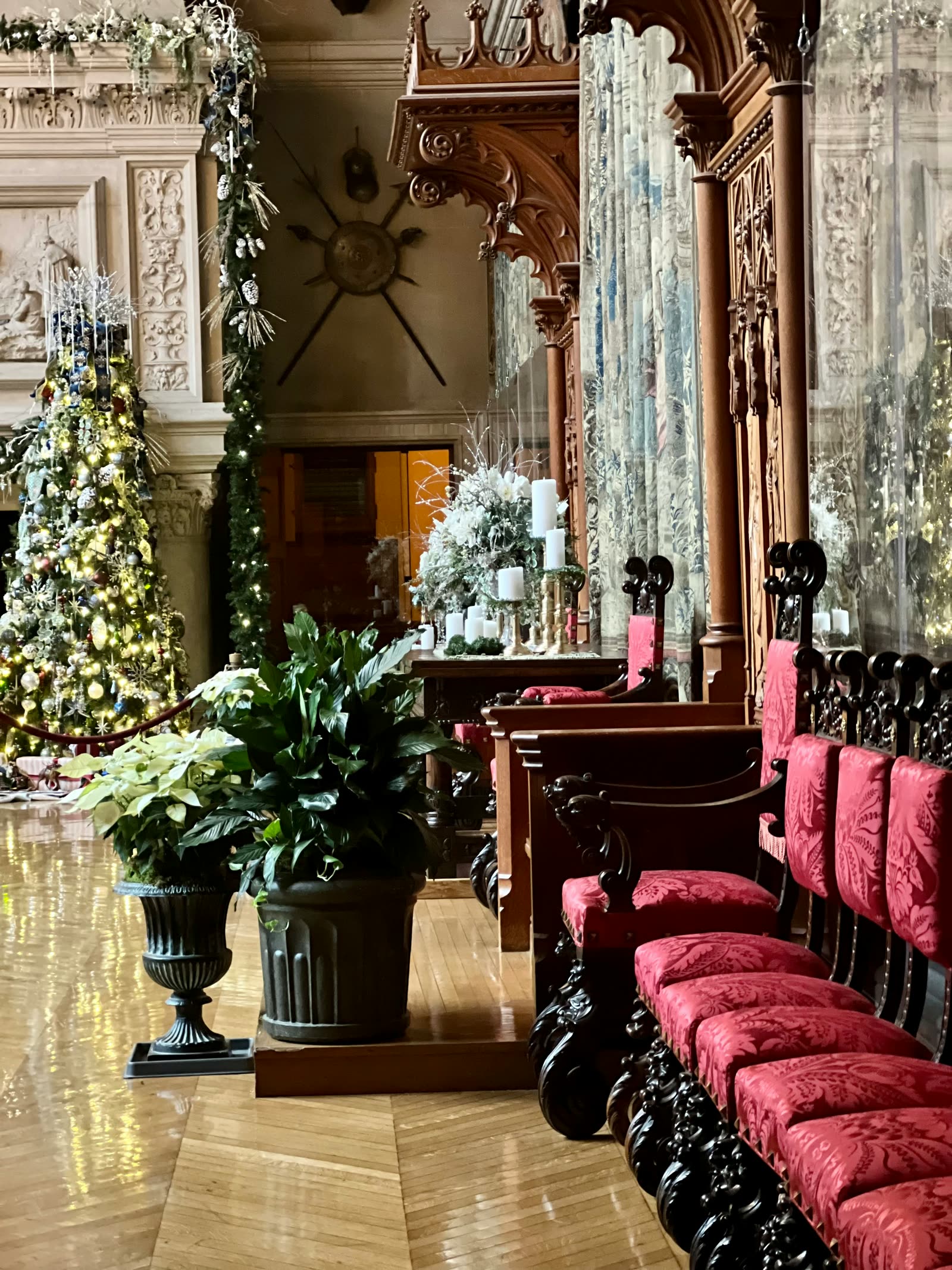
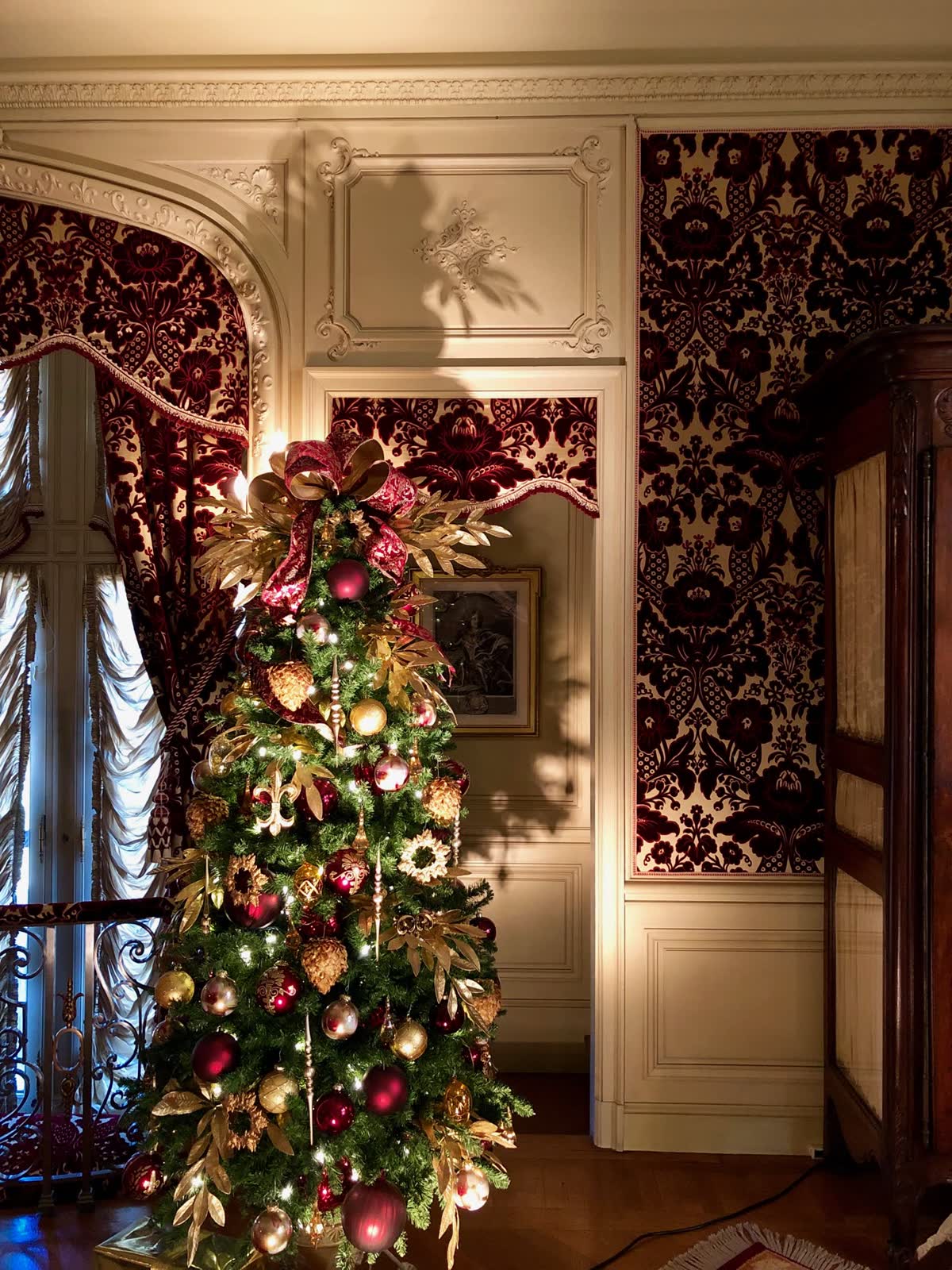
The Banquet Hall dressed for the season. The tree here is a 35-foot Fraser fir, always the tallest in the house.
Photo: Stephanie Klepacki / Unsplash.
Daytime
The same rooms in daylight, decorated for the season. A daytime ticket does not
admit you to Candlelight — that is its own ticket.
The gardens are the daytime half. Biltmore's own Candlelight itinerary puts the
gardens and Conservatory in the afternoon, before your evening house visit, so arrive with daylight
left if you want to see them.
Candlelight Christmas Evenings
An evening-only experience recreating 1895, the first Christmas at Biltmore House: rooms lit by
candle and firelight, live music, lit fireplaces, thousands of ornaments, through the house and
Antler Hill Village. A different thing from walking the same rooms in daylight, not an upgrade to
it.
One Candlelight ticket covers both halves, and the cut-off is the clock.
The 4:30pm rule
Enter the estate before 4:30pm and you use the daytime portion and the evening
house on the same day. Arrive at or after 4:30pm and your daytime portion moves to
the following day. There is no separate two-day combination ticket beyond that split.
What the daytime portion covers
In Biltmore's own words, every Candlelight ticket includes daytime admission to Antler Hill
Village and the Winery, the gardens, the shops and the restaurants.
Dress code
There is none for Candlelight. Biltmore's guidance for the whole estate is to
dress comfortably in walking shoes and layers. The only dress code on the property applies at The
Dining Room and the Library Lounge.
Parking and shuttles
Parking is included in admission, and Lots A and B are roughly an eight-to-ten minute walk from
the house. Biltmore states plainly that it does not run a complimentary estate-wide
shuttle. There is an accessibility shuttle from Lot E, a Garden Shuttle between the house
and the Conservatory, and Biltmore Connect at $15 per person per day. Whether those shuttles run
during Candlelight evening hours is not published — call Biltmore guest services on
800-411-3812 if it matters to your plan.
Booking window
Biltmore publishes no sell-out window, but every credible account agrees that prime December
dates and Candlelight evenings go weeks to months ahead. December weekends disappear first.
Pricing
Candlelight House & Grounds was showing from $110 and the Exclusive Tour from $345 when we
checked on 29 July 2026, alongside an early-booking discount. We could not determine whether the $110
already had that discount applied, so treat it as an indicative floor and confirm at checkout.
The Winery in the evening
Open during Candlelight — evening admission includes same-day or free next-day access to
the gardens, grounds and Winery. Whether the Winery extends its hours for Candlelight specifically is
not something the Estate publishes.
Photography
Phone and camera stills without flash are fine for personal use. Inside the house there are no
tripods, monopods, selfie sticks, gimbals or GoPros, and no lenses over 135mm. Audio recording of the
live music during Candlelight is specifically prohibited.
Book dinner when you book the ticket
Biltmore says reservations are “available and highly recommended” for Candlelight
guests at Stable Café, Cedric's Tavern, Bistro and Village Social. One catch: through November
and December, The Dining Room at The Inn is reserved exclusively for guests staying
at The Inn, Village Hotel or the Cottages — so if that was your plan for a Candlelight evening,
it is not available to day visitors.
Christmas at Biltmore by the numbers, from the Estate's own published figures
What
Figure
Detail
The Banquet Hall tree
35 feet
A Fraser fir, always the tallest tree in the house. The tradition goes back to the first Christmas at Biltmore in 1895, and it takes around 50 staff to carry in, raise and secure.
Trees inside Biltmore House
36
Other sources give higher counts for the whole estate rather than the house alone; 36 is the Estate's current inside-the-house figure.
Poinsettias
1,618
Tended daily.
The Front Lawn tree
55 feet
A lit Norway spruce ringed by 40 illuminated evergreens, set up specifically for Candlelight Christmas Evenings.
A chaptered walk through the decorated house and the Antler Hill Village lights, if you want to see what the season actually looks like before you commit to a date. Video: Adventure Is Out There on YouTube.
Also new for 2026 — but check the dates
Luminère, an outdoor evening light-and-sound experience, debuted in spring 2026 and is ticketed
separately from a daytime visit. The dates we saw ran on select evenings through 18 October
2026, and Biltmore has also described it as an all-season experience — so confirm
current dates before planning a December visit around it. Dogs are explicitly not permitted at
Luminère. Most Biltmore guides written before this year do not mention it at all.
When to go, month by month
Two months carry the estate — April into May for the gardens, and November into December for Christmas — and Biltmore's own garden calendar is candid that January through March is thin outdoors.
Christmas at Biltmore3 November 2026 – 10 January 2027
The daytime holiday season. It runs ten days into the new year, which makes early January the one quiet week you can still see the house dressed.
Candlelight Christmas Evenings3 November 2026 – 9 January 2027
A separate evening ticket, and not every night — there is no Candlelight on 17 or 26 November, or on Christmas Eve. It closes the night before the daytime season ends.
JanuaryQuiet
Christmas runs to the 10th, then the estate empties. Outdoors it is winter jasmine, wintersweet and vernal witch hazel; indoors the Conservatory orchids reach peak bloom.
FebruaryQuiet
The thinnest month outside. The Winter Border carries "Midwinter Flame" dogwood and Angelina stonecrop, and the Conservatory orchids hold their peak.
MarchTurning
The first real movement: daffodils, hellebores, snowdrops and hyacinth, star and kobus magnolias, and a Conservatory brimming with tulips and daffodils.
AprilBiltmore Blooms
Thousands of tulips in the Walled Garden, daffodils at the entrance and Antler Hill, dogwoods and redbuds along the Approach Road — and the azaleas beginning to catch.
MayPeak bloom
Mountain laurel and Catawba rhododendron along the Approach Road, the Rose Garden building, the Azalea Garden at its prime — mid-April to the end of May is the peak window.
JuneSummer
More than 200 varieties of heirloom and hybrid roses in full bloom, with the international trial roses being judged. Hydrangeas start.
JulySummer
The Conservatory's tropicals spill outdoors into more than 1,200 pots, including the original giant urns. Sunflowers at Antler Hill Village; crepe myrtle and sourwood estate-wide.
AugustSummer
The Italian Garden water-lily display — including the giant Victoria lilies, which bloom at night and smell of pineapple. Hydrangeas and abelia in the Shrub Garden.
SeptemberLate summer
Shrub roses still in full bloom, ironweed and goldenrod and eight-foot Joe Pye weed in the meadows, and the first red showing on the dogwoods.
OctoberFall colour
The big one. Mums peak mid-month in the Walled Garden; sugar and red maples, hickories and gum trees peak late in the month. Japanese maples in the Shrub Garden.
NovemberChristmas opens
Christmas at Biltmore opens on the 3rd. Outside it becomes bark-and-structure season, with the Deer Park oaks and grasses taking autumn's final bow.
DecemberChristmas
The house at full dress, and the Conservatory bedecked with poinsettias and exotic orchids. Outdoors it is evergreen structure — pines, hemlocks, firs, hollies, blue-green cedars.
The Biltmore year at a glance
Month
Season
What is happening
January
Quiet
Christmas at Biltmore runs to 10 January; winter jasmine, wintersweet, vernal witch hazel; Conservatory orchids at peak
February
Quiet
"Midwinter Flame" dogwood and Angelina stonecrop in the Winter Border; Conservatory orchids at peak
March
Turning
Daffodils, hellebores, snowdrops, hyacinth; star and kobus magnolias; Conservatory tulips and daffodils
April
Biltmore Blooms
Tulips in the Walled Garden; dogwoods and redbuds on the Approach Road; azaleas begin
May
Peak bloom
Mountain laurel and rhododendron; Rose Garden building; Azalea Garden at its prime
June
Summer
200+ varieties of roses in full bloom; international trial roses judged; hydrangeas begin
July
Summer
Conservatory tropicals outdoors in 1,200+ pots; sunflowers at Antler Hill; crepe myrtle, sourwood
August
Summer
Italian Garden water-lily display, incl. night-blooming Victoria lilies; hydrangeas and abelia
September
Late summer
Shrub roses still in bloom; ironweed, goldenrod, Joe Pye weed; first colour on the dogwoods
October
Fall colour
Mums peak mid-month; sugar and red maples, hickories, gums peak late-month; Japanese maples
November
Christmas opens
Christmas at Biltmore from 3 November; bark and structure season; Deer Park oaks and grasses
December
Christmas
Conservatory poinsettias and orchids; evergreen structure estate-wide
When and how Biltmore was built
Construction ran six years. Site work started in January 1890, the first stone was laid on 8 June 1891, and Biltmore House opened on Christmas Eve 1895 — still unfinished. Richard Morris Hunt designed it, roughly 1,000 workers built it, and nearly ten million pounds of Indiana limestone faced it.
6years from ground-breaking to opening
~1,000workers at the peak, 60 of them stonemasons
10Mpounds of limestone, quarried in Indiana
38,000bricks a day from the on-site kilns
704windows
65fireplaces, served by 16 chimneys
George Vanderbilt first saw Asheville in 1888. He began buying land shortly after and hired two of the most sought-after men in America: Richard Morris Hunt for the house, Frederick Law Olmsted for everything around it.
Nothing vertical happened for the first six months. January 1890 was spent laying water lines, building rail spurs, starting brick production, erecting workshops on the Esplanade and re-grading the entire site. Commercial explosives — a tool barely two decades old at that point — were used to level the ground the house now stands on.
Then the weather intervened. Rain and cold halted work for thirteen non-consecutive days in January and February 1891, and on the days work stopped, the men were sent home without pay.
The first stone went down on 8 June 1891, in the west wall of the South Terrace — a retaining wall 18 feet wide and 40 feet high. It was chosen deliberately as a test section for the footing method used on the rest of the house. That December, the superintendent Richard Sharp Smith wrote to the estate's manager Charles McNamee that every effort would be made to have the house ready for occupancy by Christmas 1895. They made the deadline by four years of continuous pressure.
Where the materials came from
The limestone that gives the house its colour was quarried in Oolitic, Indiana, and shipped in: 9,973,638 pounds of it, an exact figure the estate still publishes. The foundation stone came from a quarry on the property. The bricks came from kilns on the property. The roof slate came from Philadelphia. The marble lions at the entrance are Rosso di Verona, from Verona. Interior oak ran to 132,000 board feet.
Moving that much material over mountain terrain required two railways. A standard-gauge spur ran from the freight depot in Biltmore Village up to the Esplanade on Olmsted-designed terraced trestles, hauling supplies and carrying the workforce in each morning and out each evening behind a locomotive named, inevitably, Biltmore. A second, narrow-gauge line ran between the on-site quarry and the on-site brickworks. Lifting was done with wooden derricks, pulleys and hand-cranked winches.
The roof was built with no wood at all, as a fire precaution. Slate tiles were wired by hand, one at a time, to iron cross-beams, with copper ridge caps and gutters. The exterior walls are 16.5 inches thick.
The pay, and who was on the payroll
A skilled stonemason earned $3.50 a day in 1893; a general labourer about $1.00. The African American blacksmith George Payne earned $2.25. Everyone worked ten hours a day, six days a week — and estate records from 1893 note more African American employees than white on site at that point in construction.
Not everything went smoothly. In 1893 the Pittsburgh Bridge Company ran badly late on the iron beams; Hunt described the firm in writing as impervious to shame or other moral feelings, and McNamee leaned on family connections to unstick the order. A wet spring flooded the clay pits and stopped brick production. In 1894 an inferior batch of brick came out of the kilns, was caught on inspection by Richard Sharp Smith, and had to be replaced.
Interiors went in between September 1894 and March 1895 — floors, walls, ceilings, the 288 light fixtures, the 43 bathrooms, the elevators. Exterior walls had reached full height that spring.
And then the house opened on 24 December 1895 without being finished. The Tapestry Gallery, Winter Garden and Banquet Hall were largely done. The Library and George Vanderbilt's own bedroom were unusable: the walnut woodwork was still drying. Most of the remaining interior work was completed through July 1896, some decorative finishes ran to 1898, and the Music Room was not finished and opened to the public until 1976 — eighty-one years late.
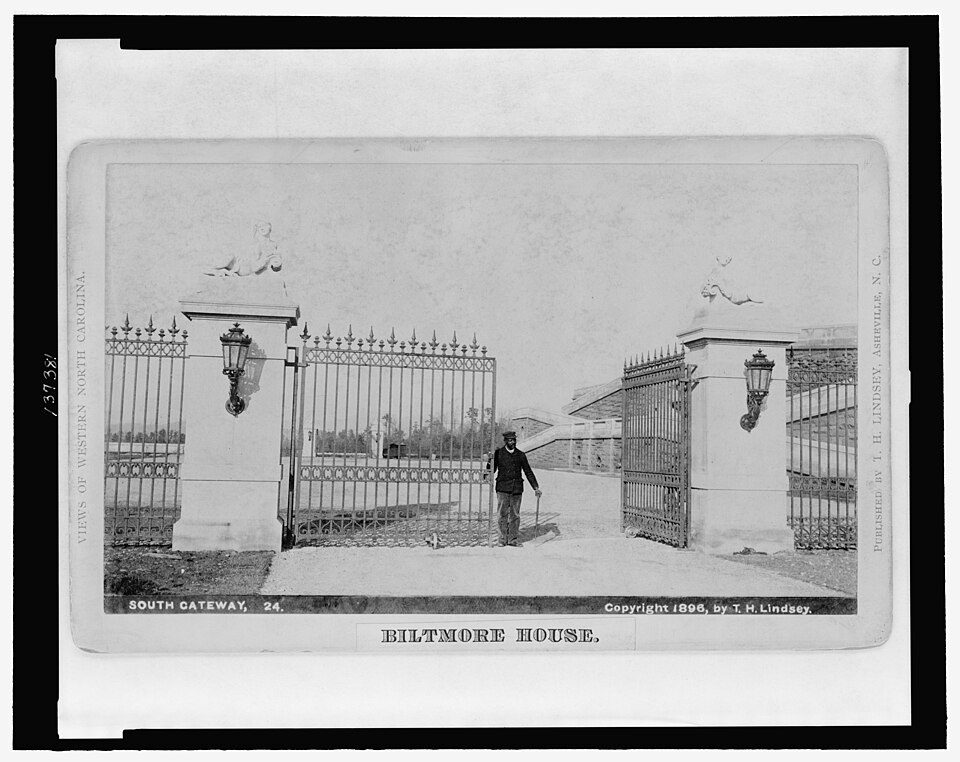
The south gateway in 1896, months after the house opened and while interior work was still running.
Photo: T. H. Lindsey, 1896 / Library of Congress, Prints & Photographs Division (LCCN 2007680394). No known copyright restrictions.A colour print made in 1896. The ground around the house is still raw — Olmsted's planting had barely begun to close in.
State Archives of North Carolina, Original Prints collection, 1896. No known copyright restrictions.
The house by the numbers
Two hundred and fifty rooms under one roof and roughly four acres of floor — more than three times the floor space of the White House residence, and still the largest privately owned home in America.
175,000square feet of floor
Biltmore's own figure, and about four acres of floor space stacked across four storeys and a full basement. The Buncombe County tax record puts it slightly higher, at 178,926 square feet.
250rooms
35bedrooms
43bathrooms
65fireplaces
704windows
74exterior doors
16chimneys
107steps, grand staircase
Biltmore House against the White House
Floor space
Biltmore House175,000 sq ft
The White House55,000 sq ft
Rooms
Biltmore House250
The White House132
Fireplaces
Biltmore House65
The White House28
Bathrooms
Biltmore House43
The White House35
The floor-space figures count every level, so Biltmore's roughly three football fields' worth of floor is stacked five levels high — it is not three football fields of ground. Both houses have an indoor bowling alley: Biltmore's two lanes went in with the house in 1895, the White House's single lane arrived in 1969.
Biltmore House, counted
Measure
Biltmore House
The White House
Floor space
175,000 sq ft (Biltmore's figure; 178,926 sq ft on the county tax record)
55,000 sq ft
Rooms
250
132
Bedrooms
35
—
Bathrooms
43
35
Fireplaces
65
28
Chimneys
16
—
Windows
704
—
Exterior doors
74
—
Grand staircase
107 steps
—
Storeys
4 plus a full basement
—
Bowling lanes
2 (1895)
1 (1969)
What this house could do in 1895
Biltmore was wired for electricity from the day it was built, at a time when almost no American home was. George Vanderbilt was a personal friend of Thomas Edison, and the house ran on direct current through 288 light fixtures. That is the least of it. The full list is closer to a small city than a residence.
This is the part almost no visitor arrives knowing, and it is the single best reason to pay attention while you are inside.
Forty-three bathrooms with full indoor plumbing, in a country where most homes had none.
Start with the electricity, because everything else hangs off it. Direct-current power meant the house needed protection from a technology nobody fully trusted yet, so it was divided into six separate sections by brick firewalls and given a house-wide fire alarm system. The roof was built without wood for the same reason. This is a mansion designed by people who assumed the new equipment might try to burn it down.
Then the systems most homes would not see until the 1930s or later:
Systems installed at Biltmore House by 1895
System
What it actually was
Electric light
288 fixtures on direct current, installed 1894–95
Indoor plumbing
43 bathrooms, house-wide
Elevators
Two electric Otis elevators — among the earliest residential electric elevators in the country
Central heating
A forced-air system, unusual in a private residence at the time
Refrigeration
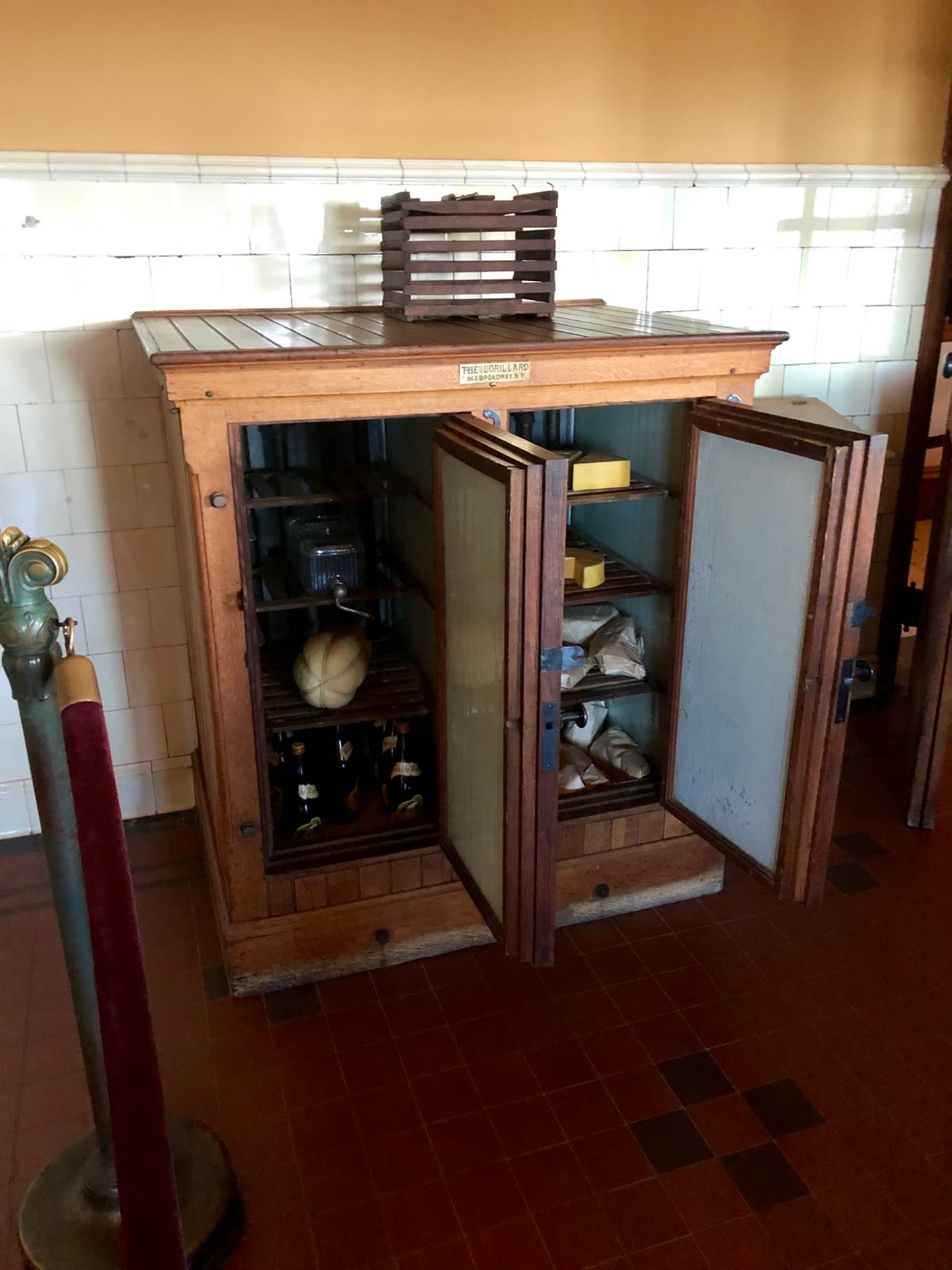
Walk-in refrigerators cooled by ammonia gas, holding roughly 500 lbs of meat and vegetables and 50 gallons of liquid at about 40°F, while most of America still used iceboxes
Clocks
A house-wide centrally controlled, synchronised clock system
Fire alarm
A whole-house alarm system
Call bells
A servant call-bell network throughout the house
Telephone
Installed, and genuinely newfangled at the time of construction
The elevators come with an honest caveat. Biltmore's own construction history says two electric Otis elevators were installed in 1894–95; Wikipedia and much of the tourism coverage refer to a single elevator that is still working today. Those are probably not the same claim — one is an original count, the other a description of what still runs — but the sources do not disambiguate it, so we are not going to pretend they do.
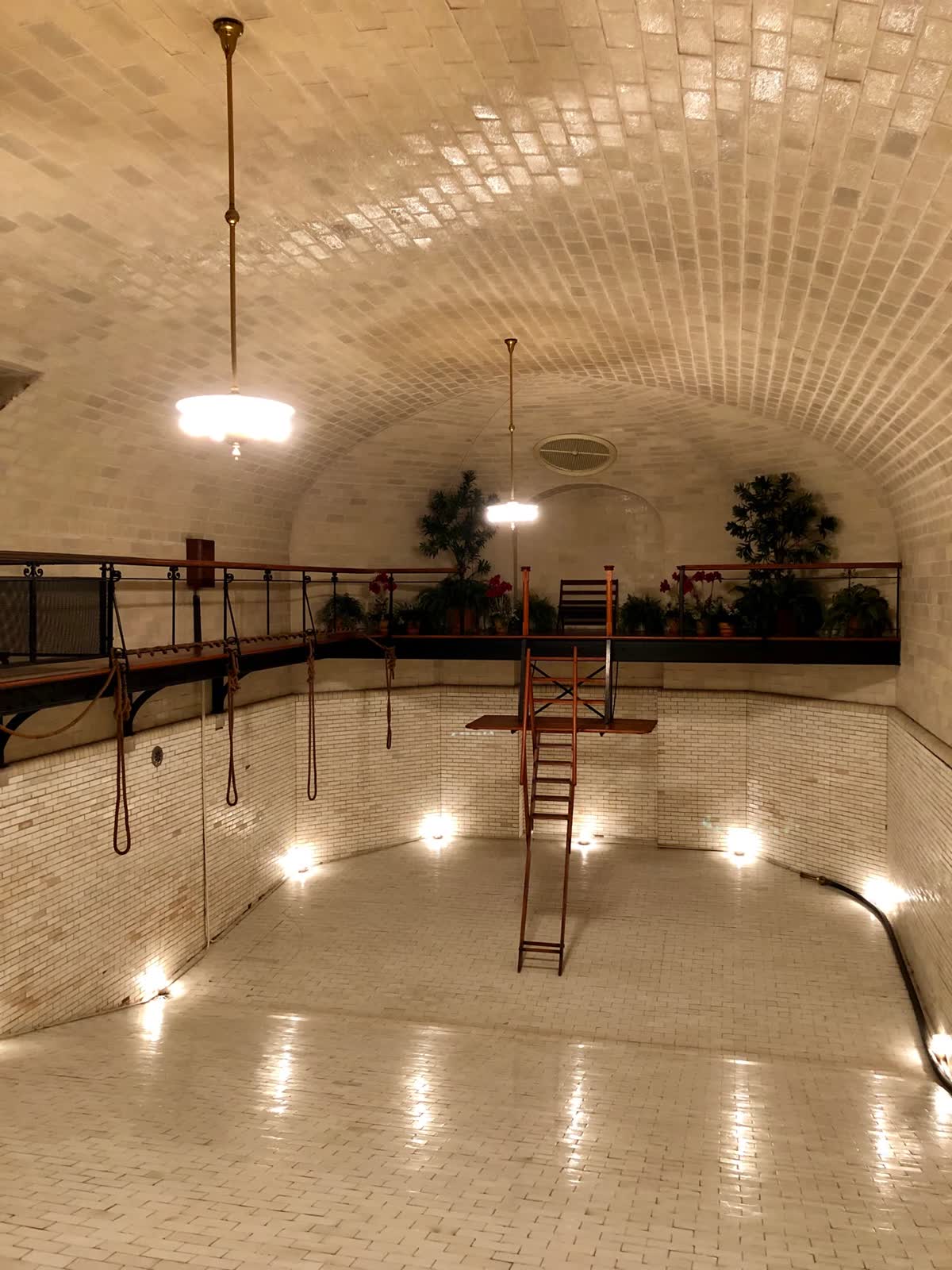
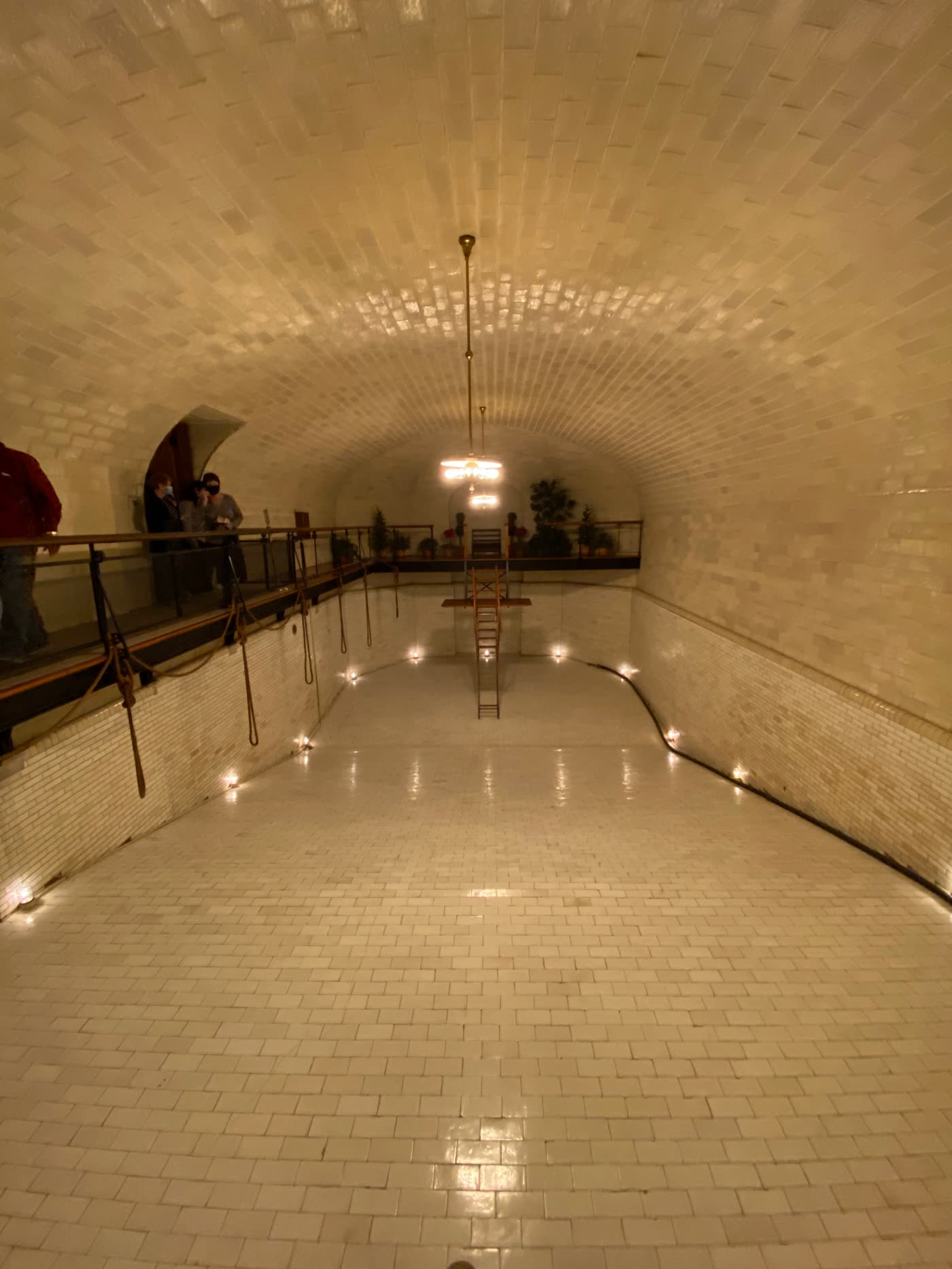
The pool had no filtration, so they drained it
The basement swimming pool holds 70,000 gallons, was heated by steam from the mansion's own boilers and lit from underwater. There was no filtration system and no chemical treatment. The solution was brute force: drain it and scrub it by hand, every three days.
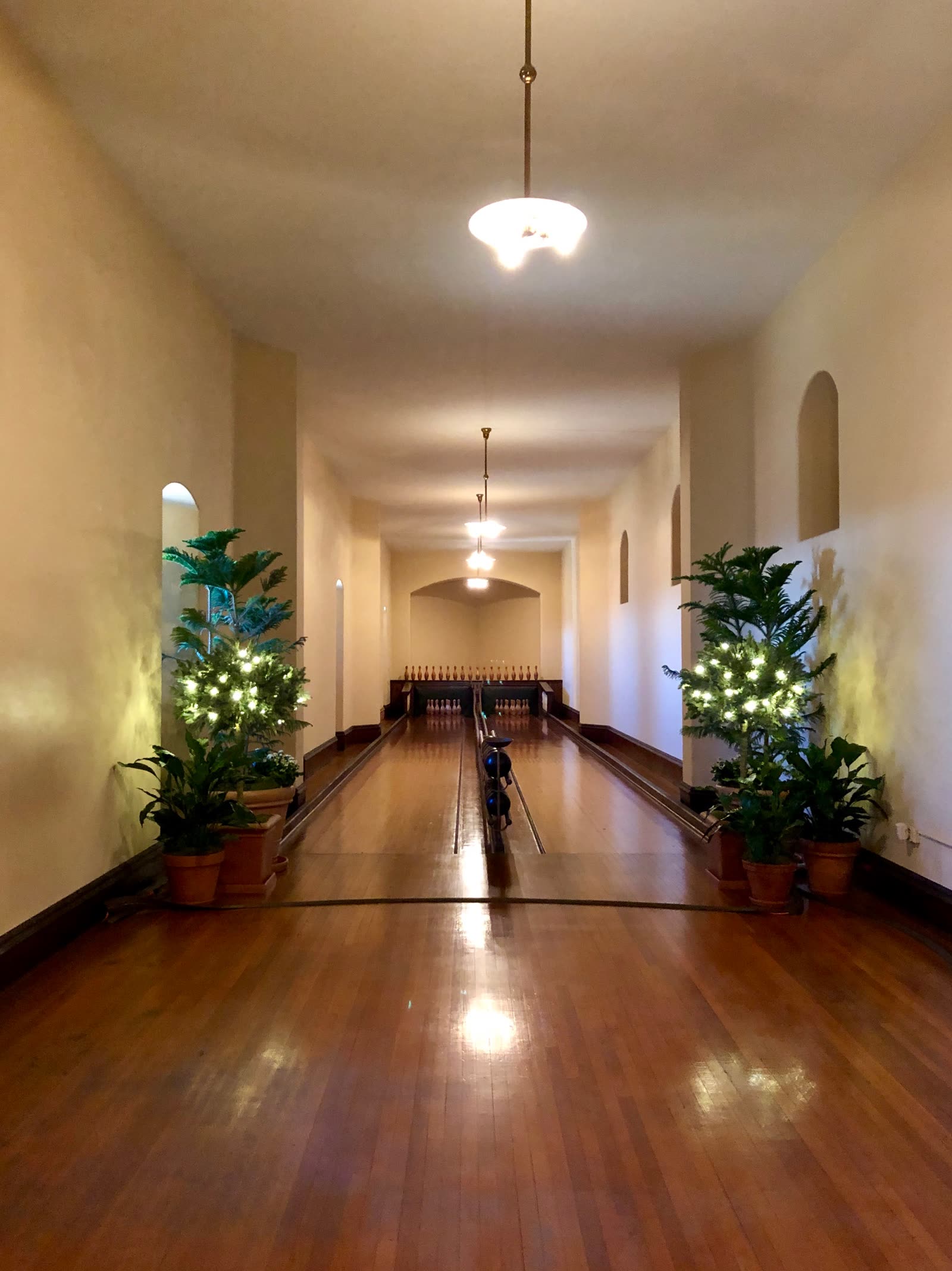
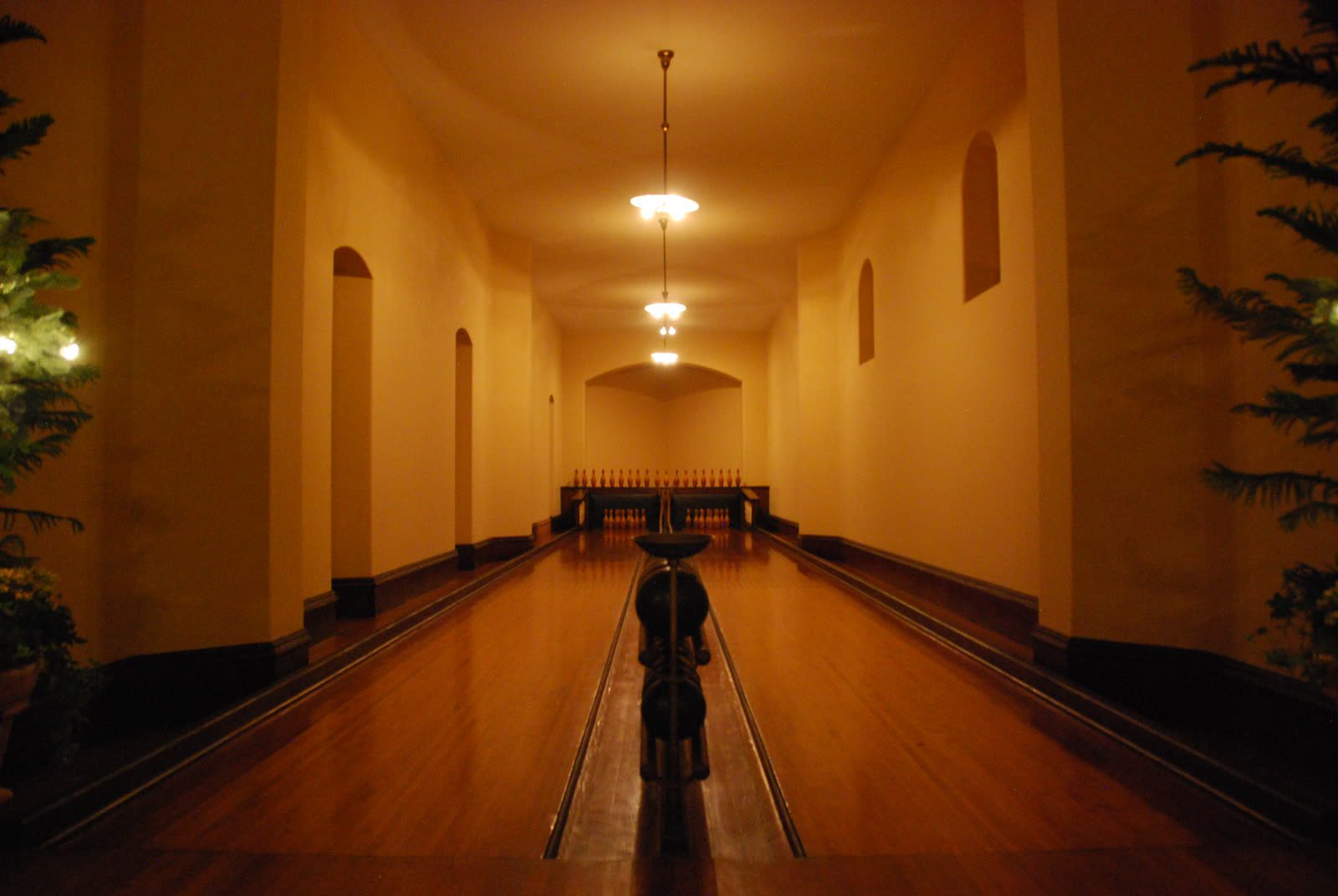
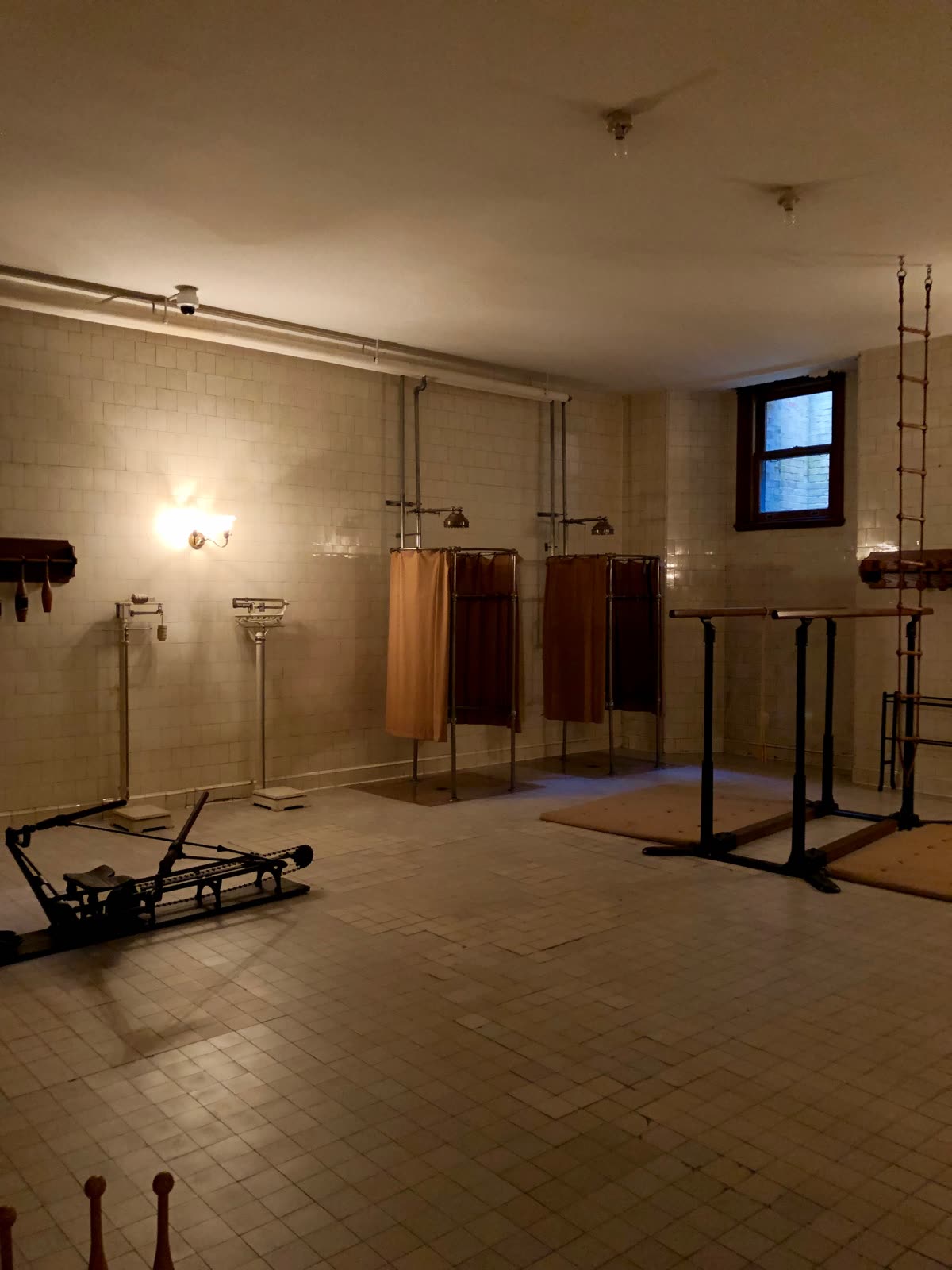
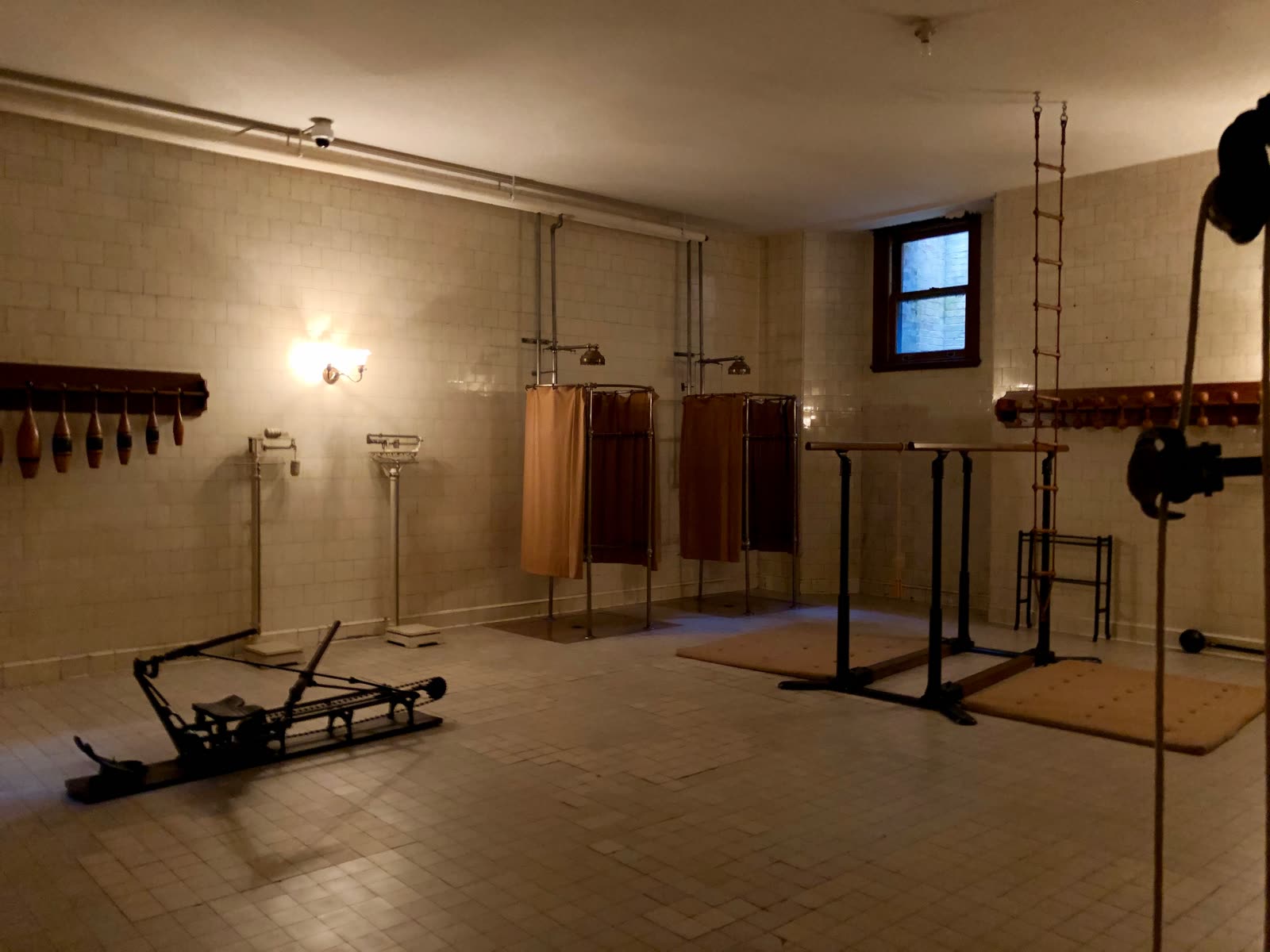
Next to the pool is a two-lane bowling alley, described as one of the oldest residential lanes in America, and a gymnasium fitted with what passed for state-of-the-art equipment in the 1890s. The boilers that fed the whole operation held 20,000 gallons.
One more piece of engineering deserves naming, because you will walk under it without noticing. Rafael Guastavino's patented self-supporting ceramic tile vaulting is used extensively inside and outside the house, and Guastavino supervised the installation personally. It is the same system that holds up the ceilings in some of the best-known public rooms in America, and it is here because Hunt wanted arches that did not need timber centring or steel.
For scale on the water side: Vanderbilt had a reservoir engineered 266 feet above the Esplanade to give the house pressure. The estate later built the Lone Pine Reservoir in 1899, 100 by 200 feet, holding 2.2 million gallons — and it supplied the estate's drinking water until 1992.
Theodore Roosevelt and his party at Biltmore, September 1902 — the house at seven years old, still a working private residence and already running on electric light.
Photo: Underwood & Underwood, September 1902 / Library of Congress. Public domain.
What to see inside Biltmore House
Biltmore House is four storeys over a full basement, and the rooms that matter are not evenly distributed. Six or seven spaces carry the whole building: the Banquet Hall, the Library, the Tapestry Gallery, the Winter Garden, the Grand Staircase, and the working basement underneath all of it.
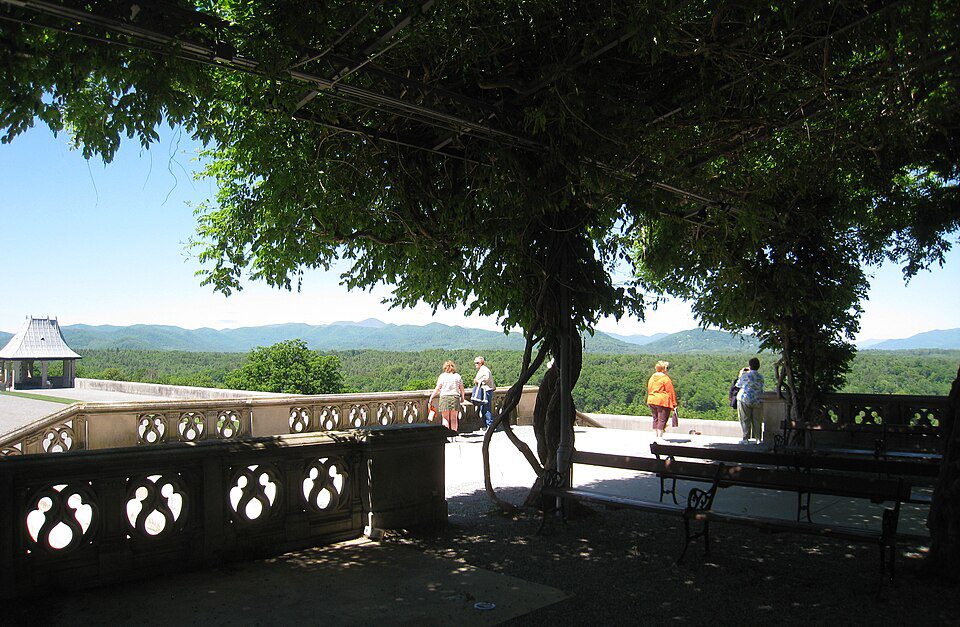
The South Terrace, under the wisteria. This is the view the house was sited for — the reason the whole thing sits where it does.
Photo: Daderot / Wikimedia Commons, public domain.
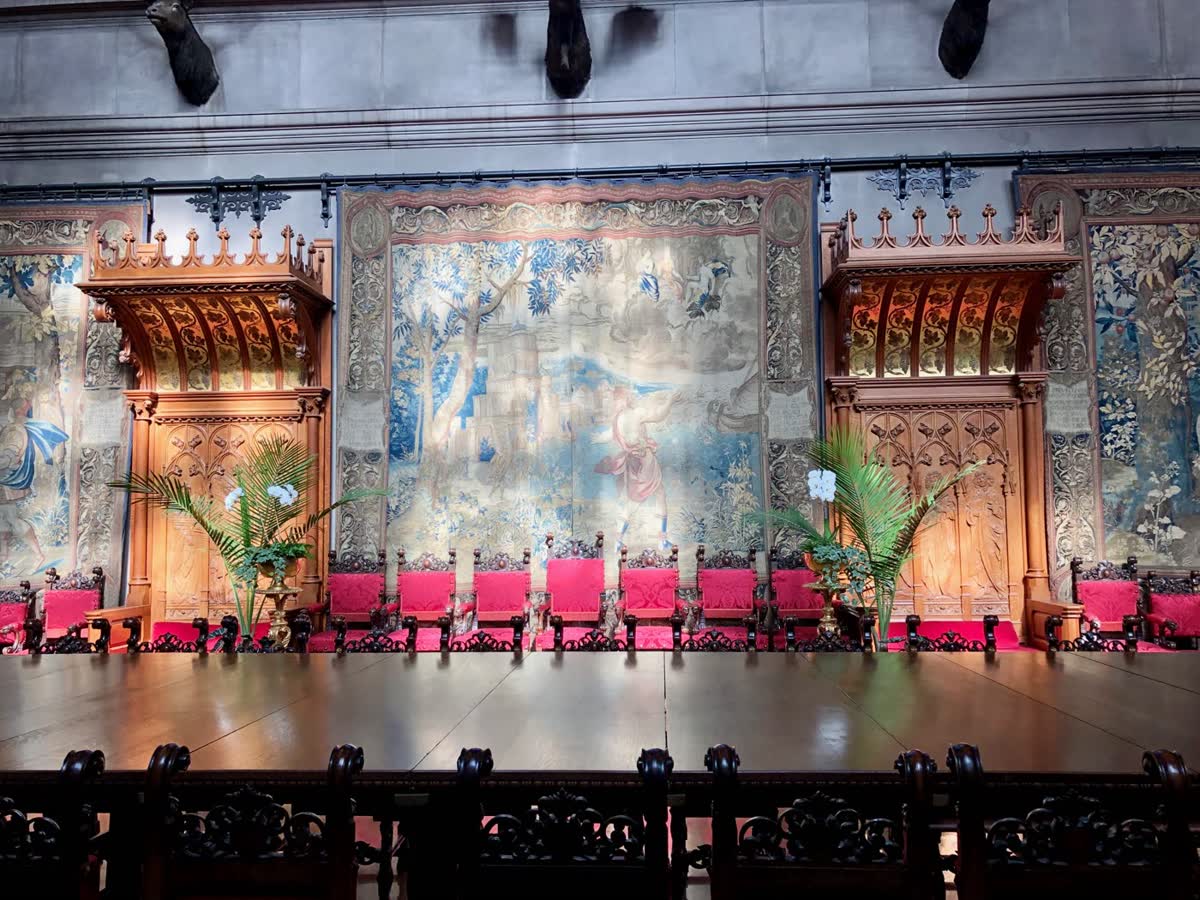
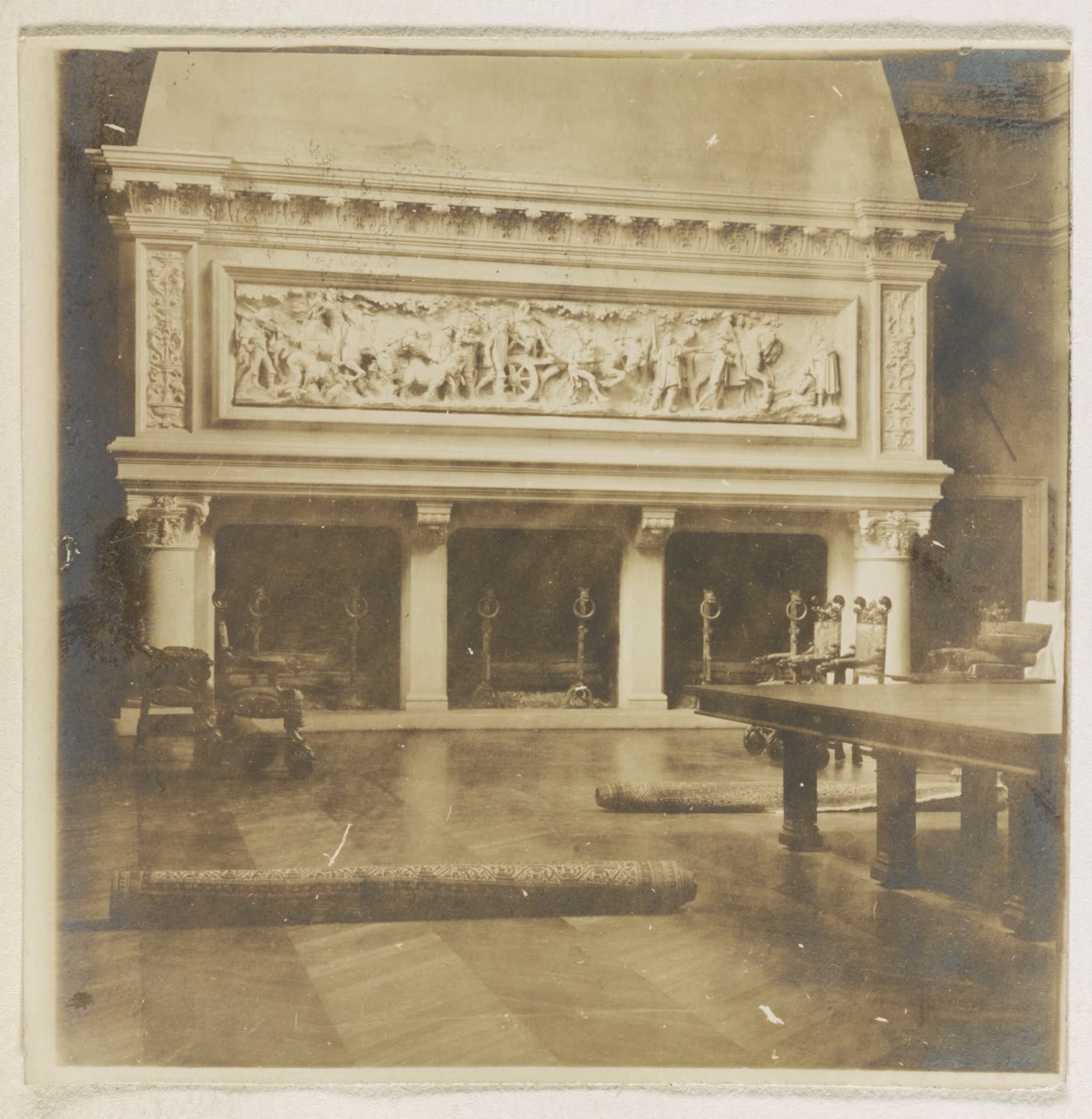
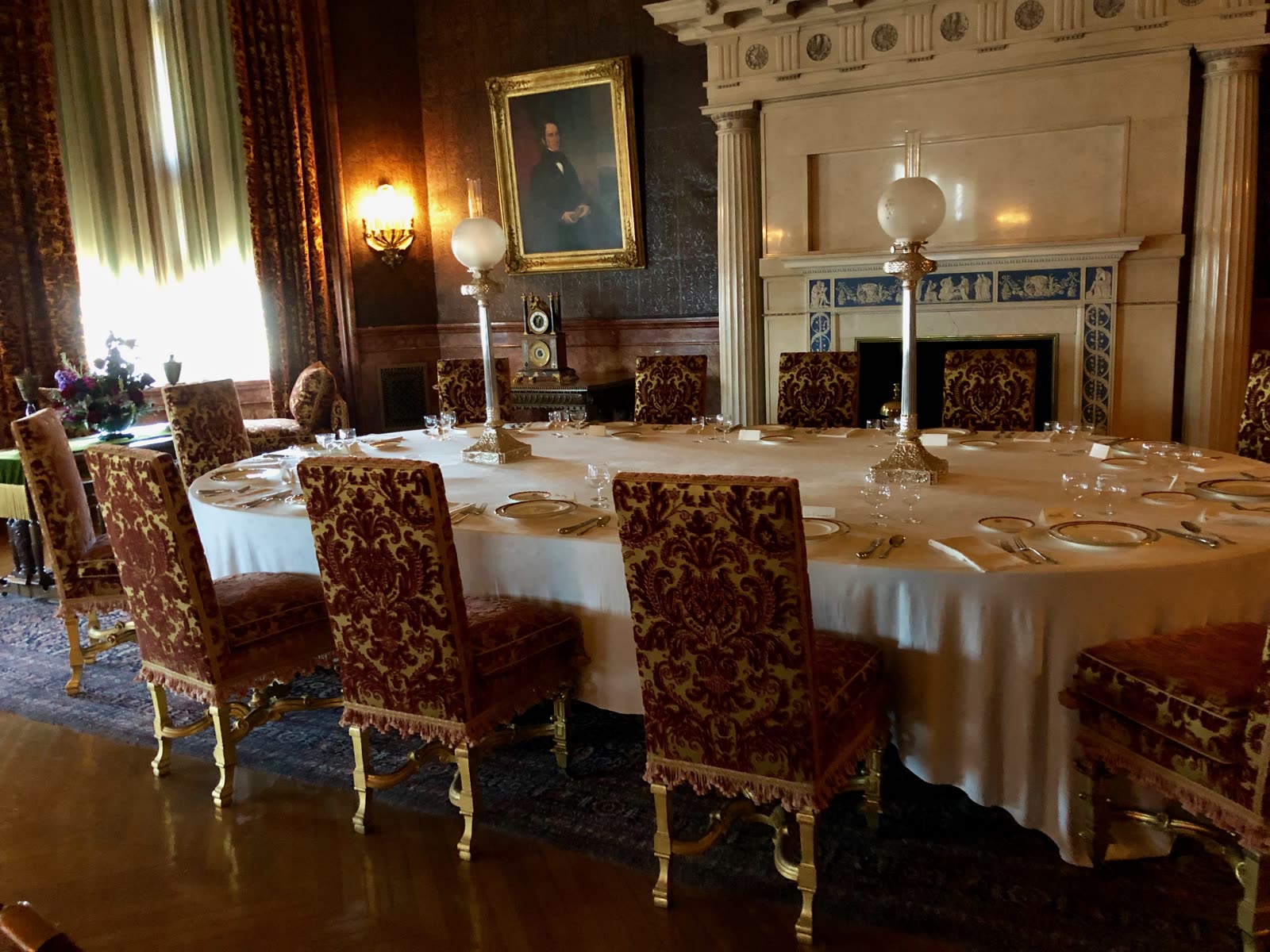
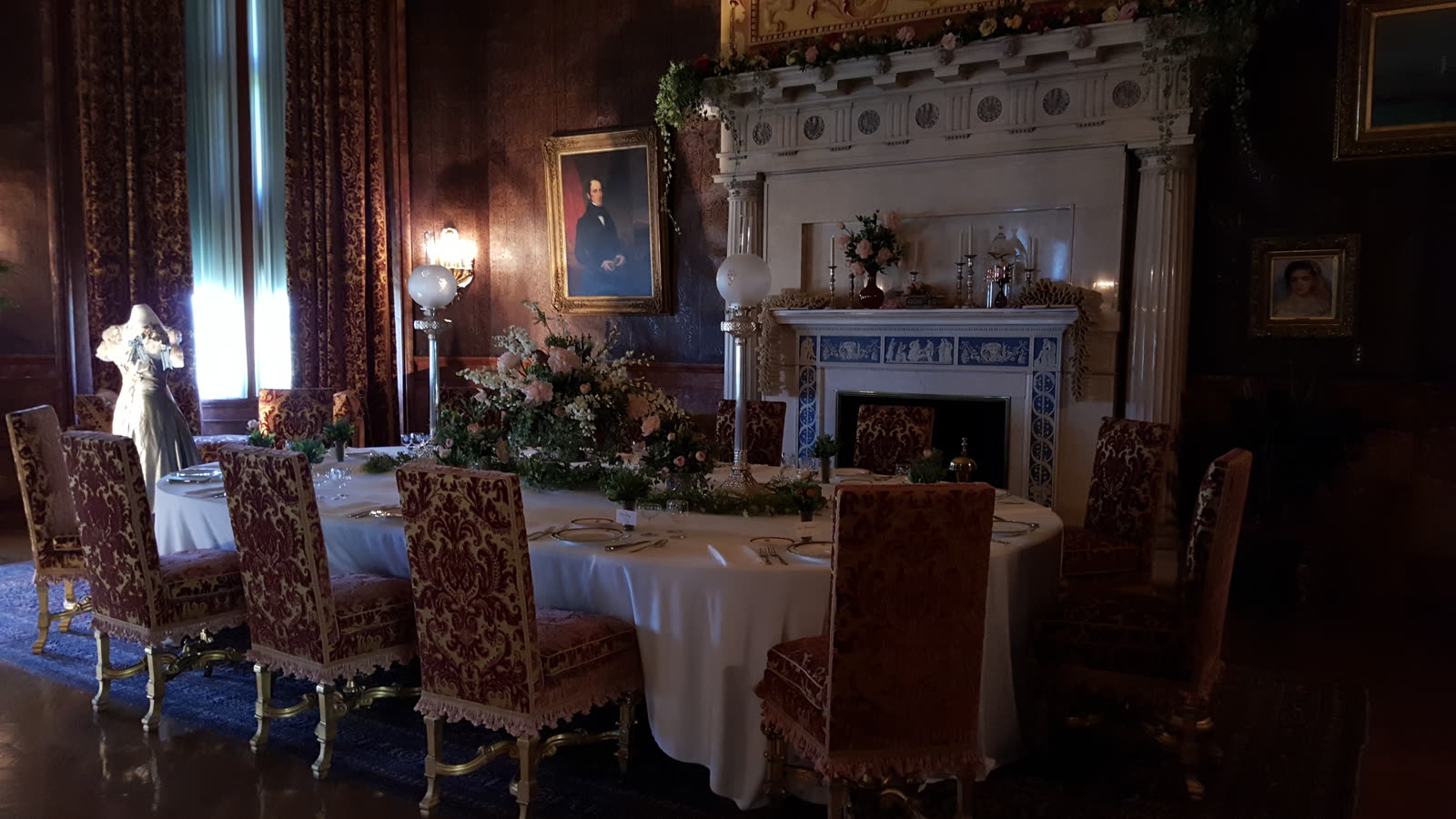
The Banquet Hall is the largest room in the house and the one people photograph in their heads for years afterwards. It measures 42 by 72 feet with a barrel-vaulted ceiling 70 feet up — the equivalent of seven storeys of open air over the dinner table. The table itself is 40 feet long and seats 64. A Skinner pipe organ of 1916 sits in the organ gallery above. At Christmas the room takes a 35-foot Fraser fir, always the tallest tree in the house.
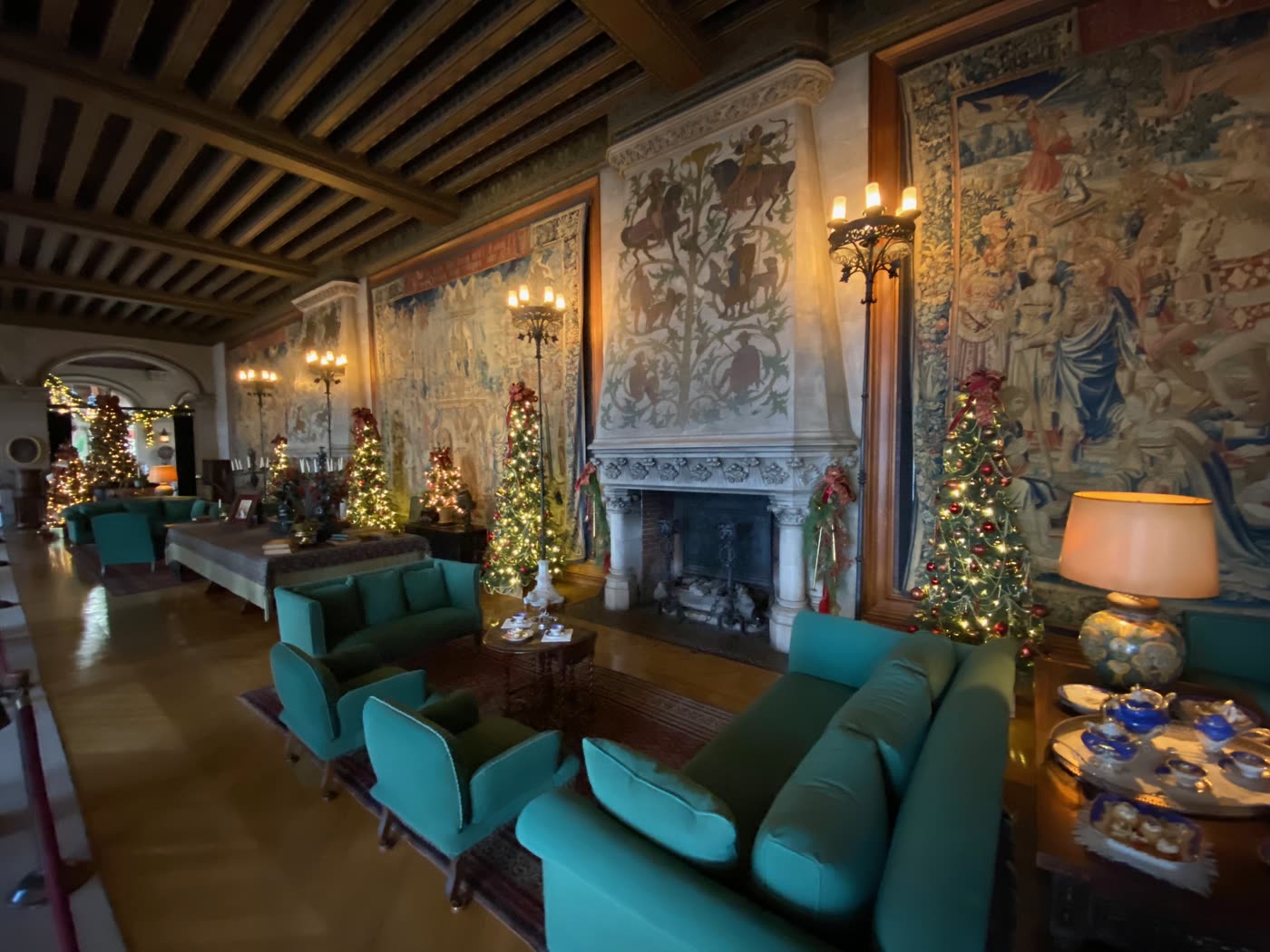
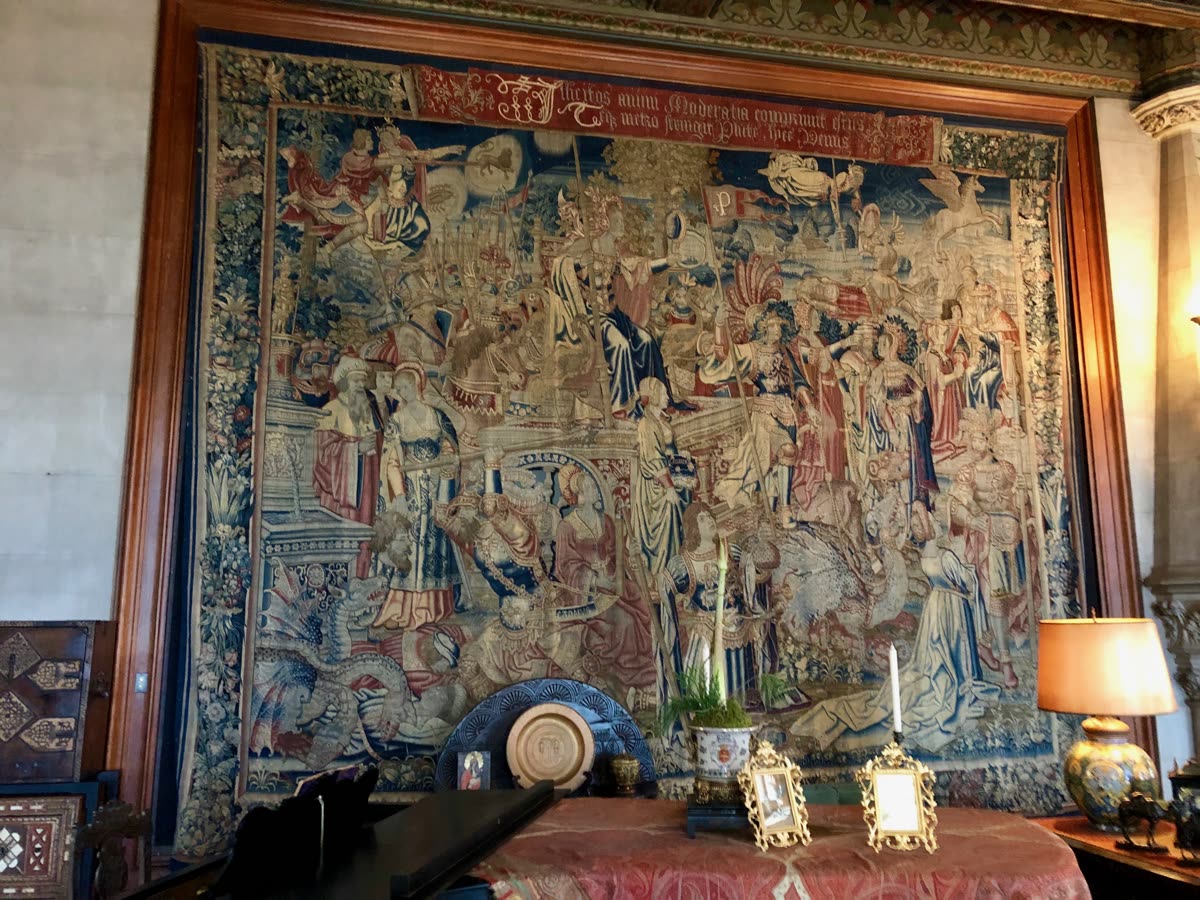
The Tapestry Gallery runs 90 feet — a corridor long enough to be a room, hung as one.
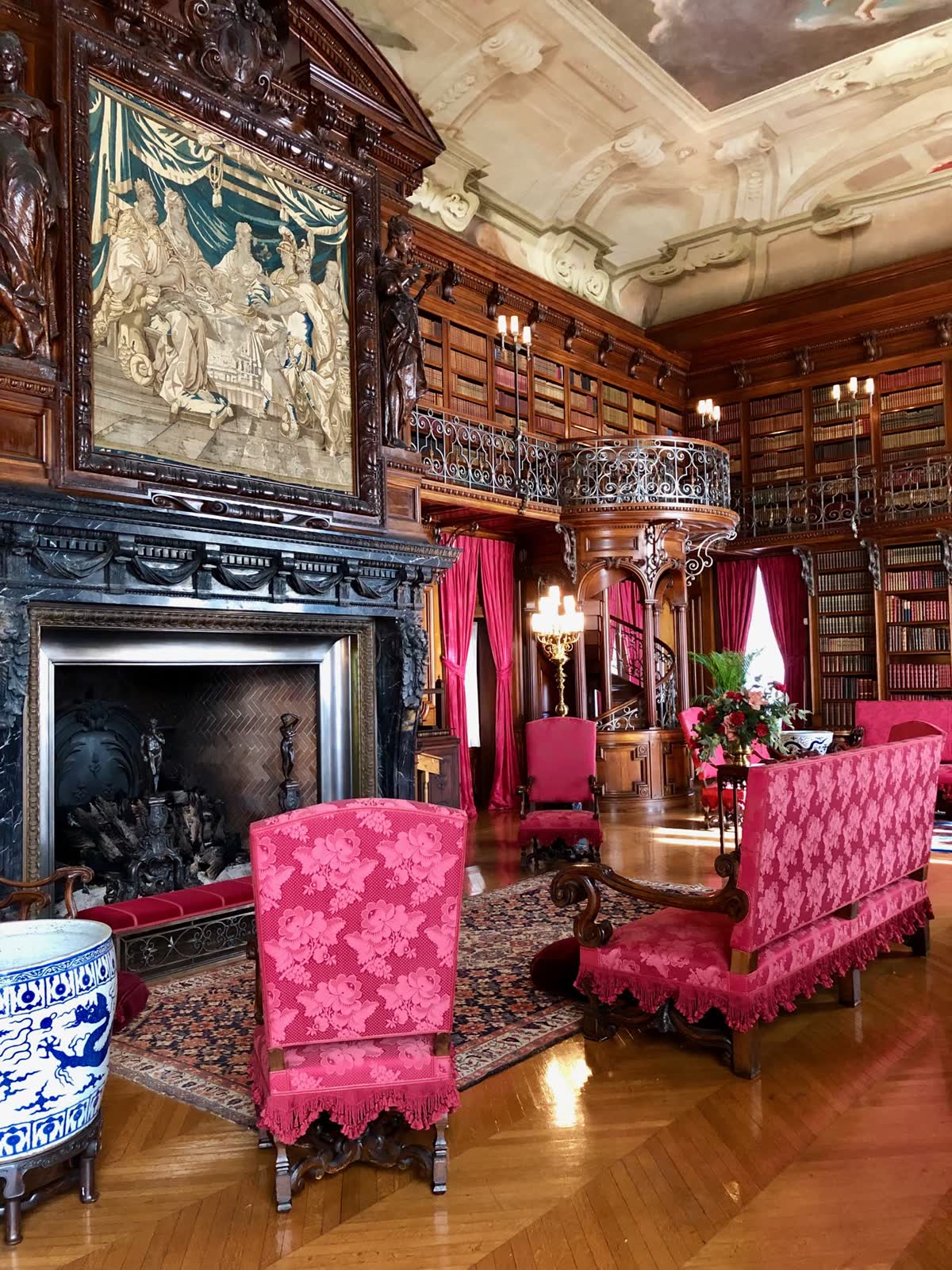
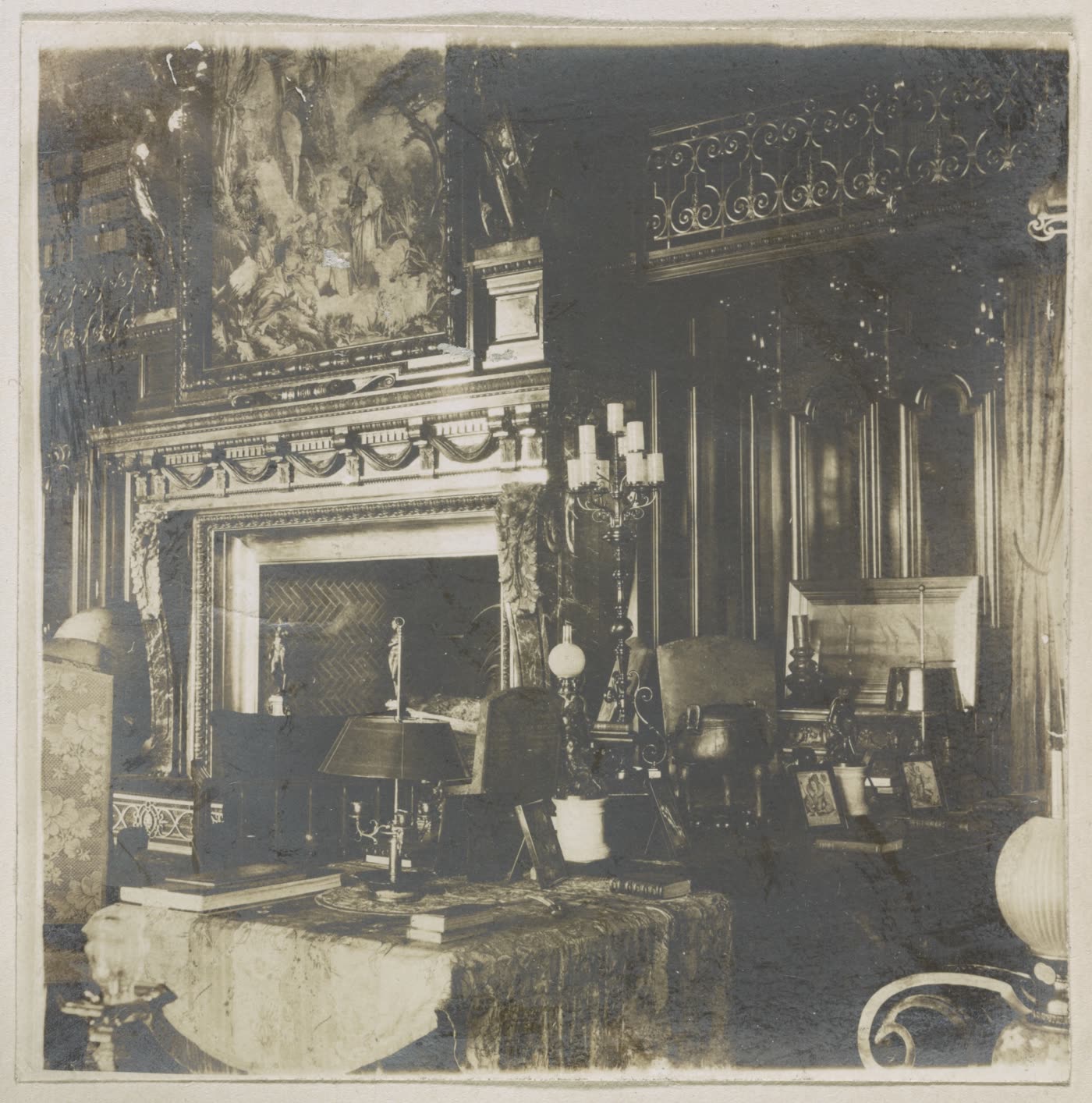
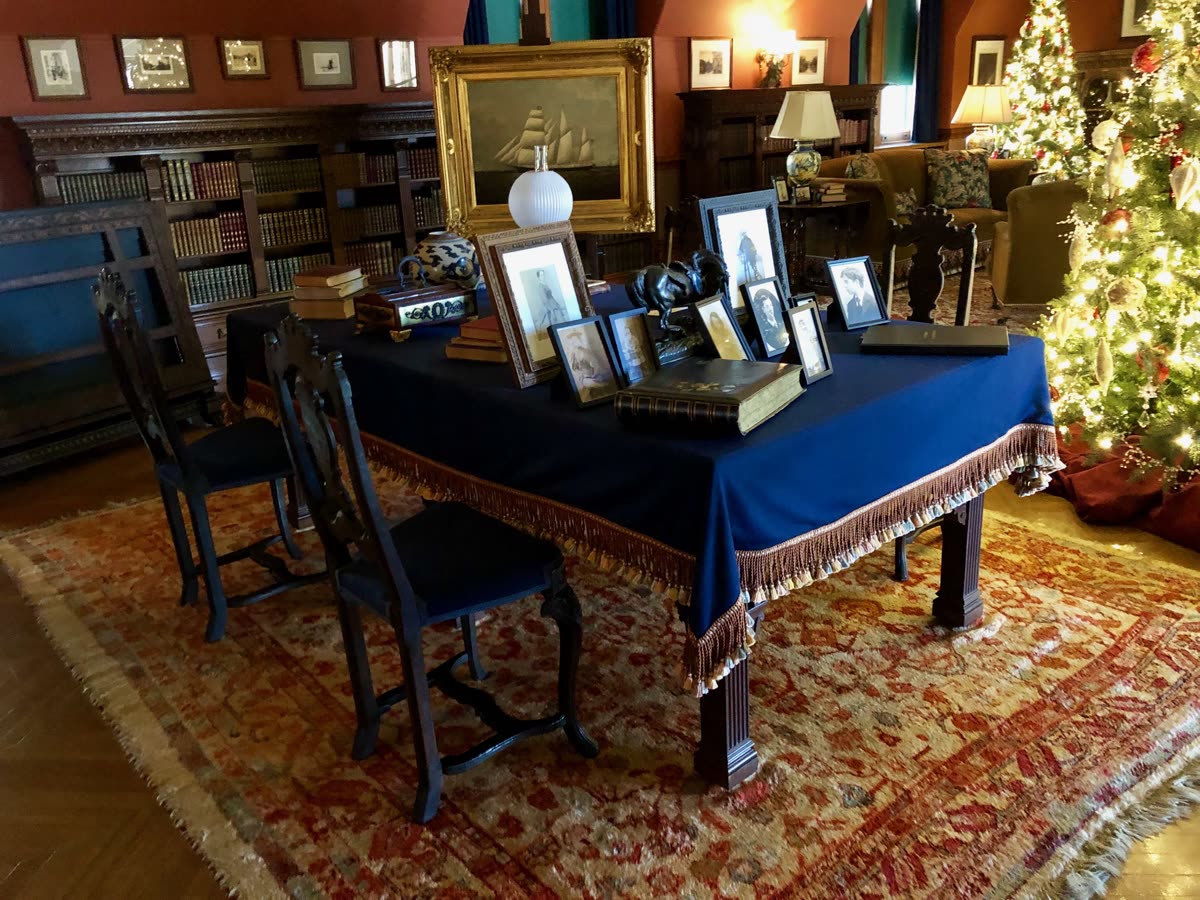
The Library is two storeys tall and holds 10,000 volumes in the room itself. Overhead is The Chariot of Aurora by Giovanni Antonio Pellegrini, brought to Asheville from the Palazzo Pisani Moretta in Venice and installed as thirteen separate canvases. Vanderbilt's full personal collection was far larger than the room — Biltmore's own materials give roughly 23,000 volumes, though one of its archival fact sheets says about 24,000 and an older blog post says 20,000, which is a good reminder that even a house this well documented does not agree with itself. Another 3,000 books sat in his Den.
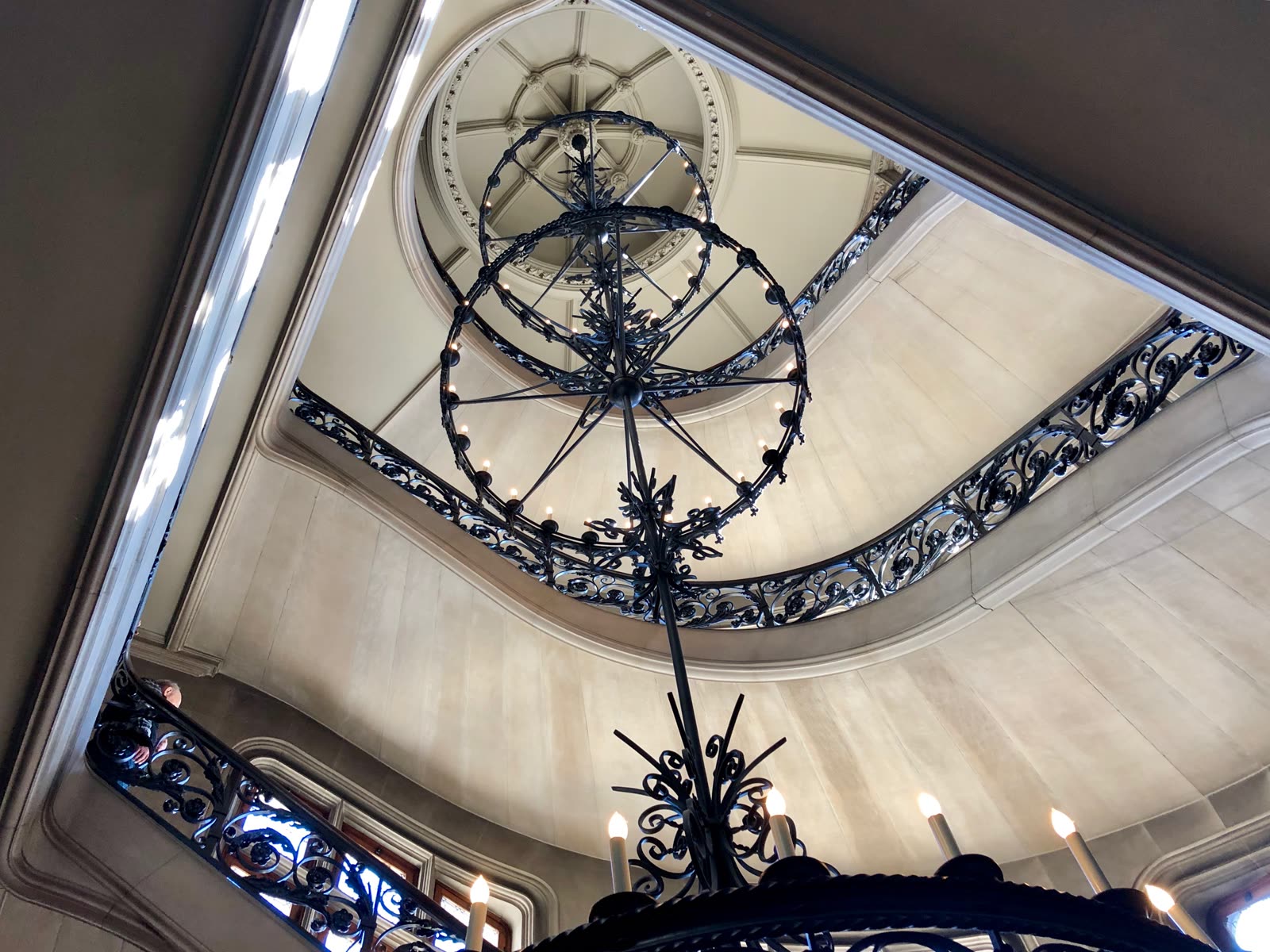
A staircase built around a chandelier
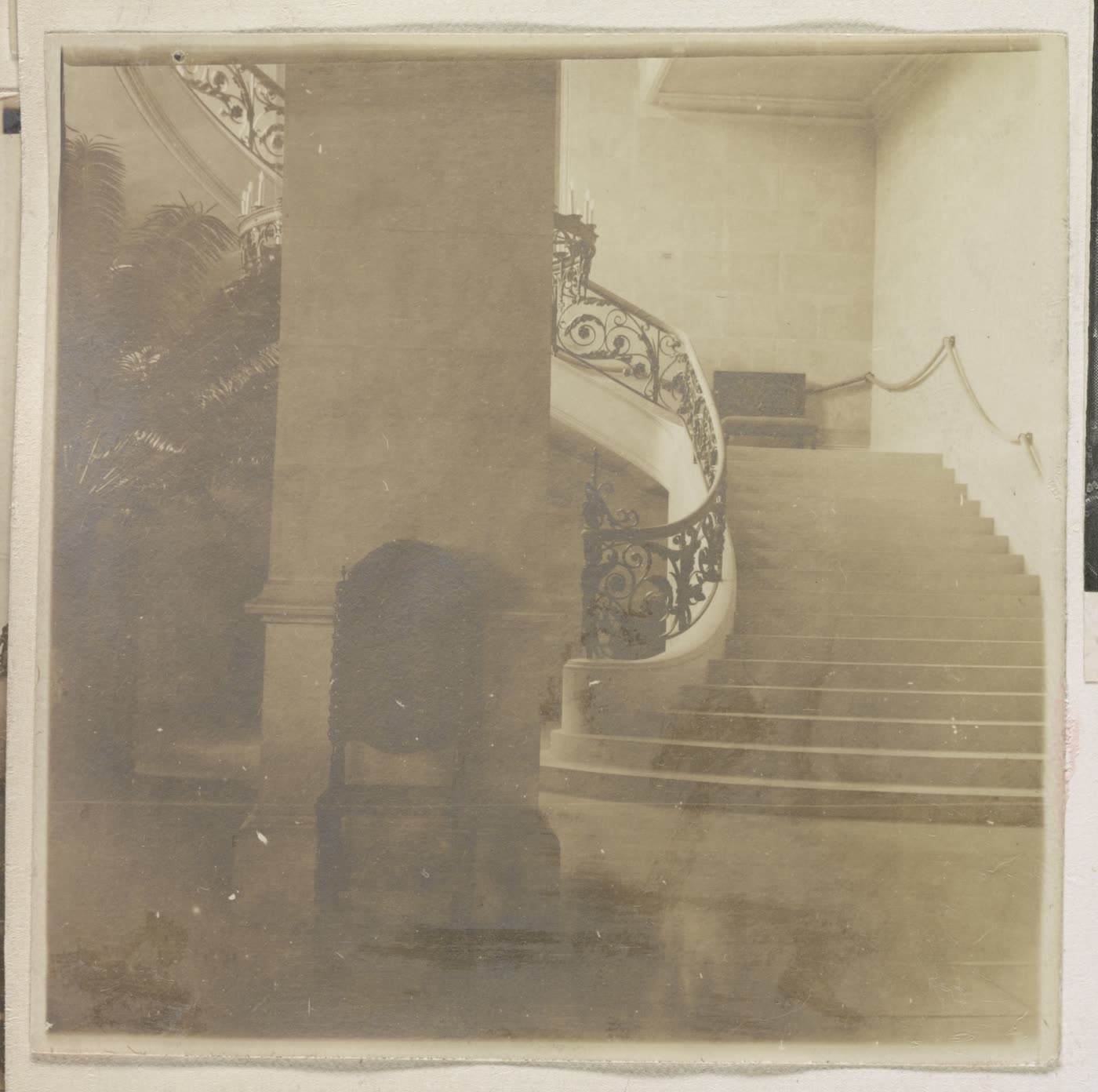
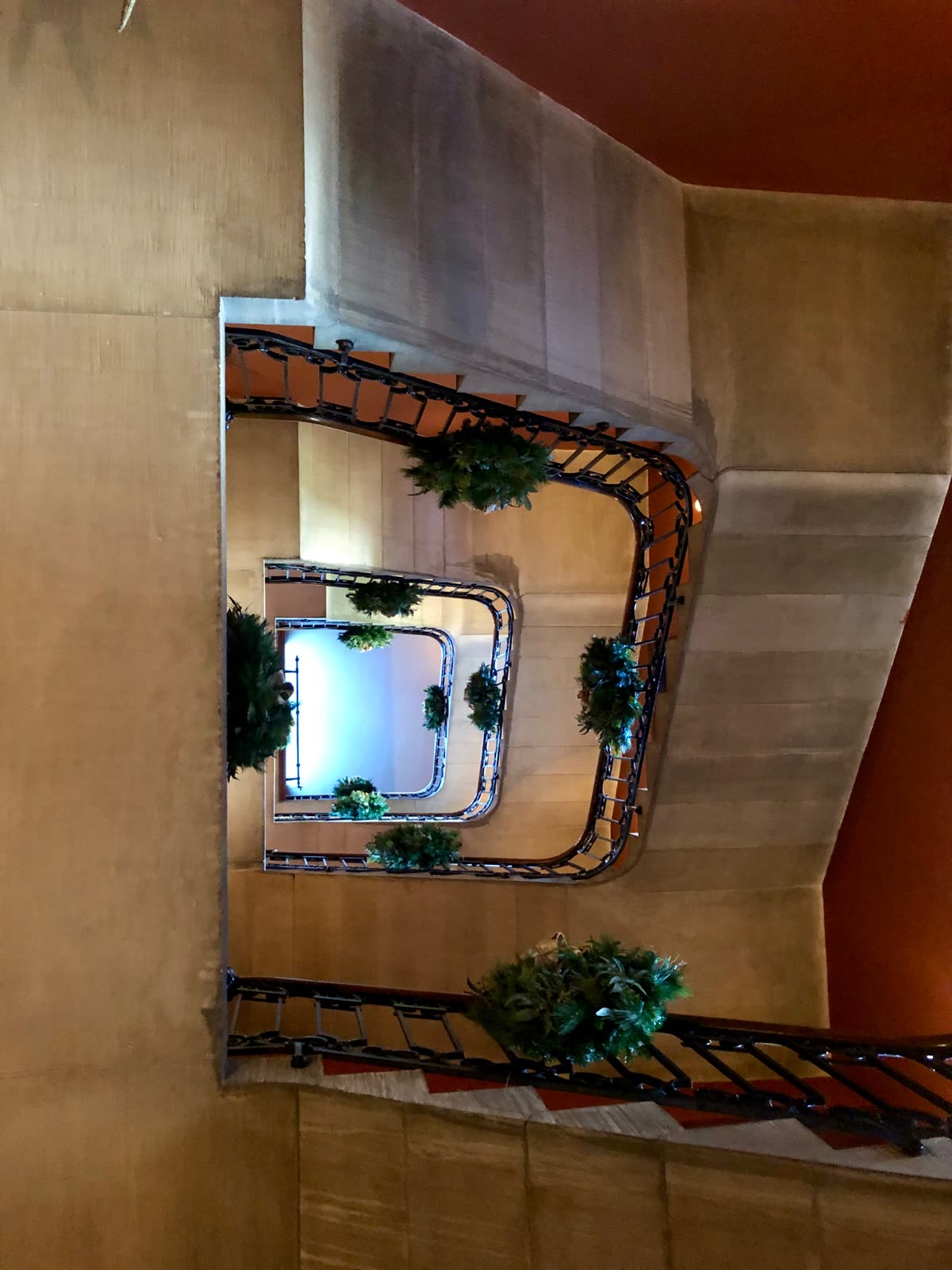
The Grand Staircase spirals 107 steps up four floors around a wrought-iron chandelier hanging the full height of the shaft, carrying 72 light bulbs. It is not supported by the chandelier, but it is composed around it, which is the more interesting design decision.
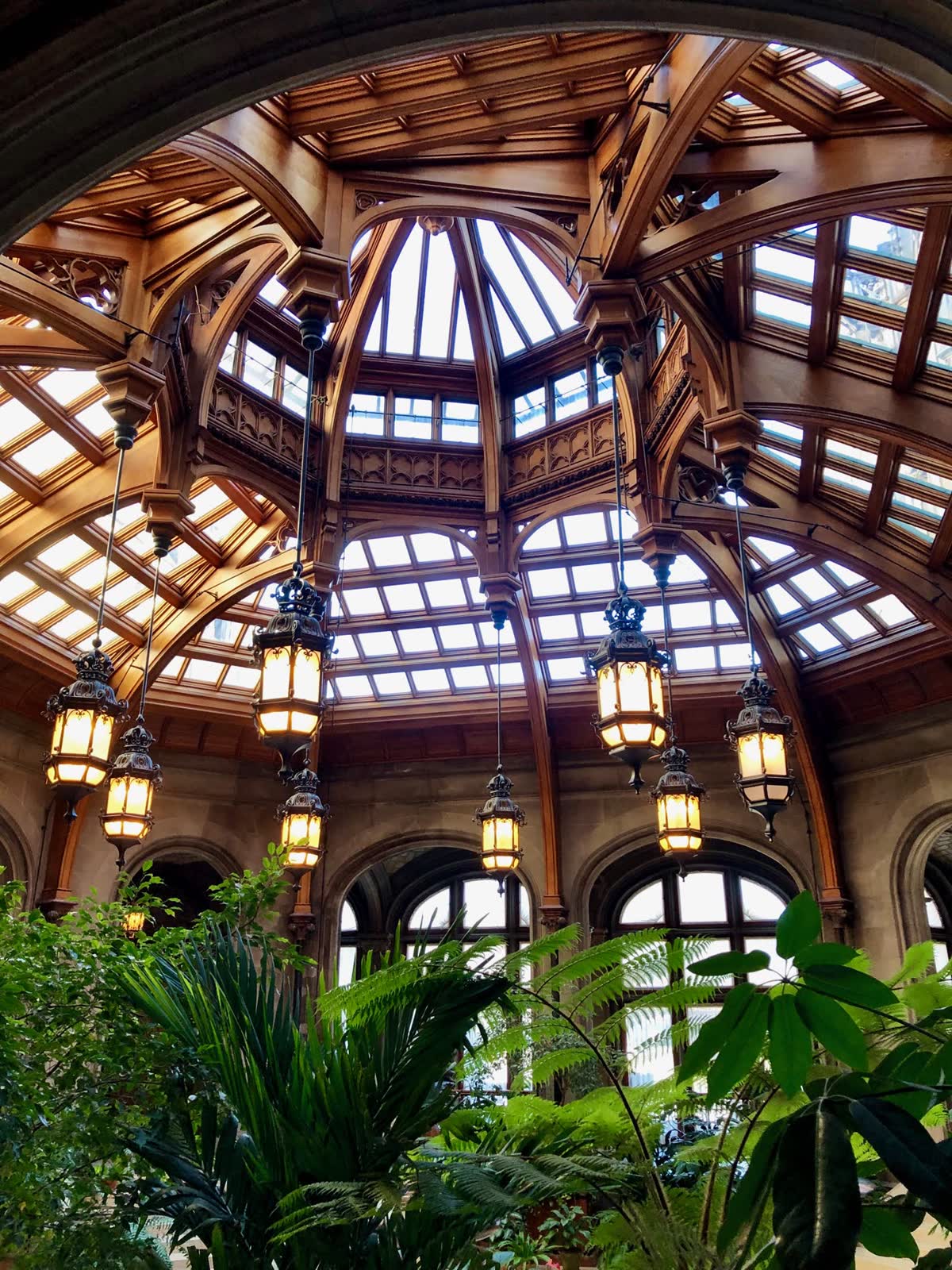
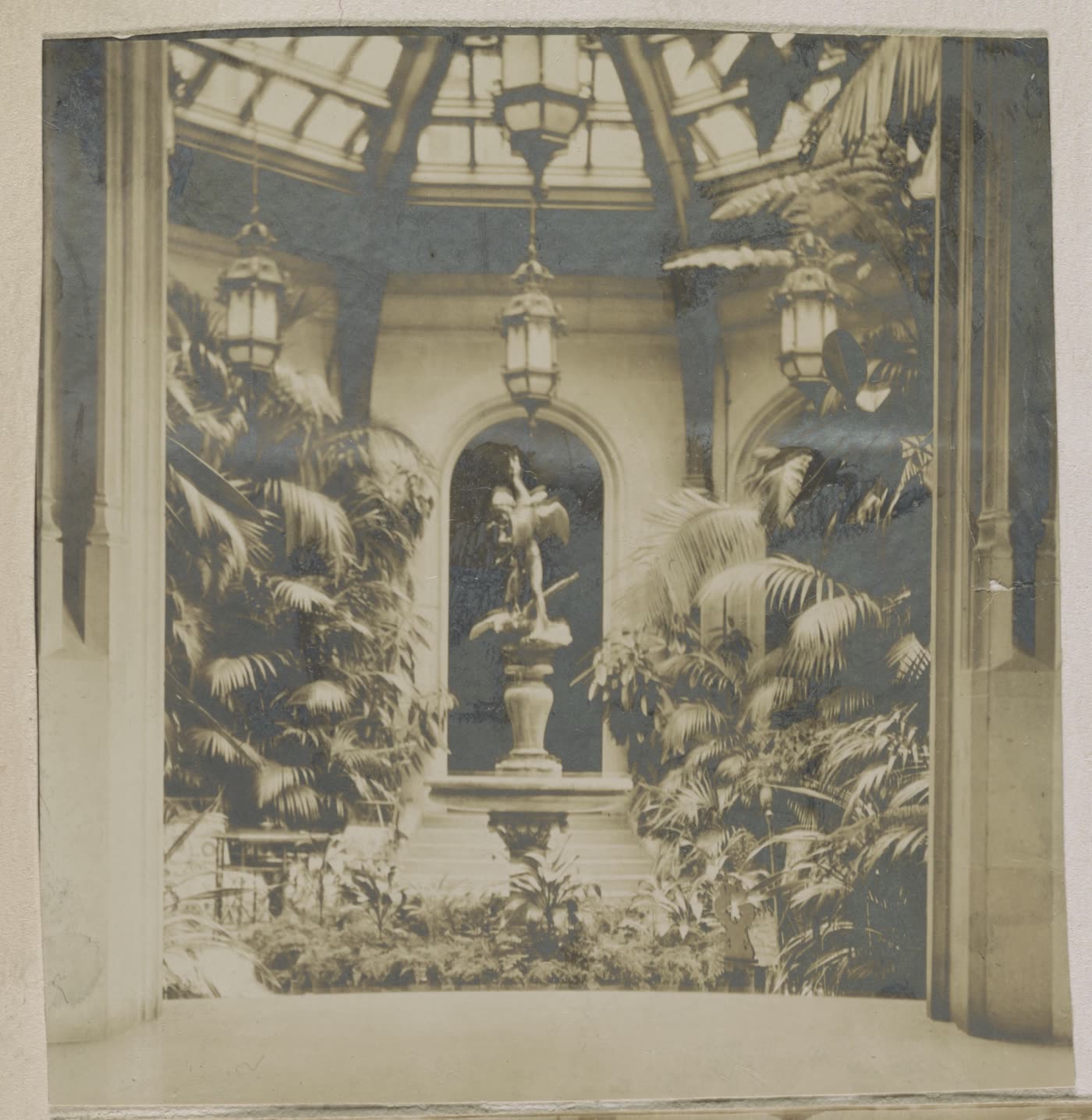
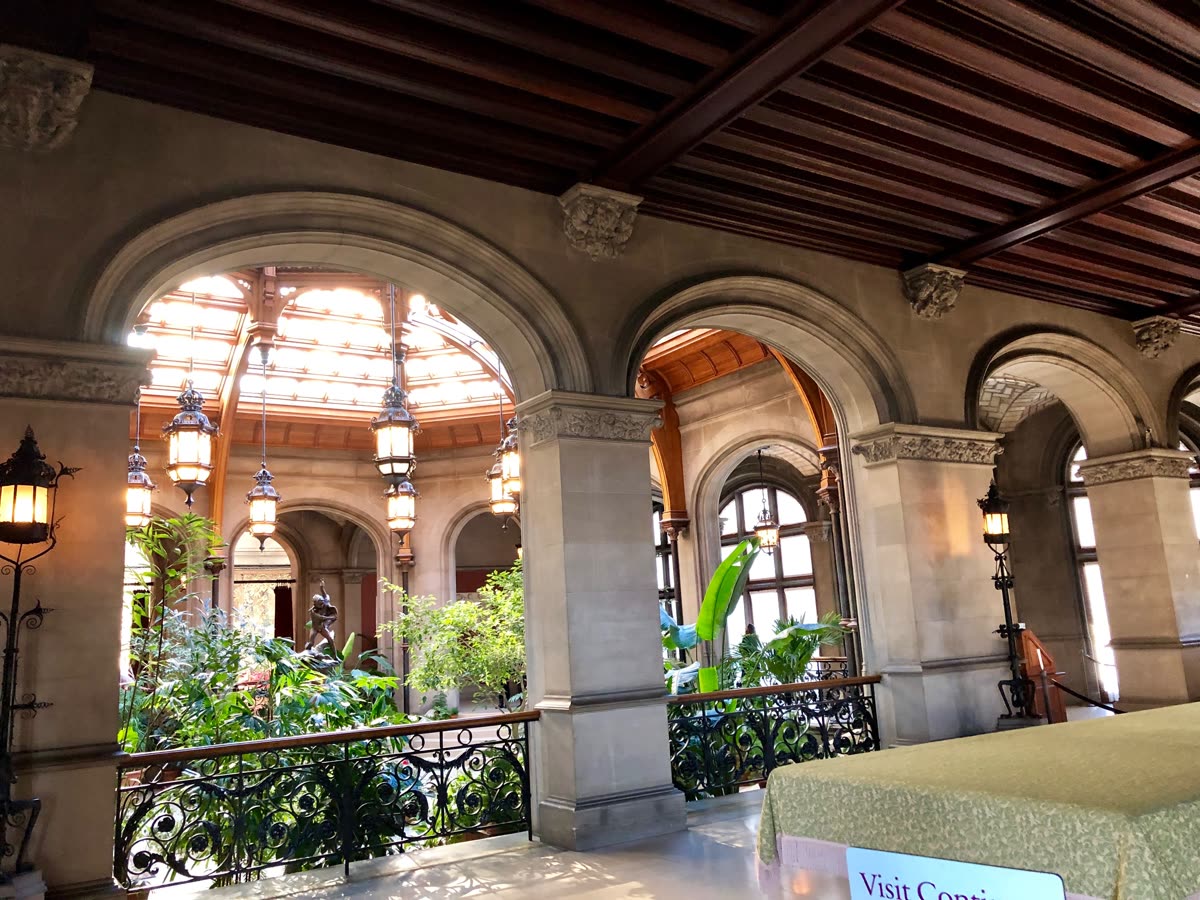
The Winter Garden is the octagonal, sunken glass-roofed room on the ground floor, ceilinged in sculpted wood and faceted glass, with Karl Bitter's marble and bronze fountain Boy Stealing Geese at its centre. No published measurement of the room exists, which is unusual for a house catalogued this thoroughly.
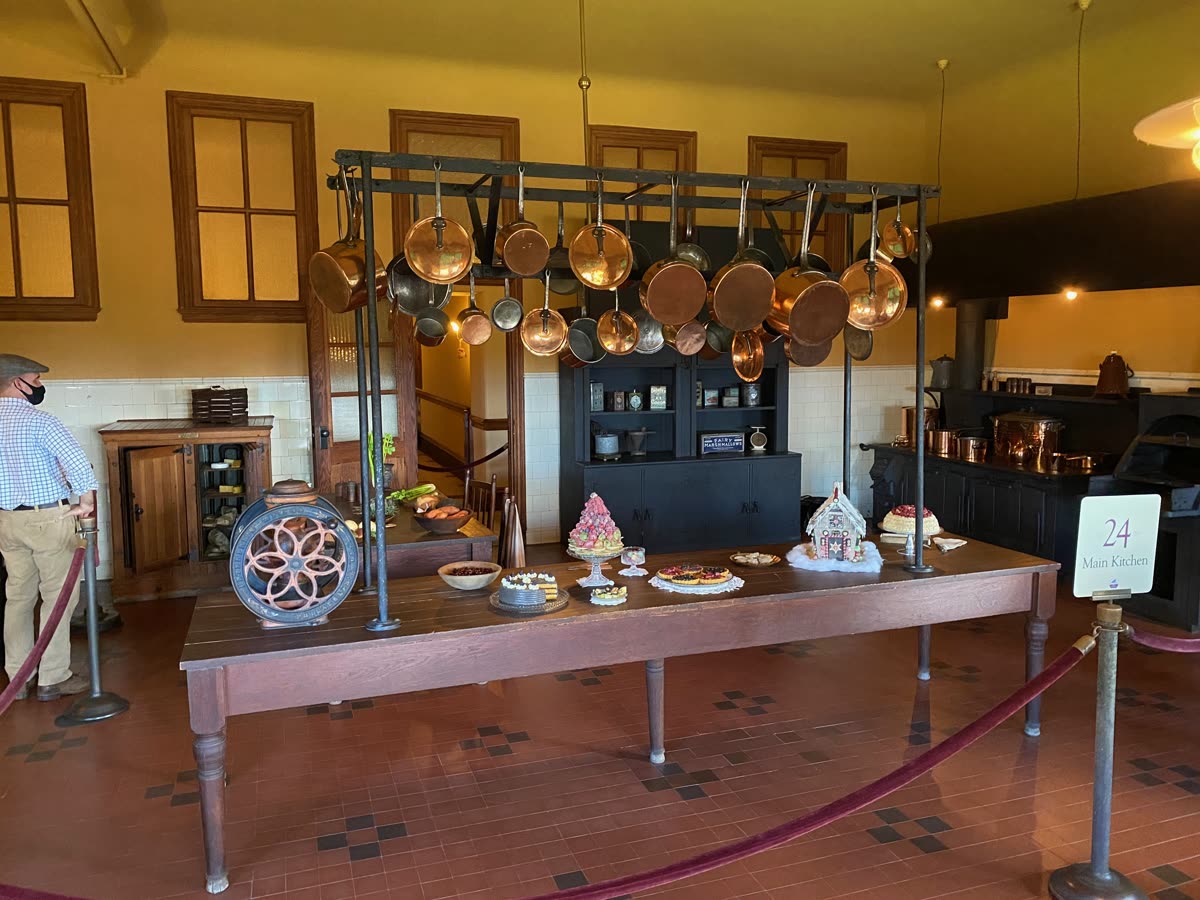
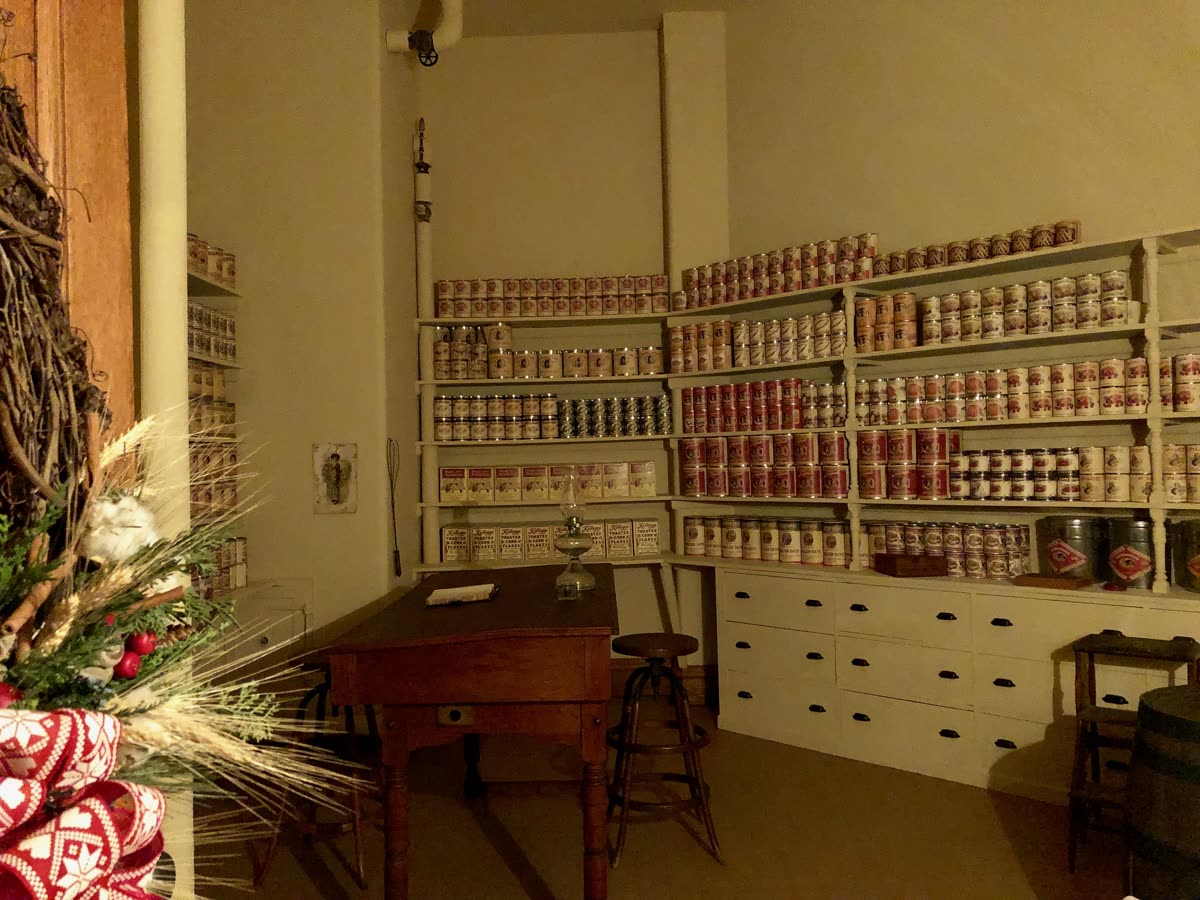
The basement is the best part and most people underrate it. This is where the 70,000-gallon heated swimming pool sits, alongside the two-lane bowling alley, the gymnasium, three kitchens — main, pastry and rotisserie — and the ammonia-gas refrigerators. Upstairs is where the family lived. Downstairs is where the house actually worked.
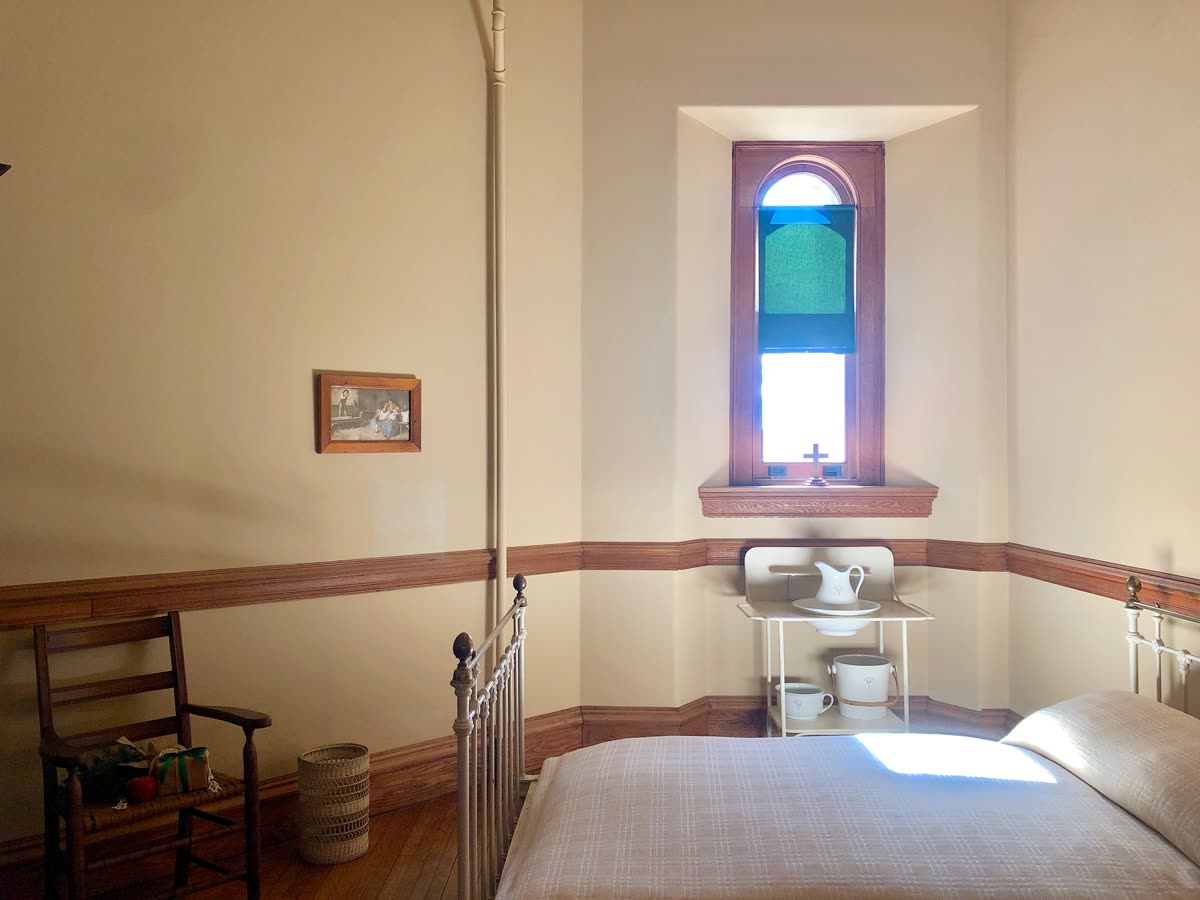
The staff footprint is worth registering while you walk it: 26 servants' bedrooms inside the house and another 40 in the stable complex, 66 in all, with 21 of the in-house rooms on the fourth floor for female staff. In the Vanderbilt era around 30 to 35 domestic servants lived and worked inside the house; the wider estate employed 438 people as early as 1894, while the house was still being built.
250rooms in total
35bedrooms
43bathrooms
74exterior doors
~50,000objects in the Vanderbilt collection
6John Singer Sargent portraits in the house
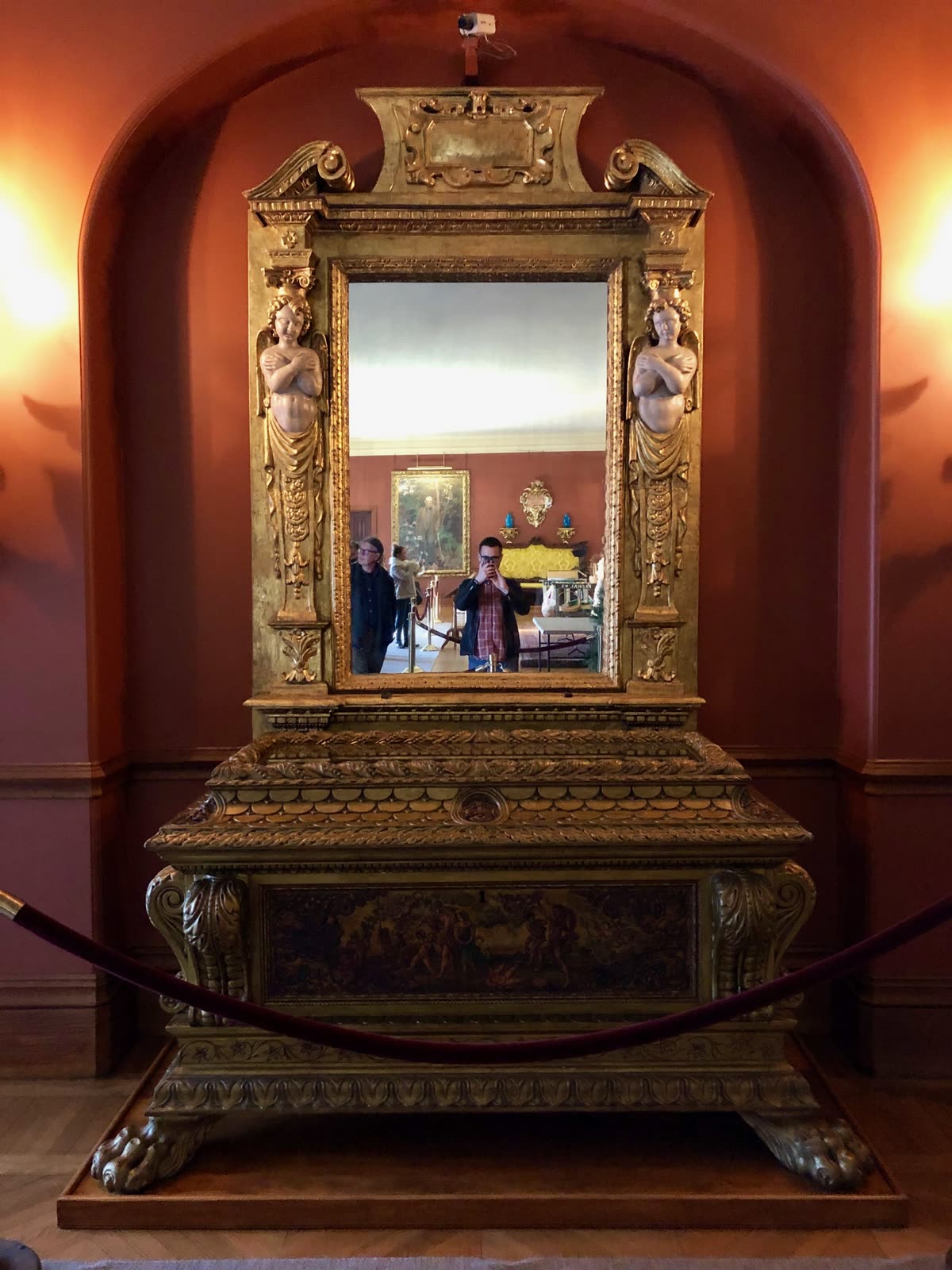
That collection breaks down into roughly 28,000 non-book objects, 1,313 prints, 206 paintings and 165 rugs, most of it bought by Vanderbilt himself on overseas trips and ranging from the fifteenth century to the late nineteenth.
One planning note: Biltmore warns that ongoing preservation work can produce modified tour routes, so no individual room is guaranteed to be open on the day you visit.
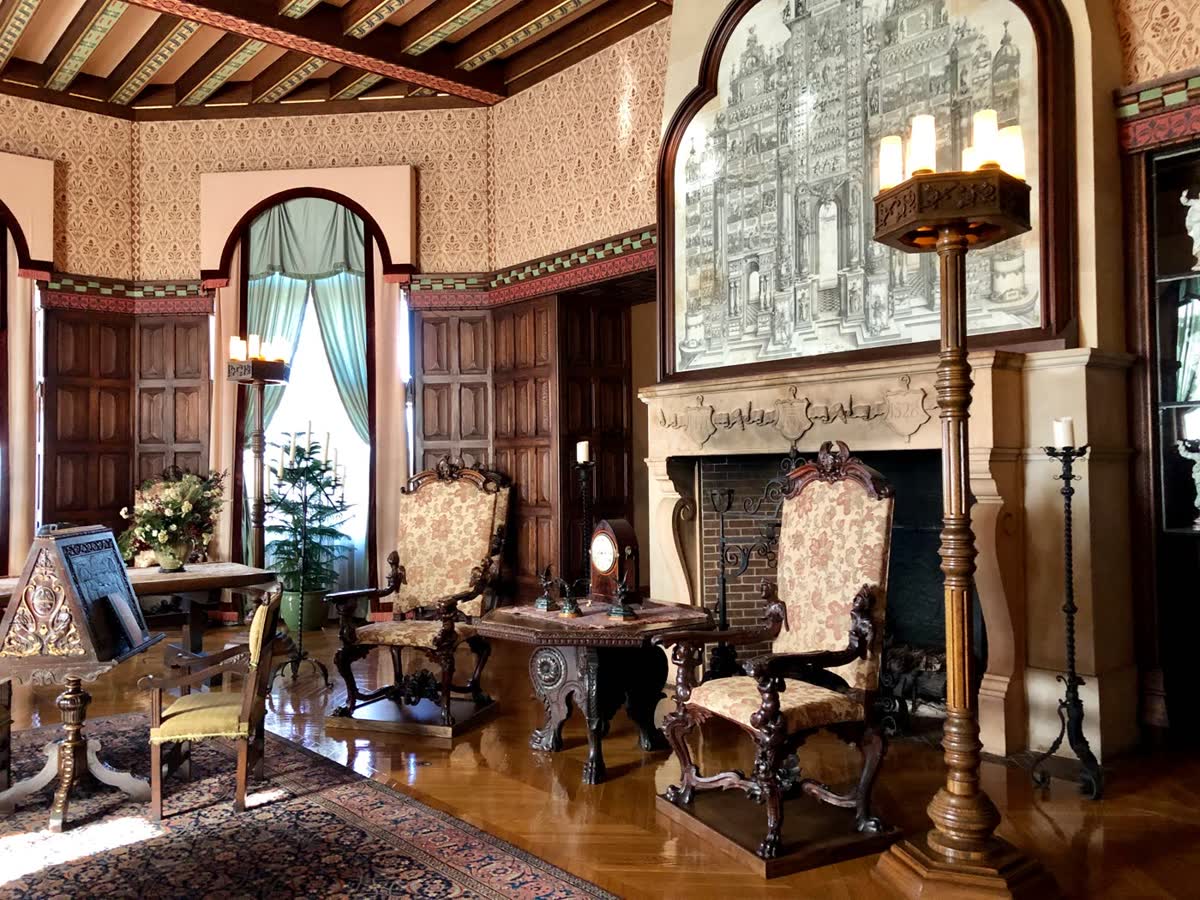
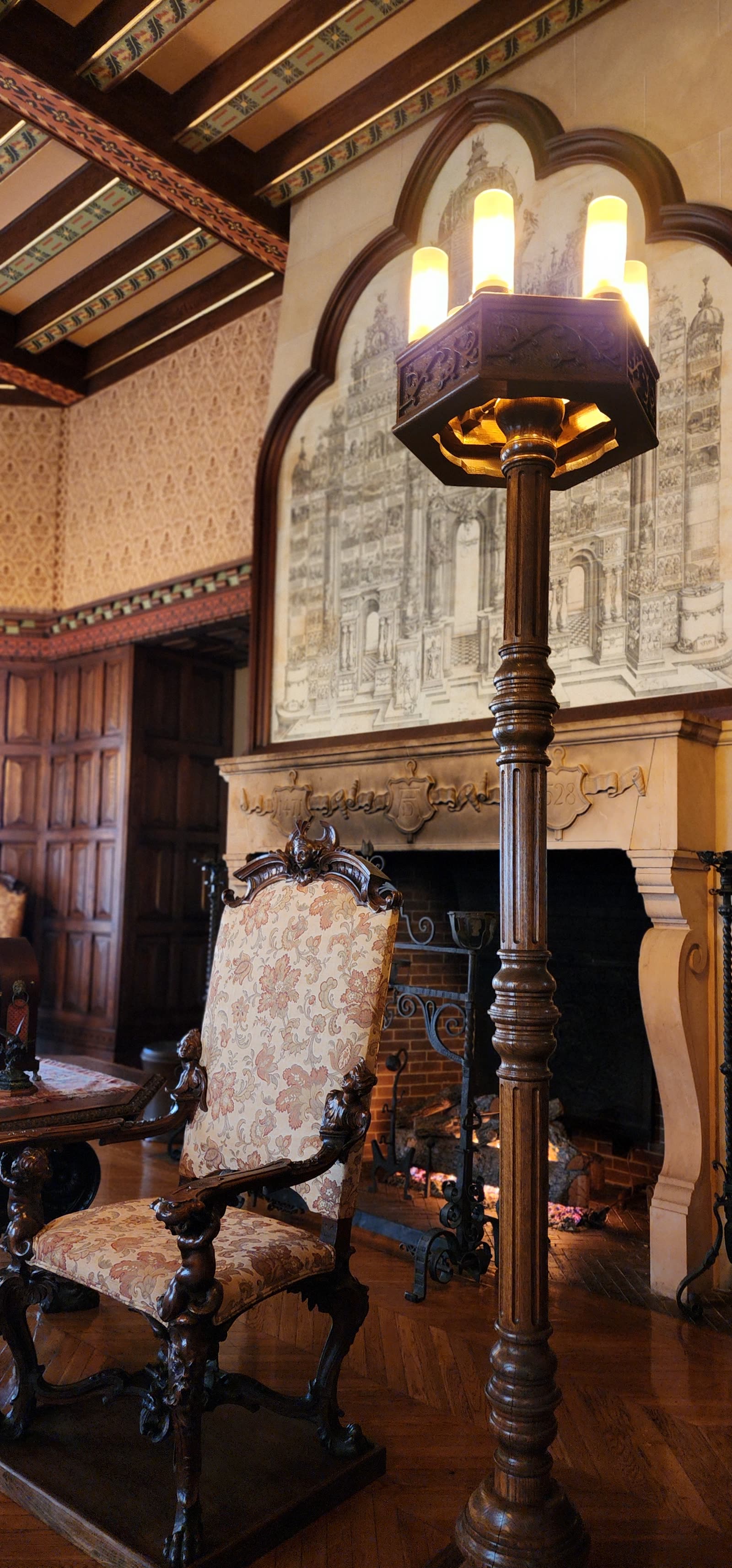
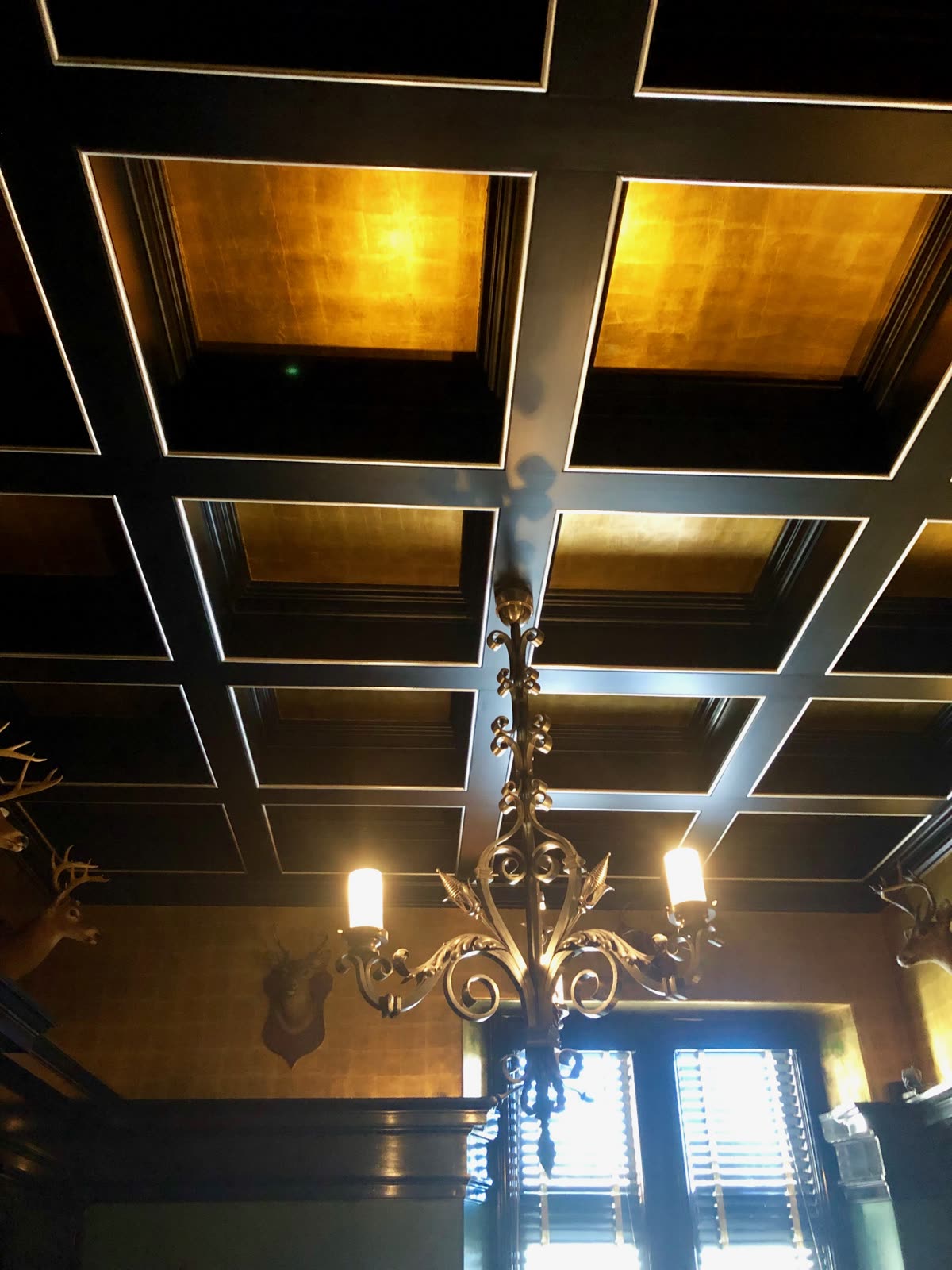
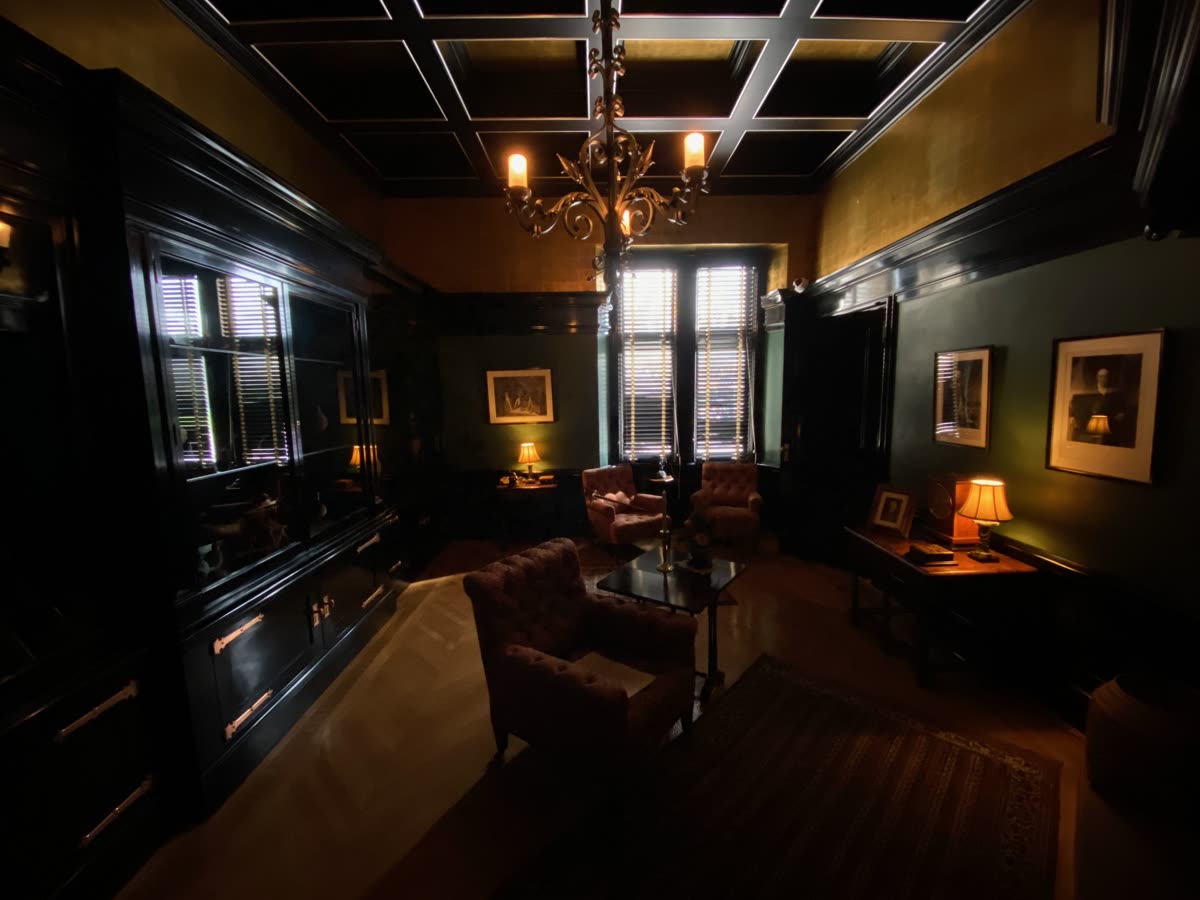
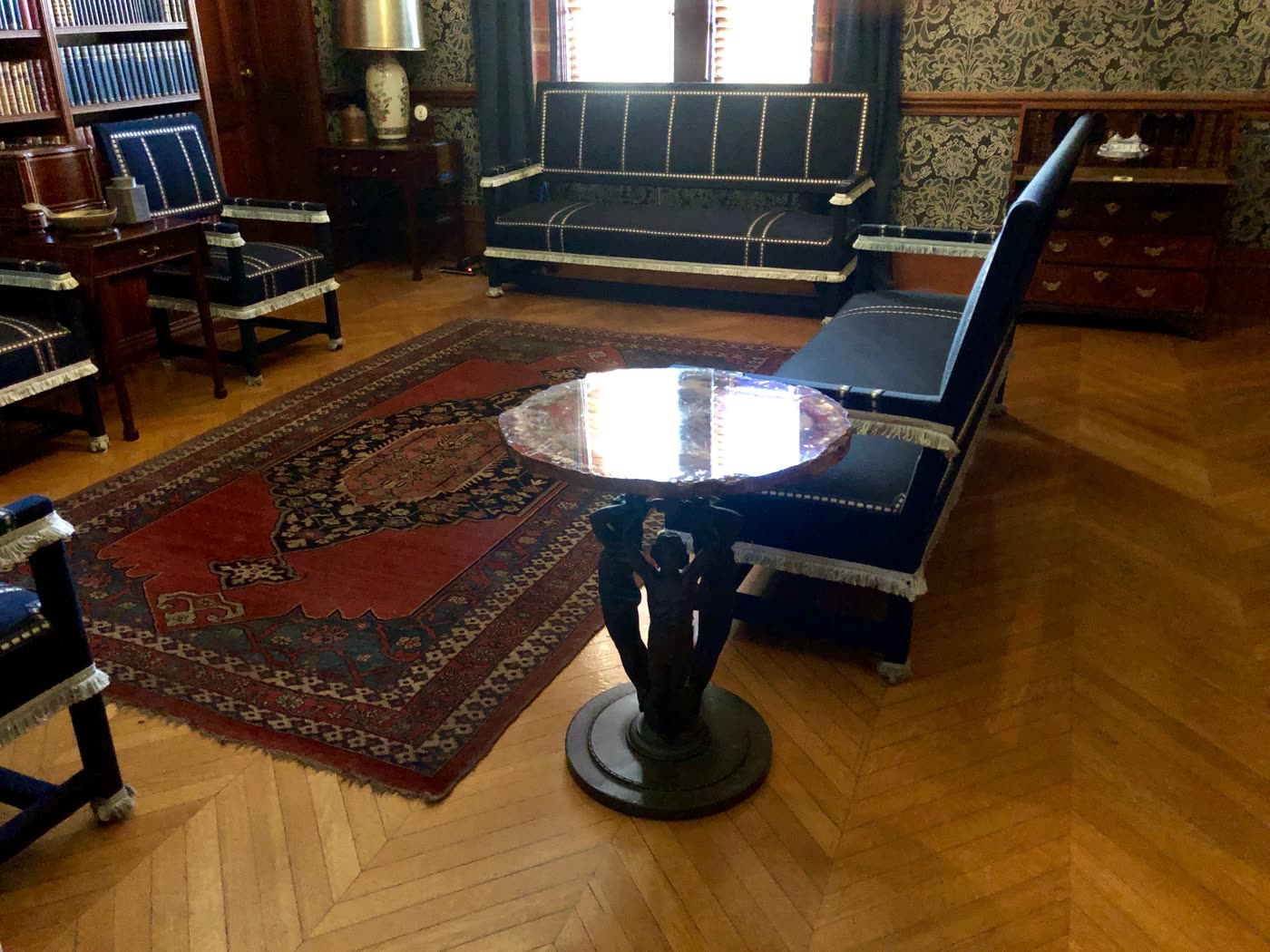
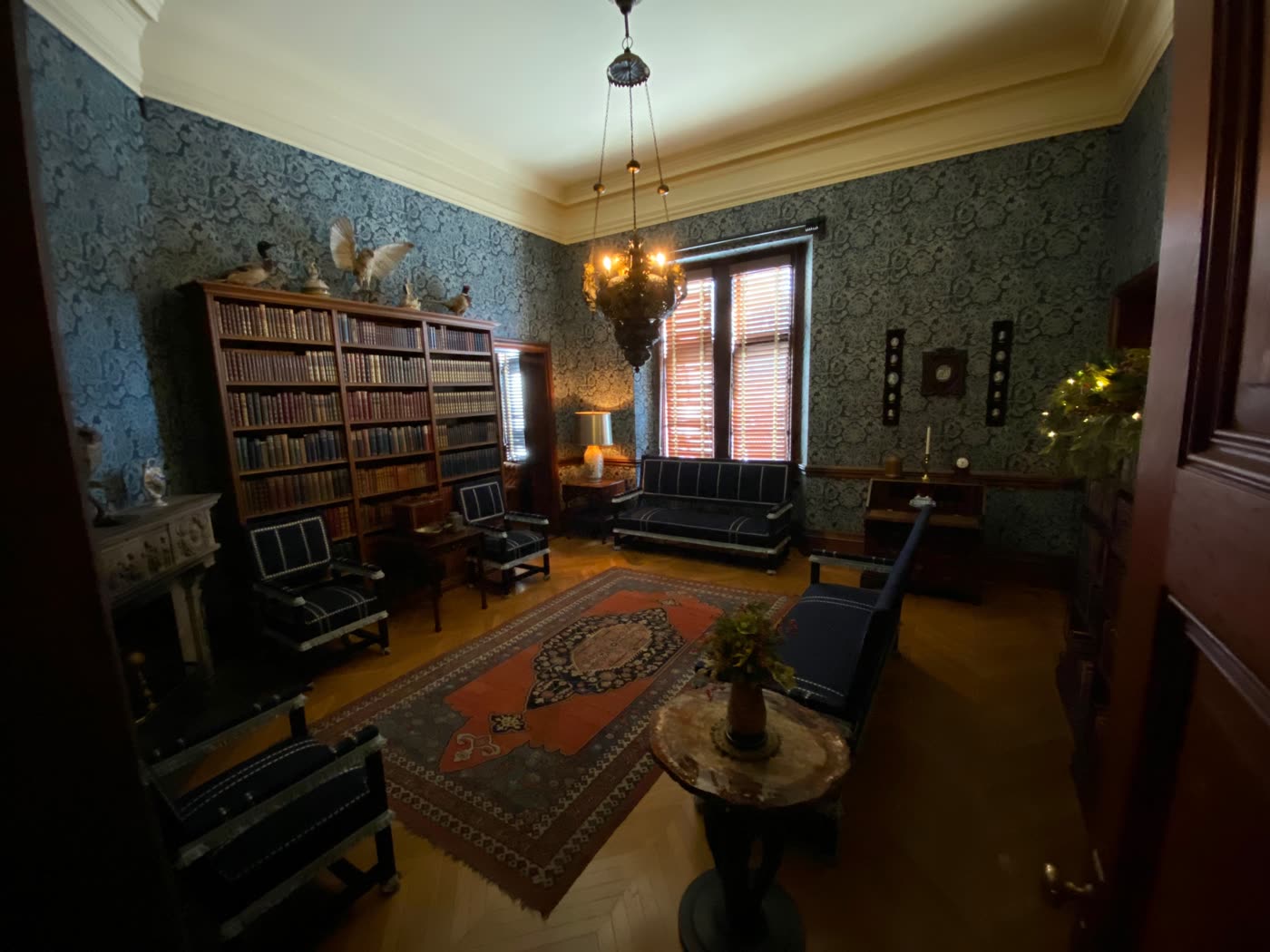
Inside the house
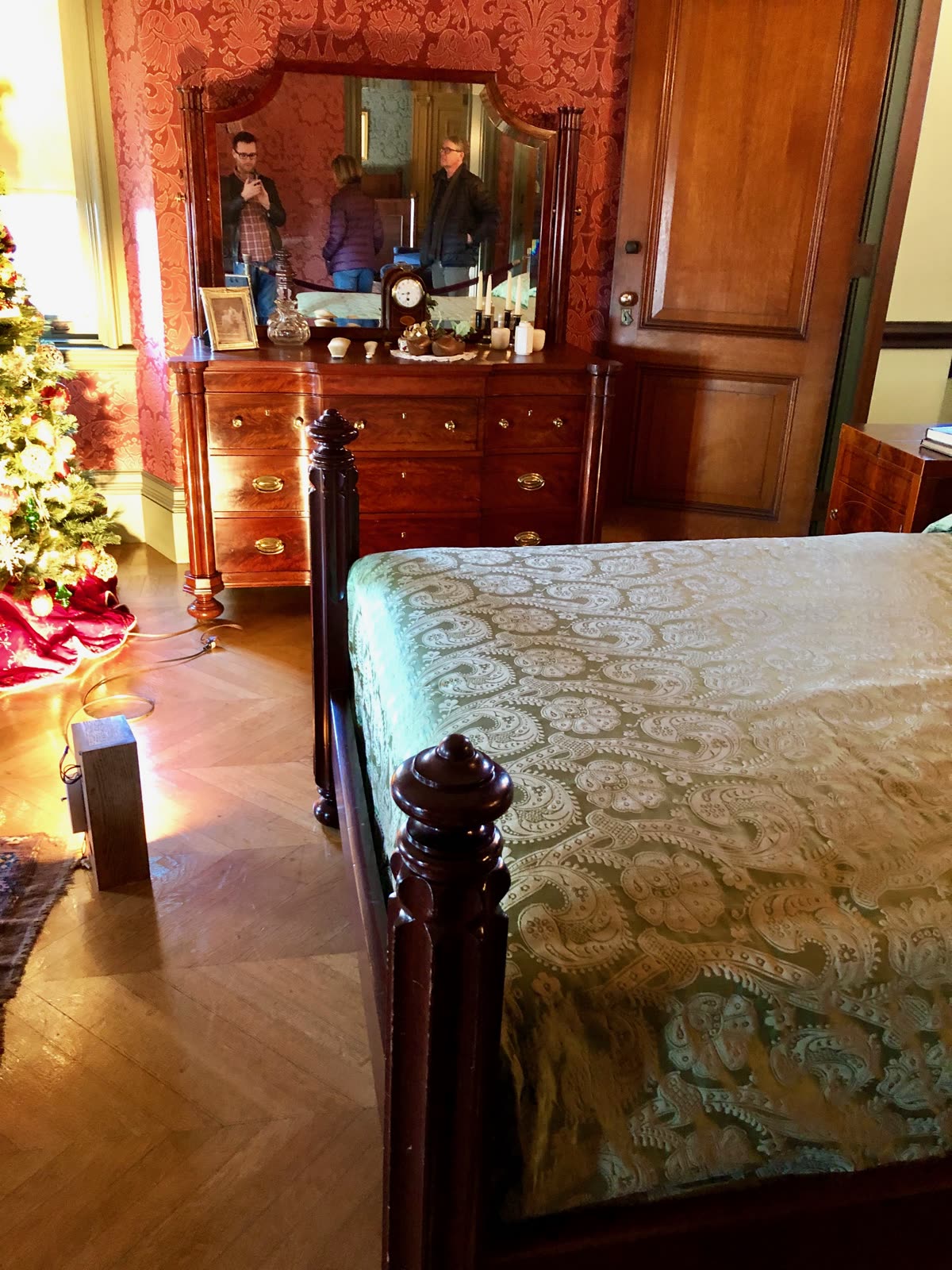
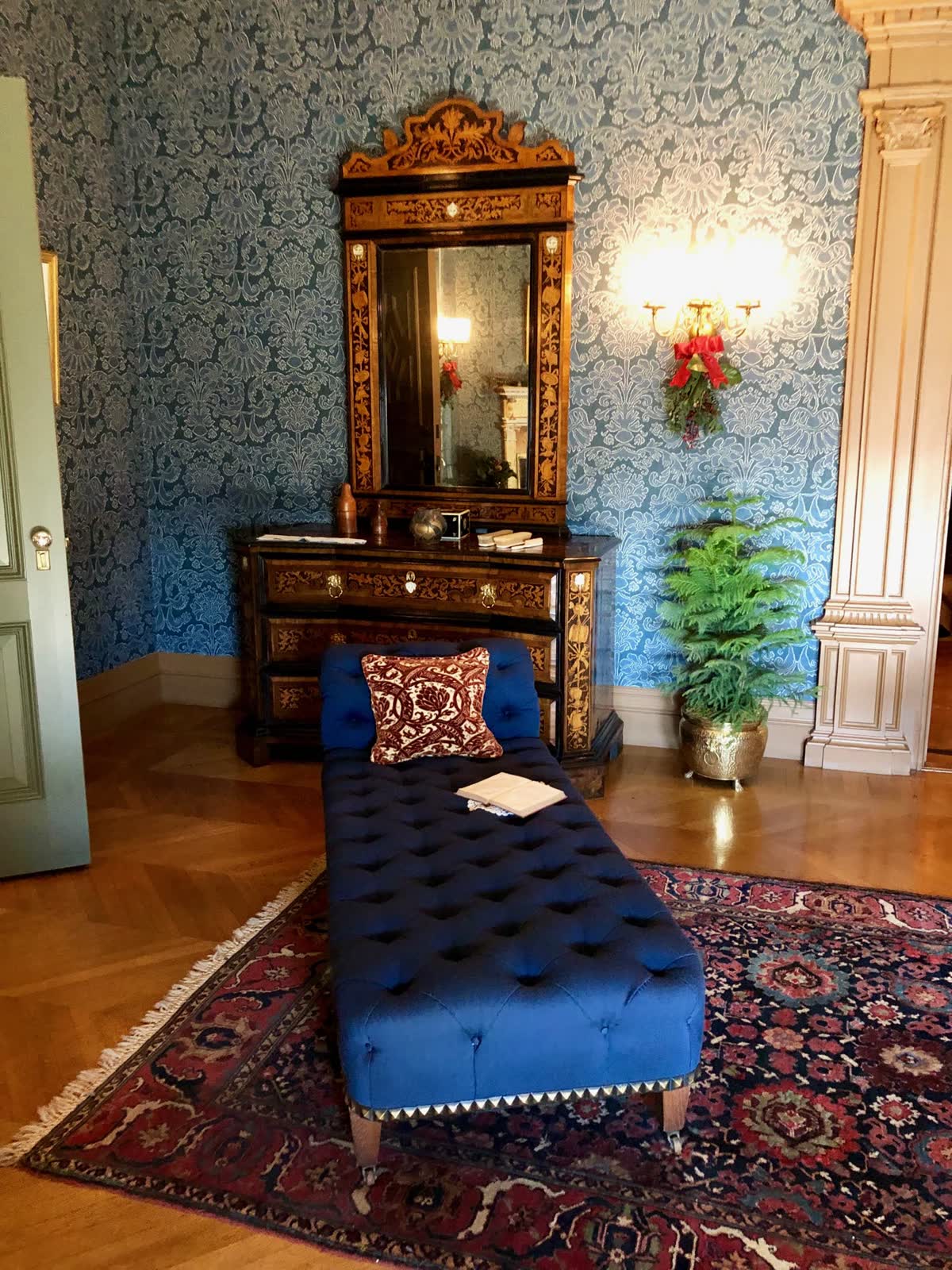
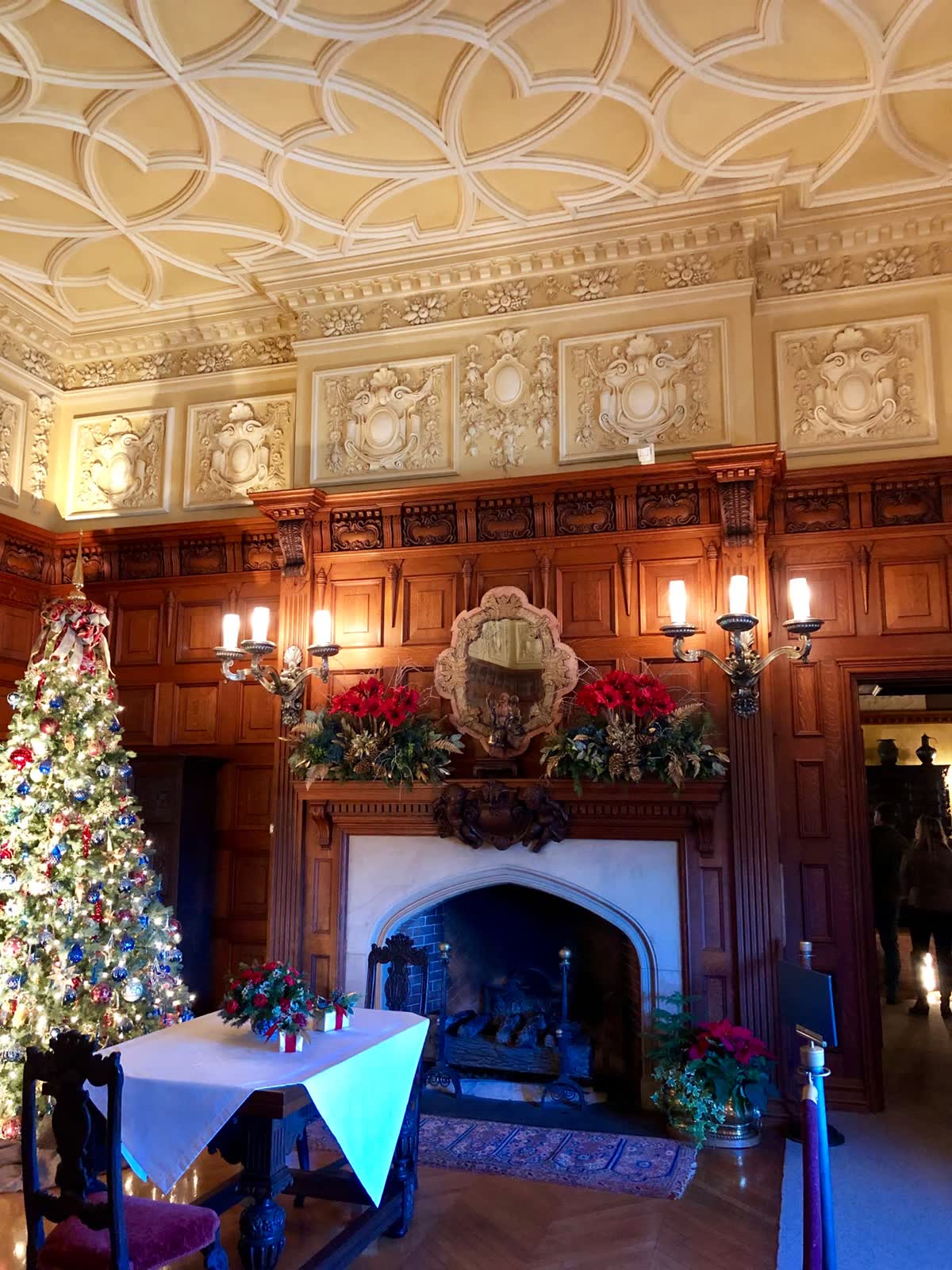
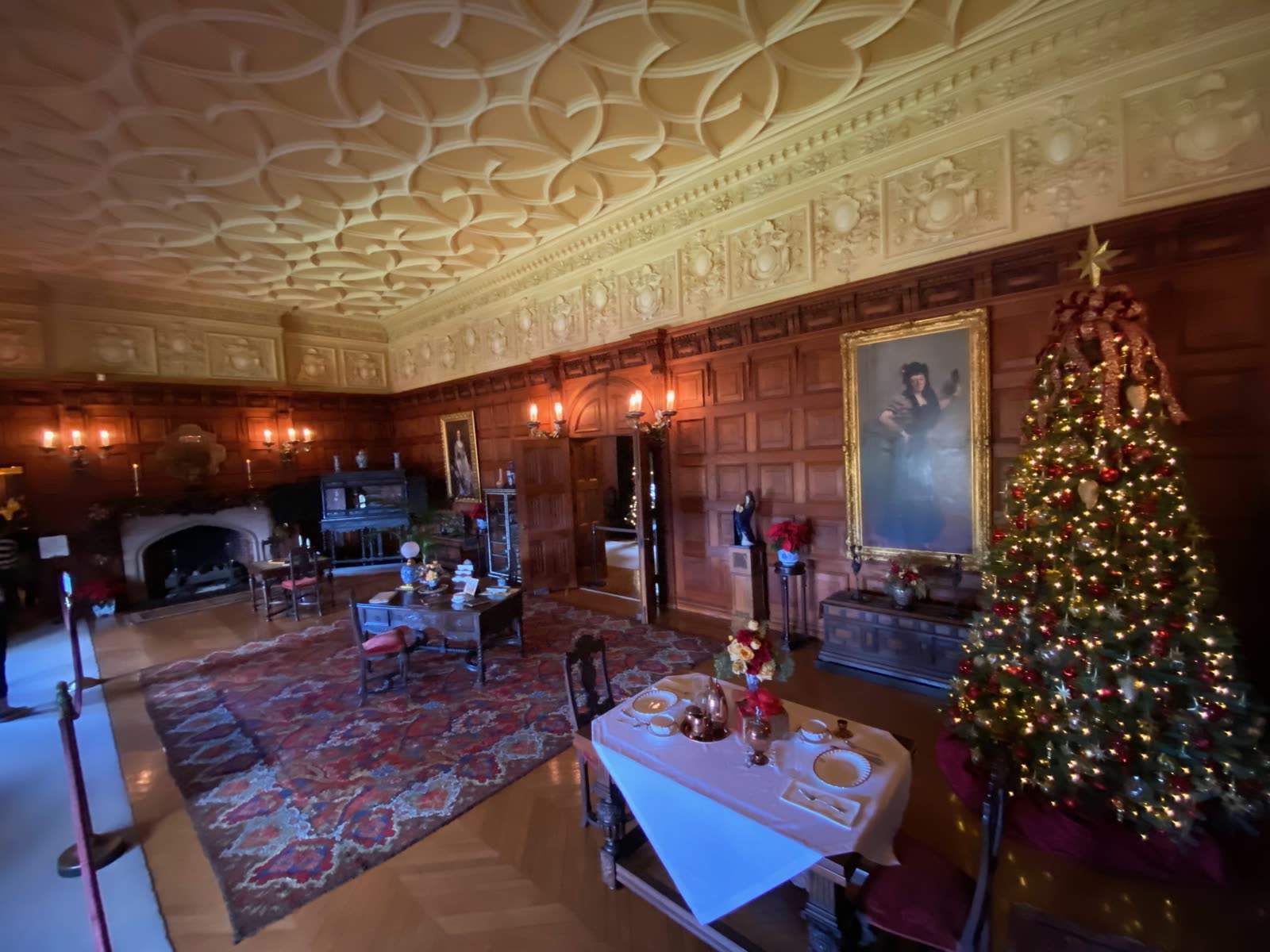
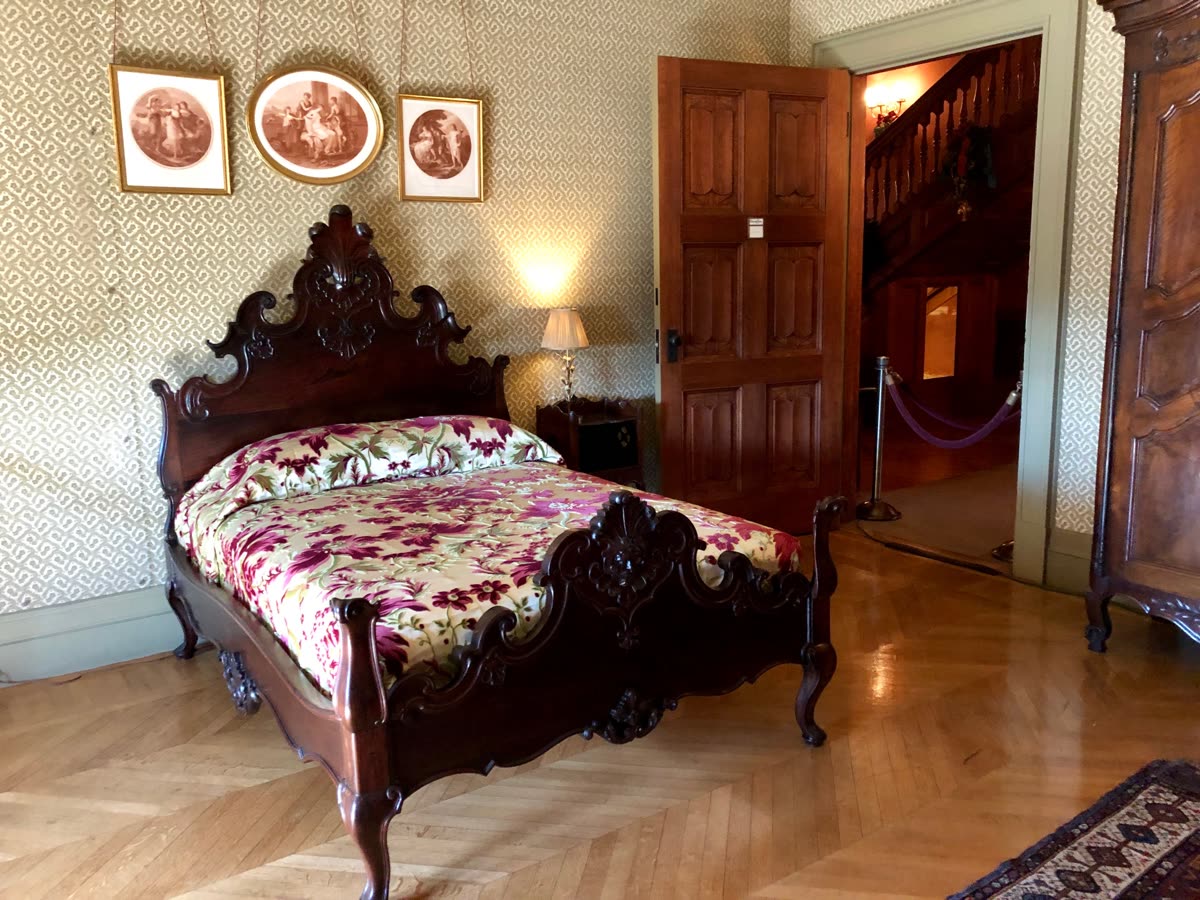
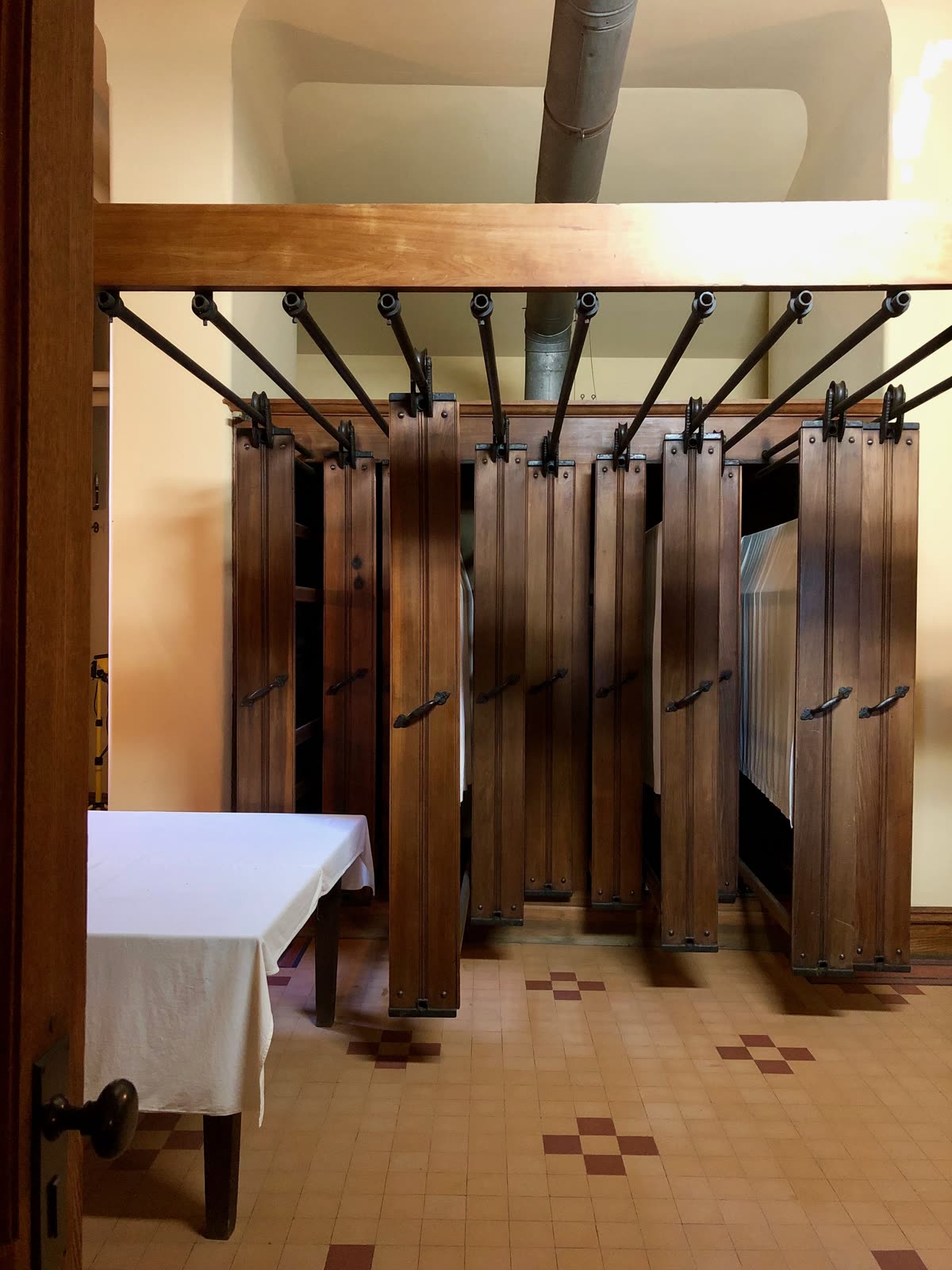
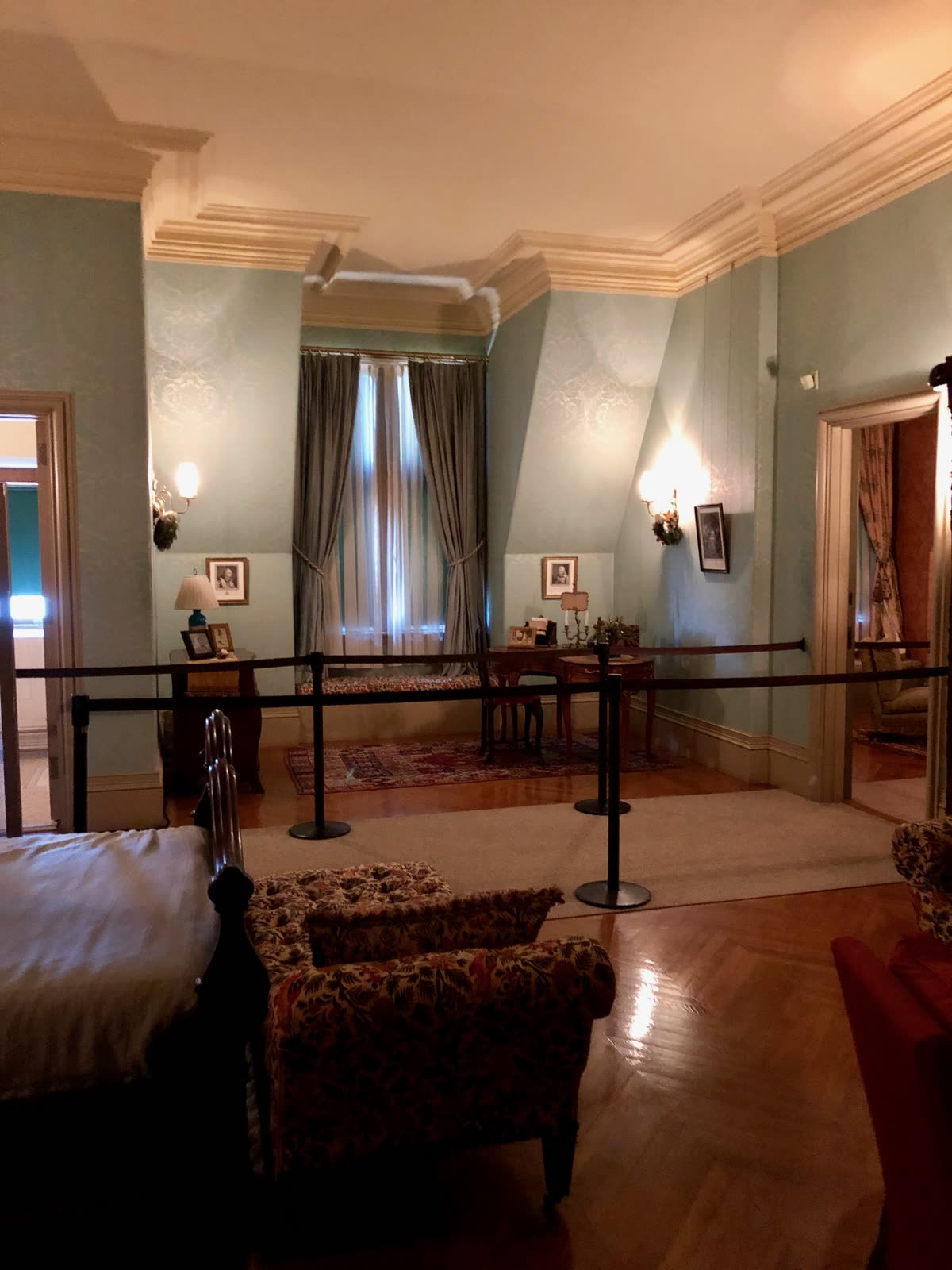
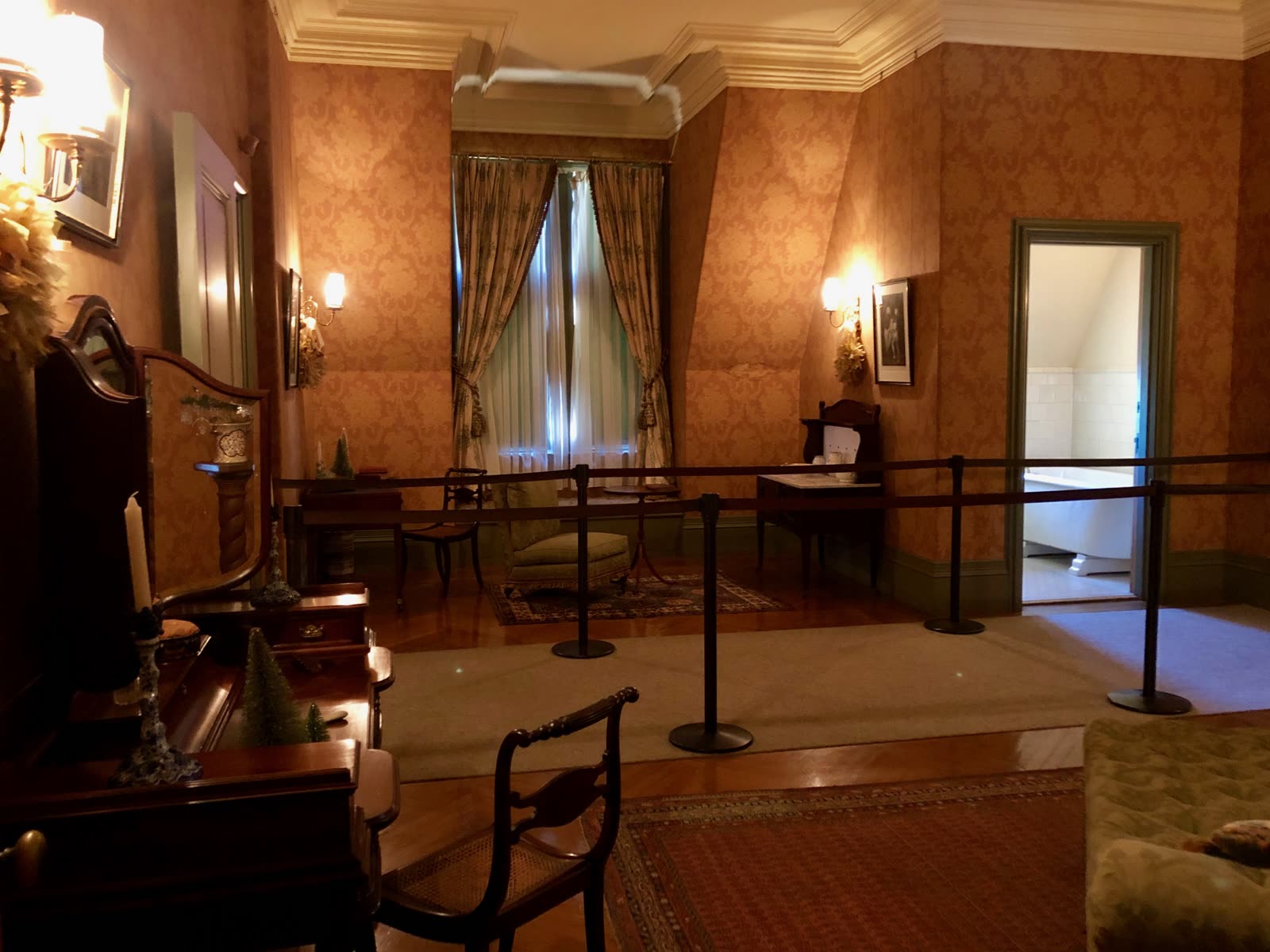
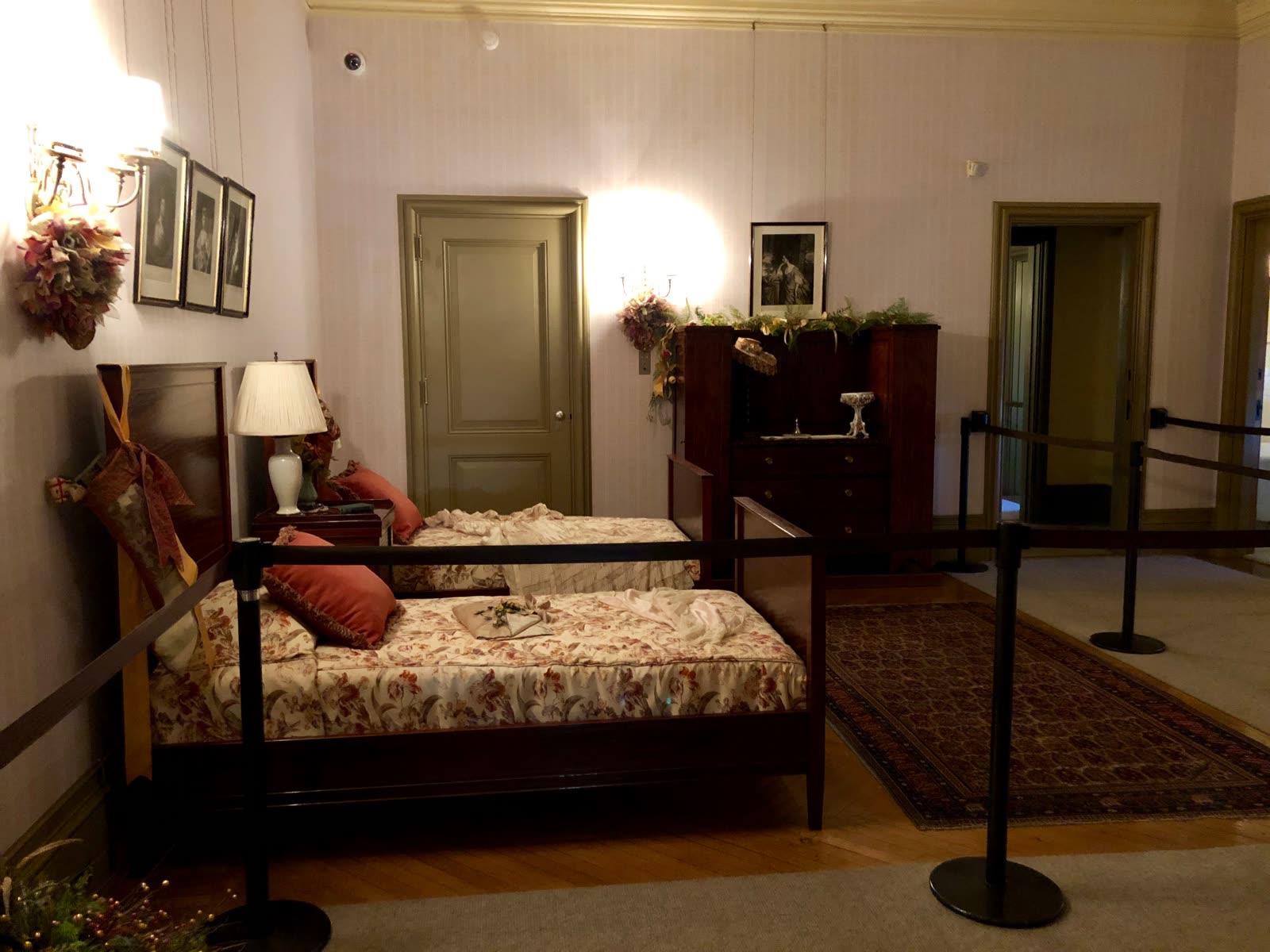
Every room we could photograph
Biltmore does not publish a room list, so this is assembled from
freely-licensed photography — 35 rooms, 55 photographs. Each frame is
captioned with the room it shows, and where a room has a period photograph as well as a
modern one, both are here.
Biltmore Estate is privately held, not public land. The Biltmore Company, founded in 1933, still runs it, and George Vanderbilt's descendants — the Cecil family — still own it. William A. V. Cecil Jr. has been President and CEO since 1995; Diana (Dini) Cecil Pickering has chaired the board since 2017. It is not a national park.
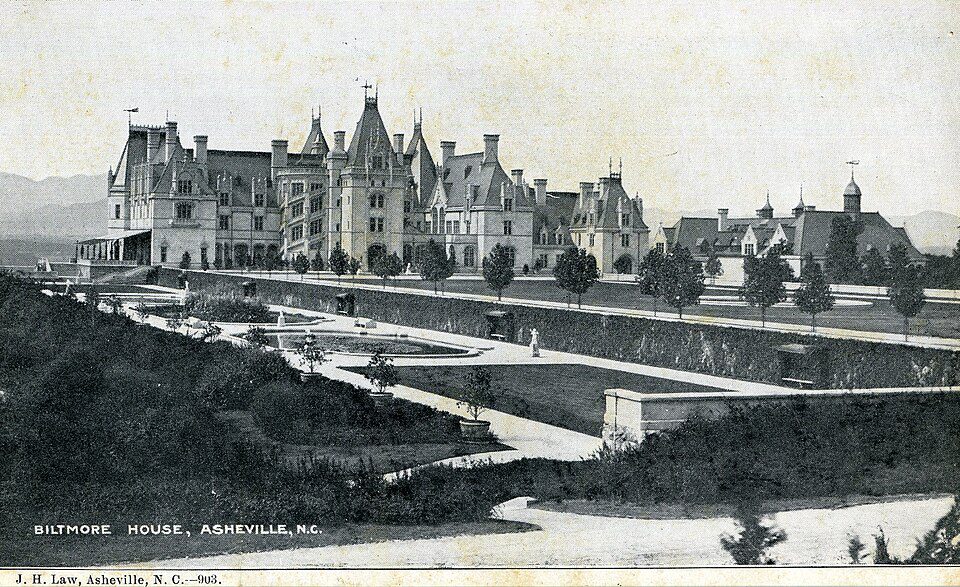
There are no outside shareholders and no public stock. The house was not always open: it admitted visitors for the first time on 15 March 1930, when Cornelia Vanderbilt Cecil and John Cecil opened the doors at the City of Asheville's request to pull Depression-era revenue into the town. Around 300 people came on opening day. The Biltmore Company itself was formed three years later, in 1933.
A postcard from about 1915. For the first thirty-five years of its life the house was closed to the public, and this is how most of America saw it.
Karl Larson Photograph Collection (PhC.205), State Archives of North Carolina. No known copyright restrictions.
The man who made it a business was the grandson. William A. V. Cecil Sr. came back in 1960 to a house losing roughly $250,000 a year. Under him it became a National Historic Landmark in 1963 and joined the National Register of Historic Places on 15 October 1966. It turned its first profit — $16.34 — in either 1968 or 1969; the sources genuinely disagree and we are not going to pick one for you. He planted the first vines in the early 1970s, the Winery opened in 1985, and he handed the chief executive's seat to his son in 1995. He kept a board seat until he died at home in Asheville on 31 October 2017, aged 89.
The turnaround from there is the real number. Annual sales were $32 million when Bill Cecil Jr. took over in 1995 and $207 million by 2016 — roughly six and a half times, in twenty-one years, from a starting point of $16.34.
One honest hole in the story. Between the Cecil divorce in 1934 and William Cecil Sr.'s return in 1960, no source we could reach names who held operational control. That is twenty-six years of custody the published record does not document. The Biltmore Company existed throughout. Anyone narrating those years confidently is filling the gap rather than reading it.
The fifth generation — Ryan Cecil, Chase Pickering and Aubrey Cecil — are in operating roles now, but no source publishes start dates for them, so we give no timeline.
Cornelia herself did not stay. She left Biltmore for New York around 1932, reportedly finding estate life too dull to endure, and never came back. She and John Cecil divorced in 1934. Her mother Edith had remarried in 1925 and lived until 1958.
Does Anderson Cooper own part of Biltmore?
No. Anderson Cooper descends from Cornelius Vanderbilt II, the older brother of George Washington Vanderbilt II, who built Biltmore. Both were sons of William Henry Vanderbilt and grandsons of Commodore Cornelius Vanderbilt. Biltmore has stated Cooper holds no ownership in the estate. Biltmore is owned by George's Cecil descendants through The Biltmore Company.
The line runs Cornelius II → Reginald Claypoole Vanderbilt → Gloria Vanderbilt (1924–2019) → Anderson Cooper. Biltmore's own spokeswoman put it on the record in 2005: Cooper “does not have any ownership in, or get any special privileges at, Biltmore Estate.” It is a collateral branch of the same family, not the Biltmore line — which is why the question comes up so often and the answer is still no.
We are not going to tell you the exact cousin degree between the two branches. Published sources contradict each other on it, and one widely-repeated version is internally inconsistent with the generations it cites. What is settled is the part that matters to a visitor: Biltmore Estate has stayed in one line of the family since it was built.
Who has owned Biltmore Estate, 1889 to today
One family has held Biltmore since George Vanderbilt began building it — apart from a 26-year stretch in the middle that no record we could find accounts for.
1889–1914
George Washington Vanderbilt II
He built it — work began in 1889 or 1890, depending on which account you read. The house opened to his family on 24 December 1895 and stayed a private retreat for the rest of his life. He died on 6 March 1914, after an appendectomy, aged 51.
1914–1924
Edith Stuyvesant Dresser Vanderbilt
His widow sold land to save the house: 86,700 acres at $5 an acre, completed in 1915, which became the nucleus of Pisgah National Forest. No record we could find publishes the year she handed the estate on.
1924–1934
Cornelia Vanderbilt and John Francis Amherst Cecil
They opened the doors. On 15 March 1930 Biltmore House admitted the public for the first time, at the City of Asheville's request, to draw Depression-era money into town; about 300 people came. Cornelia left around 1932 and never returned.
1934–1960
26 years
that nobody we can name accounts for
The Cecils divorced in 1934. Until William Cecil came back in 1960, no record we could find names who held operational control of the estate — even though The Biltmore Company had existed since 1933. It is the one stretch of Biltmore's history that goes quiet.
1960–1995
William A. V. Cecil Sr.
He came home to a house losing about $250,000 a year and turned it into a business — the first profit, all $16.34 of it, arrived at the end of the 1960s. He handed over as chief executive in 1995, kept his board seat, and died on 31 October 2017.
1995–today
William A. V. “Bill” Cecil Jr.
President and chief executive since 1995. The Inn opened in 2001 and Antler Hill Village in 2010, and the estate reopened on 2 November 2024 after Tropical Storm Helene closed it for a month.
The other seats, today
Chair of the board
Diana “Dini” Cecil Pickering, since 2017.
The fifth generation
Ryan Cecil, Chase Pickering and Aubrey Cecil are now in operating roles — among them Director of Investments at LionCrest Capital and Vice President of Guest Experience. No start dates have been published.
Who has held Biltmore Estate, 1889 to today
Years
Who held it
What changed
1889–1914
George Washington Vanderbilt II
Built the house and assembled the land; work began in 1889 or 1890, and it opened to his family on 24 December 1895. Died 6 March 1914, aged 51.
1914–1924
Edith Stuyvesant Dresser Vanderbilt
Sold 86,700 acres at $5 an acre, completing in 1915 — the nucleus of Pisgah National Forest. Her hand-over year is not published.
1924–1934
Cornelia Vanderbilt and John Francis Amherst Cecil
Opened Biltmore House to the public on 15 March 1930; about 300 came. The Biltmore Company was founded in 1933. Cornelia left around 1932.
1934–1960
Not documented
No record we could find names who held operational control across these 26 years.
1960–1995
William A. V. Cecil Sr.
Returned to a house losing about $250,000 a year; first profit of $16.34 at the end of the 1960s; the Winery opened in 1985. Died 31 October 2017.
1995–today
William A. V. “Bill” Cecil Jr.
President and chief executive. The Inn 2001; Antler Hill Village 2010; reopened 2 November 2024 after Tropical Storm Helene.
2017–today
Diana “Dini” Cecil Pickering
Chair of the board, previously vice chair.
The estate that became a national forest
Biltmore once ran to about 125,000 acres. In 1914 George Vanderbilt's widow Edith sold 86,700 of them to the federal government at $5 an acre, a sale completing in 1915. That land became the nucleus of Pisgah National Forest, and the forestry work done on it is where American conservation as a profession begins.
Pisgah National Forest. Its nucleus is the 86,700 acres Edith Vanderbilt sold to the federal government in 1914 — land that had been the working forest Pinchot and Schenck managed.
Photo: Jeff Gunn / Wikimedia Commons, CC BY 2.0.
Vanderbilt hired a professional forester two years before the house had a roof.
Gifford Pinchot arrived at Biltmore on 3 February 1892. He was young, largely untested, and given a working forest of a size no American had ever been asked to manage scientifically. What he produced there was the first comprehensive working plan for sustainable forest management in the United States — a survey and management scheme of about five thousand words that treated a forest as a crop to be grown rather than a stand to be liquidated.
Pinchot left in 1895 to work as a consulting forester. Ten years later he became the first Chief of the U.S. Forest Service, in office from February 1905 to January 1910. The idea he took to Washington he had worked out in these mountains.
His successor was Dr. Carl Alwin Schenck, a German forester with a doctorate from Tübingen and Giessen, who arrived in 1895 and stayed until 1909. Schenck did something Pinchot had not: he started teaching.
The first forestry school in North America
The Biltmore Forest School has two founding dates and both are honest. Schenck began teaching a small group informally in 1896–97; Biltmore's institutional position is that the school opened its doors on 1 September 1898, which is also the year most histories cite. Schenck himself settled it in one line — there was never a formal opening, he said; the first catalogue was simply issued in 1898.
Classes were held in abandoned farm buildings in the Pink Beds Valley, inside the roughly 80,000-acre Pisgah portion of the estate. It opened a few weeks before the New York State College of Forestry at Cornell, which makes it the first school of forestry in North America by a margin measured in weeks.
It ran fifteen years and closed in 1913, unable to compete with the university programmes that by then existed. How many foresters it trained is genuinely unsettled: credible accounts give 300, 350 and nearly 400, and no enrolment ledger has surfaced to decide between them. What is not disputed is the concentration — by 1913 the school had produced a large share of every forestry graduate in the country.
Congress went back for the classroom
In 1968 Congress established the Cradle of Forestry in America, roughly 6,500 acres centred on the Pink Beds inside Pisgah National Forest. Schenck's school buildings were reconstructed and designated a National Historic Site in 1976. When Biltmore was made a National Historic Landmark in 1963, the citation named the forestry school site alongside the house.
How the land actually left
George Vanderbilt died in March 1914. By the end of that May, Edith Vanderbilt and the estate's executors had agreed to sell the Pisgah Forest tract to the U.S. Forest Commission — 86,700 acres for $433,851, exactly five dollars an acre, with deeds executed in a series running through 1921. Pisgah National Forest was formally established by presidential proclamation on 17 October 1916, though at least one Forest Service page gives 7 October. It was the first national forest east of the Mississippi created out of purchased land rather than public domain.
Today Pisgah covers 512,758 acres. Roughly 16.9 per cent of it traces directly to that one sale.
The arithmetic after 1915 does not close cleanly, and we would rather say so. Take 86,700 acres off a 125,000-acre peak and about 38,300 remain; the estate today is about 8,000. That leaves roughly 30,300 acres unaccounted for in any single source. They did not vanish — they left in identifiable pieces over sixty years: a Swannanoa-side tract sold to a railway company in 1917 after the flood, Biltmore Village sold to the Stephens family in 1920, 1,461.32 acres conveyed the same year to become the town of Biltmore Forest, rights-of-way taken for the Blue Ridge Parkway in 1956 and for Interstates 40 and 26 in 1964, and a 1979 split between Vanderbilt's two grandsons that sent about 5,000 acres to the branch that built Biltmore Park and Biltmore Square Mall. No published source itemises all of it, and the peak figure itself is contested: Biltmore says 125,000 acres, while the federal landmark nomination, working from deed records, says only that the estate exceeded 100,000.
The shape of the story survives the missing decimal places. One private estate, assembled from nearly 700 parcels, gave away more land than it kept — and the part it gave away is the part you can still walk into for free.
Where the 125,000 acres actually went
Vanderbilt’s widow sold 86,700 acres of Biltmore to the U.S. Forest
Service at five dollars an acre, and that land became Pisgah National Forest.
125,000acres at the estate’s peak
George Vanderbilt bought western North Carolina by the parcel —
nearly 700 of them — until Biltmore ran to about 125,000 acres. Almost none of it is
still his family’s. Here is where it went.
86,700sold, 1914–1915
After George Vanderbilt died in 1914, his widow Edith sold the
estate’s vast outlying forest to the federal government for $433,851 —
five dollars an acre — in a sale completing in 1915.
It became the founding nucleus of Pisgah National Forest.
?~30,300unaccounted for
So where did the other 30,300 acres go?
The sale and the estate that survives it do not add up to the
peak. The remainder left in pieces across sixty years, and no published source we could
find adds them up. We would rather leave the question open than invent an answer.
~8,000acres today
What is left is the estate you can buy a ticket to — the house,
the gardens, the farm and the woods around them.
Roughly a sixth of Pisgah started as Biltmore
Pisgah National Forest today · 512,758 acres
the forest that grew around it
The shaded band at the left is the 86,700 acres Biltmore sold. Everything
beyond it was added later. Pisgah was the first national forest east of the Mississippi
built from bought land rather than public domain.
What happened on that ground before it was sold
The birth of American forestry
1892Gifford Pinchot arrives as Biltmore’s forester and writes
the first working plan for sustainable forest management in the United States.
1895Carl Schenck, a German forester, takes over the estate’s
woodlands.
1898The Biltmore Forest School issues its first catalogue — the
first school of forestry in North America.
1905Pinchot becomes the first Chief of the U.S. Forest Service.
1913The school closes after fifteen years and somewhere between 300
and 400 graduates.
1916Pisgah National Forest is created around the land the estate
sold.
The land story in numbers
When
What
Acres
Where it went
by about 1900
Peak of the estate
~125,000
assembled parcel by parcel, nearly 700 of them
1914–1915
Sold to the U.S. Forest Service
86,700
$433,851, or $5.00 an acre — the founding nucleus of
Pisgah National Forest
1916
Pisgah National Forest created
—
the first national forest east of the Mississippi built
from purchased land rather than public domain
today
Pisgah National Forest
512,758
the land Biltmore sold is roughly a sixth of it
after 1915
Unaccounted for
~30,300
left the estate in pieces; no published source we found
adds them up
today
Biltmore Estate
~8,000
the house, gardens, farm and woods open to visitors
1892–1895
Gifford Pinchot, first forester
—
wrote the first U.S. working plan for sustainable forest
management; later the first Chief of the U.S. Forest Service, 1905
1895–1909
Carl Schenck, chief forester
—
ran the estate’s woodlands and its school
1898–1913
Biltmore Forest School
—
the first school of forestry in North America; about 300
to 400 graduates
What happened here
The documented record at Biltmore is thinner and more ordinary than the folklore around it suggests. One sudden death from illness, one catastrophic flood, a handful of barn fires, two modern accidents involving falling trees — and, despite roughly a thousand men working here for six years, no documented construction death toll at all.
George Vanderbilt died on 6 March 1914, aged 51, following an appendectomy. It was sudden and unexpected — a pulmonary embolism about ten days after the operation. He had lived in the house he built for fewer than twenty years, and his death is what set the Pisgah sale in motion within the same year.
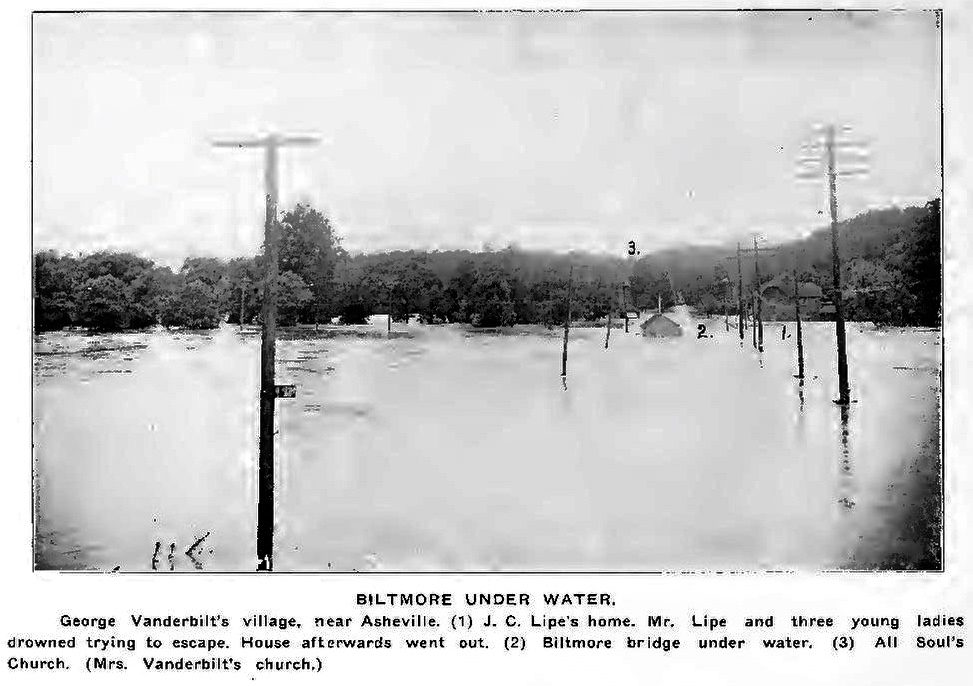
The flood of 16 July 1916 did the worst physical damage in the estate's history. It ended the nursery's commercial operation and destroyed three-quarters of the Biltmore Herbarium along with rare botanical volumes — a scientific collection that cannot be reassembled. It also directly caused the sale, the following February, of the estate land north of the Swannanoa River, including the building that had housed the original forestry school. Biltmore's own writing draws the line between 1916 and Tropical Storm Helene.
Biltmore Village under water in July 1916 — the flood that ended the nursery's commercial operation and destroyed three-quarters of the Biltmore Herbarium.
Photo: from The North Carolina flood — July 14, 15, 16, 1916, photographer not credited / Wikimedia Commons, public domain.
Fires, all in outbuildings. A stable fire in May 1906 killed several horses. The estate sawmill burned that same month, the Deerpark calving barn in 1910, the stock stable in May 1913.
Be sceptical of the 1925 fire. A "1925 fire at Biltmore" circulates widely online. We went looking and could not find it in any credible record. The dated fire history of the estate documents the 1906, 1910 and 1913 outbuilding fires above — and states plainly that Biltmore House itself has never caught fire. If a page tells you otherwise, that is where its sourcing ends.
Two people have been killed on the estate in recent years, both by trees falling in high winds: a visitor in June 2022 and an employee in April 2023. The state labour department investigated the 2023 death and did not cite Biltmore. We are not naming them here; they were real people with families, not page content.
Nobody knows how many workers died building it
Around a thousand men worked on this house over six years, in an era with no meaningful workplace safety law, using explosives, derricks and hand-cranked winches. The records of individual deaths are simply not there. If a tour guide or a website quotes you a number, they are inventing it — and we would rather hand you an honest blank than a satisfying figure.
One more thing worth saying plainly: Biltmore does not run or endorse any ghost tour. Its published activity listing contains nothing paranormal, and the estate does not permit outside companies to run tours on the property. Treat any "Biltmore ghost tour" listing accordingly.
The gardens and the Conservatory
Frederick Law Olmsted laid out 75 acres of gardens at Biltmore and deliberately left everything beyond them looking unplanned. The Walled Garden is exactly four acres — his own measurement, in his own letter. The Conservatory, over 7,000 square feet of heated glass finished in 1895, is the reason a January visit still works.
Biltmore was Olmsted's last major commission, taken in his sixties after a forty-year career, and he treated it as a landscape problem rather than a gardening one. The formal gardens are compressed into a small footprint near the house. Everything else — the Approach Road, the Deer Park, the Lagoon, the Bass Pond — was designed to look like country that happened to be there.
The Walled Garden is the four-acre centrepiece, built between 1890 and 1895 inside tall stone walls with terra-cotta coping. A grape arbour splits it into two terraces: geometric annual beds above, roses below. In a letter of 7 January 1893 to the French nurseryman M. Croux, Olmsted described it as a garden of four acres, one and six-tenths hectares — which is why this is one of the few numbers on the estate nobody argues about.
The Rose Garden is that lower terrace, and roses have grown there continuously since 1895. It now carries more than 250 varieties across roughly 2,300 bushes, against about 50 varieties at the end of the nineteenth century. Biltmore also hosts international rose trials: breeders worldwide submit plants, which are judged across two full growing seasons before a winner is named.
The Azalea Garden, about 15 acres, holds over 20,000 plants and is at its best from mid-April to the end of May. It also contains the oddest things on the estate: 115-foot dawn redwoods, a species over 100 million years old that had been absent from North America for some 15 million years until it was reintroduced from China in the 1940s, and a bog planted with carnivorous pitcher plants.
The water is engineered, not found. The six-acre Bass Pond was made by damming Four Mile Creek and enlarging an old millpond, with the dam finished in summer 1893 and the boathouse and rustic bridge in 1895. Olmsted piped storm water and silt beneath the dam through a flume system so the pond would not fill in. The Lagoon, another six acres at the lowest point of the 250-acre Deer Park, exists to reflect the west façade of the house and was not completed until 1897.
Olmsted's plant list survived 130 years
His original scheme for the Ramble called for some 500 varieties of flowering shrubs, small trees and perennials. The same ground is marketed today as the Shrub Garden — and Biltmore still puts the number at over 500 plant varieties. It is the same garden, still running his list.
What blooms when
March is the pivot: witch hazel, daffodils, hellebore, snowdrop, hyacinth and the magnolias near the Conservatory. April is the tulip month — Biltmore Blooms fills the Walled Garden with tens of thousands of bulbs, and the count moves year to year (an tally has run above 95,000 tulips, 18,000 daffodils and 3,000 hyacinths in a strong year). Redbuds, serviceberry and dogwood come out along the Approach Road; the azaleas start.
May brings mountain laurel and Catawba rhododendron along the Approach Road, and the roses begin to build. June is peak rose. July is the Conservatory's month, when the tropical collection spills outdoors into more than 1,200 pots. August belongs to the Italian Garden's water lilies, including the giant Victoria lilies, which bloom at night and smell of pineapple.
October is the other peak. Biltmore sits at 2,000 feet, so leaf colour arrives here in the mid-to-late October window, after the high Blue Ridge has already turned. The chrysanthemum display in the Walled Garden usually peaks mid-month. November is bark and structure season: paperbark maple, scarlet red-twig dogwood, the state-champion river birch, and Japanese maples that keep going after everything else has stopped.
The honest low season
January through early March, there is not much blooming outdoors, and pretending otherwise would waste your trip. What is actually out: winter jasmine, vernal witch hazel and wintersweet in the Shrub Garden, "Midwinter Flame" dogwood and Angelina stonecrop in the Walled Garden's winter border. That is the list. Biltmore publishes it as such, which is to its credit.
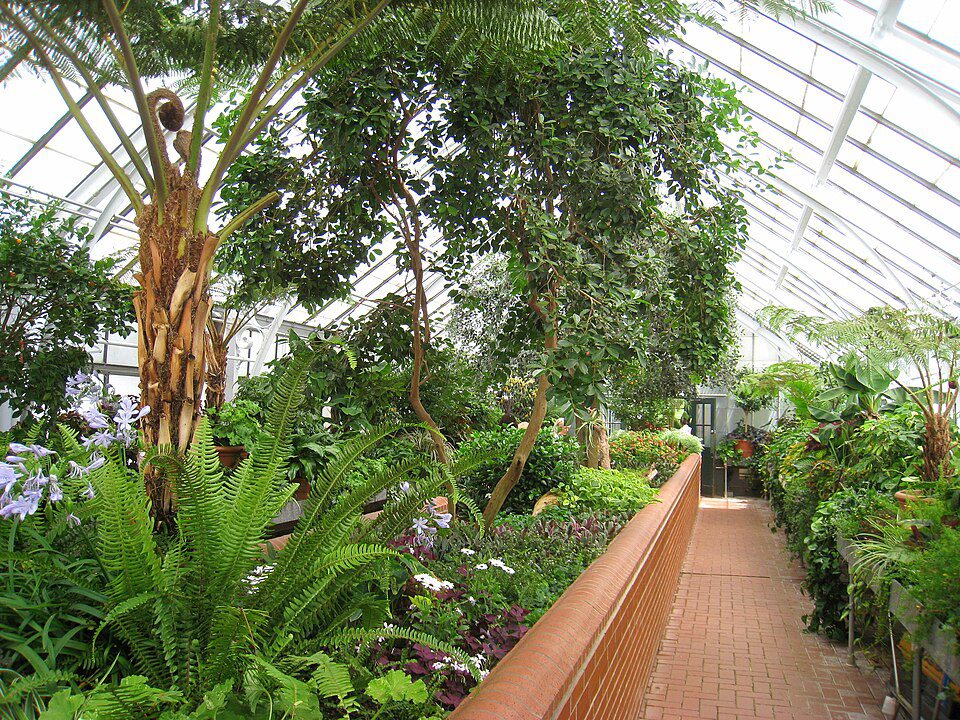
The Conservatory is the answer to that problem, and it is a real one. Over 7,000 square feet of heated glass, completed in 1895, open 365 days a year, arranged into a central Palm House plus Cool House, Hot House and Orchid Room. The historic orchid collection runs to more than 500 plants — and its peak bloom is January and February, exactly when the outdoor gardens have nothing. In December it fills with poinsettias.
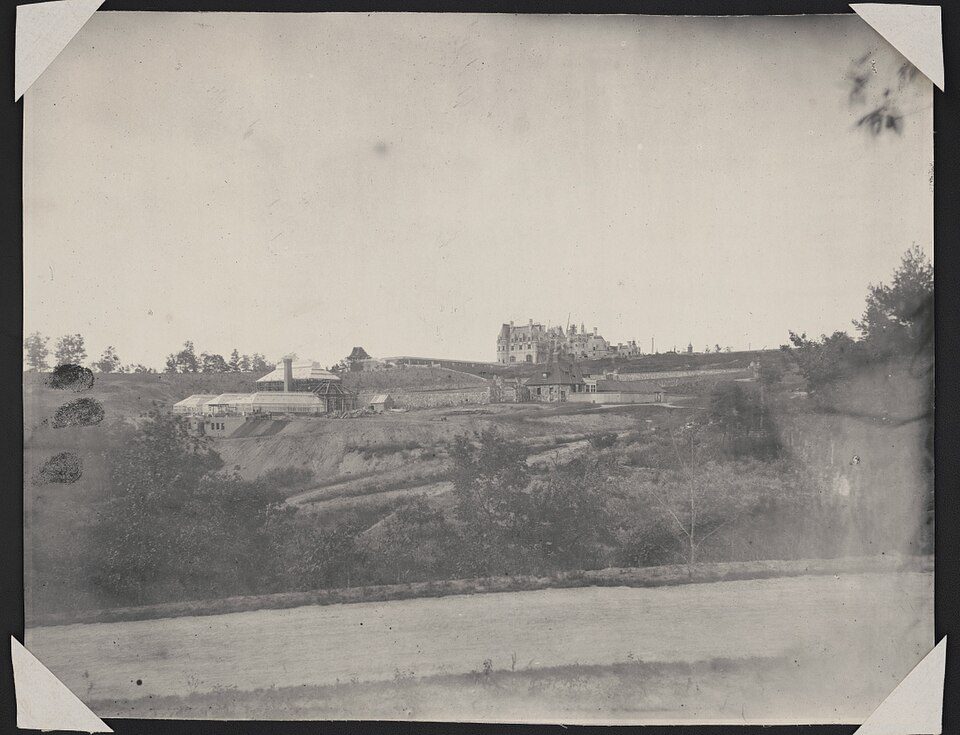
The greenhouse and conservatory range going up in 1895. Olmsted had it sited downhill at the far end of the Walled Garden so it would never interrupt the view from the house.
Library of Congress, Prints & Photographs Division (LCCN 2016650340). No known copyright restrictions.The same glass, still working. Over 7,000 square feet of it, heated, open every day of the year, and at its best in the two months the gardens outside have nothing.
Photo: Daderot / Wikimedia Commons, public domain.
The Winter Garden is not the Conservatory
Two different glass rooms, and visitors mix them up constantly. The Winter Garden is the sunken octagonal room inside Biltmore House, on the house tour. The Conservatory is a separate glasshouse downhill at the far end of the Walled Garden — Olmsted sited it there deliberately so it would not block the view from the house.
A visitor walk-through of the gardens, the Walled Garden and both halves of the Conservatory, useful for judging how much walking is involved. Video: VA Travels on YouTube.
Where to eat
You cannot bring lunch in. Biltmore allows no outside food or drink except clear
plastic water bottles, and no outside alcohol at all, ever. Six places serve food across the estate,
picnicking is permitted in exactly three spots, and the property is primarily cashless.
Where to eat on the estate. Opening times vary by day and season.
Venue
Where
What it is
Stable Café
At Biltmore House
In the former stables. Reservations available and highly recommended.
Cedric's Tavern
Antler Hill Village
Tavern dining. Leashed dogs welcome on the patio — ask the host first. Reservations recommended.
Bistro
Antler Hill Village
Leashed dogs welcome on the patio. Reservations recommended.
Village Social
Antler Hill Village
Reservations available and highly recommended.
The Wine Bar
At the Winery
Indoor and outdoor on Scholar's Walk, with charcuterie, local truffles and wines by the glass, bottle or flight. Live music and patio seating.
The Dining Room
At The Inn
Through November and December, reservations are exclusive to guests staying at The Inn, Village Hotel or the Cottages. Day visitors cannot book it. A dress code applies here and at the Library Lounge.
What you may bring
Clear plastic water bottles only. No other outside food or drink, and no outside alcohol at any
time.
Where you can picnic
The sloped lawn in front of the Diana statue, the Bass Pond, and the Lagoon. Those three, and
nowhere else. No tailgating in the car parks.
Reservations
Biltmore calls them “available and highly recommended” at Stable Café,
Cedric's Tavern, Bistro and Village Social. Book when you book your ticket, not on the day.
Paying
Biltmore is primarily cashless. Cash is accepted only at the Inn and Village Hotel front desks,
the Library Lounge and The Dining Room. Three fee-free machines on site convert cash to a prepaid
card.
Where to stay
Staying on the estate does not include admission to Biltmore House — the single
most expensive misunderstanding here. Biltmore runs three on-estate properties, and five hotels sit in
Biltmore Village at the gate. All five were open and taking bookings when we checked on 30 July
2026.
A stay is not a ticket
We checked all three on-estate property pages and the exclusion is stated consistently on every
one. A stay includes the gardens, the grounds, Antler Hill Village and the Winery, plus a
complimentary lodging shuttle running every half hour — but house entry is a separate
ticket you still buy.
The three on-estate options
Property
Where
Notes
The Inn on Biltmore Estate
~3 miles from the entrance
Four-star; Forbes Four-Star for 25 consecutive years, and named to Condé Nast Traveler's 2026 Gold List in December 2025.
Village Hotel on Biltmore Estate
~3.25 miles from the entrance
In Antler Hill Village, so the Winery and its restaurants are on your doorstep.
The Cottages
On the estate
Vanderbilt-era houses. The Dairy Foreman's Cottage sleeps 6; Line House Cottages I and II sleep 4 each. Historic, and not wheelchair accessible.
Staying in Biltmore Village instead
Biltmore Village sits immediately outside the Lodge Street entrance — a historic district of
shops, galleries and restaurants around the Cathedral of All Souls, a short walk from the gate. Five
hotels are there.
Biltmore Village, immediately outside the Lodge Street gate. It was built as the estate's own planned village and sold out of the family in 1920; it flooded badly in Helene, so check what is trading before you plan an evening here.
Photo: Teemu08 / Wikimedia Commons, licensed CC BY-SA 3.0.
Biltmore Village hotels — status checked 30 July 2026 on booking platforms
Hotel
Status when checked, 30 July 2026
Hampton Inn & Suites Asheville Biltmore Village
Open and taking bookings
DoubleTree by Hilton Asheville–Biltmore
Open and taking bookings
Courtyard Asheville Biltmore Village
Open and taking bookings
AC Hotel Asheville Biltmore Village
Open and taking bookings
Home2 Suites Asheville Biltmore Village
Open and taking bookings
All five were operating and taking bookings when we checked on 30 July 2026, and no
source we found reported any of them closed after Helene. That is a booking-platform
reading, not a statement from the hotels: the Hilton and Marriott brand sites block automated
checks, so we read live listings, availability and dated 2026 reviews instead. Confirm with the
property when you book.
Check the village before you book
Biltmore Village flooded badly in Hurricane Helene. As of March 2026 a number of storefronts were
still vacant or boarded, and the Cathedral of All Souls is not open for regular
worship — its bells returned in May 2026 and interior restoration is targeting
December 2026. The Grand Bohemian Lodge is confirmed reopened.
Combining it with the Blue Ridge Parkway
A full Biltmore day runs seven to nine hours. A real waterfall trip out to the Brevard
corridor or DuPont adds another 90 minutes to two hours of driving before you stand in front of
anything. The two do not fit in one day. Here is what does.
The arithmetic nobody else will do for you
House, gardens, the 5-mile leg out to the Winery, the Estate's own recommended 30-minute buffers
between areas and lunch come to seven to nine hours once you count arrival, parking and the 3-mile
approach drive. Add a waterfall afternoon and you are over the top of the day. Biltmore says it
plainly too — at least one full day, two for a complete visit. Anyone promising you
both is selling you a rushed version of each.
What does fit
Biltmore House and gardens only, about four hours from gate-open, then the Parkway. That is a
genuinely easy afternoon, and it is the pairing we would actually recommend.
Nearest Parkway access
Where US-25 crosses at milepost 388.8, roughly 3–4 miles from the estate
— about ten minutes.
A day that actually works
Early start from downtown Asheville, at the Admissions Gate 30 minutes before your house entry
time. House and gardens, about four hours — skip the Winery leg today. Lunch in Biltmore
Village, immediately outside the gate. Then onto the Parkway at milepost 388.8 for an overlook loop,
an hour to ninety minutes.
What is open right now — checked 29 July 2026
Hurricane Helene reshaped access across western North Carolina in September 2024 and recovery has
not been uniform. Below is where each place stood when we last checked it, sourced to the agency that
manages it where one publishes a status and to a dated news report where it does not.
Access status, checked 29 July 2026 against each site's managing agency or a dated news report
Place
Status
Detail
Biltmore Estate
Open
House, Conservatory, Winery and gardens report minimal or no storm damage. Reopened 2 November 2024.
Blue Ridge Parkway near Asheville, MP 375.7–423.2
Open
Includes the Folk Art Center, the US-25 and NC-191 crossings, Graveyard Fields and Black Balsam. Possible short single-lane daytime traffic control near MP 388.8–393.6 for unrelated bridge work. NPS status stamped 23 July 2026.
Blue Ridge Parkway north-east of Asheville, MP 317.5–355.3
Closed
Helene-related. Covers Linville Falls and the Mount Mitchell approach; recreation of any kind is prohibited in these sections. One short open gap around MP 327.5–330.9 (Little Switzerland / Orchard at Altapass). Craggy Gardens Picnic Area also closed. Repair target late 2026.
Biltmore Village
Partly open
Many businesses have reopened, some on a reduced scale, but as of March 2026 a number of storefronts were still vacant or boarded. Do not assume a full high street.
Cathedral of All Souls, Biltmore Village
Closed
Not open for regular worship. The bells rang again in May 2026; interior restoration targets December 2026. Services are at St. George's in the meantime.
Looking Glass Falls
Open
No Helene closure on file. A separate contained wildfire in April 2026 closed the Looking Glass Rock trailhead and forest roads 475/475B — not the roadside falls.
Sliding Rock
Open
Normal seasonal hours, 9am–6pm daily.
Moore Cove Falls
Open
Confirmed open.
Triple Falls, DuPont State Forest
Partly open
The falls and overlook are open via the High Falls Loop. The Triple Falls Stairs, the closer-view staircase, remain closed from Helene damage.
Catawba Falls
Partly open
The loop trail is open. The upper viewing platform and the Wildflower Trail remain closed while repairs continue.
I-40 through the Pigeon River Gorge
Restricted
Still one lane in each direction. Full four-lane restoration is not expected until 2028. Relevant if you are driving in from Tennessee.
Reporting from September 2025, a year on from the storm, on what had reopened in Biltmore Village and what had not. Video: FOX Weather on YouTube.
Statuses change
Everything above carries the date we checked it. If you are reading this well after 29 July 2026,
check the managing-agency pages before you build a day around any of it — NCDOT publishes live
road conditions at drivenc.gov — and
call us on (828) 269-3936 if you want to know what the roads are
actually doing this week.
Blue Ridge Parkway Scenic Tour — if you would rather not drive it
Three hours on the Parkway in an open-air safari Jeep with a guide who drives it every week
— overlooks, mile markers and the stories that go with them. It is the half of the day
Biltmore does not cover, and you are not the one navigating.
$99 adult · $59 child
3-hour tour · departs Brevard, about 45 minutes to an hour from Asheville
· meets at 209 N. Caldwell Street, Brevard
Biltmore is one item on a long list. If you are still building an itinerary, start with our guide to
things to do in Asheville, and if the mountains are what brought you here,
the best waterfalls near Asheville covers
the afternoon that pairs best with an estate morning.
First-hand
What our guides tell guests before they go
We are not the Estate, and we do not tour it — the Estate's own guides do that. What we
run is everything around it: the Parkway, the waterfalls, the backroads. Which means we spend a lot
of time answering the small practical questions that decide whether a Biltmore day goes well. So
here they are, free.
When guests ask us about Biltmore Estate tours, it is almost never about
the house. It is the logistics: what time to leave, where to park, what they are allowed to carry in.
Six things worth knowing before you go.
Leave earlier than you think
Thirty minutes before your house entry, at the gate — then a 3-mile approach drive and an
8–10 minute walk from the lot. That is close to an hour of buffer that is not the drive from
town. The single most common way to lose a timed entry is treating the gate as the destination.
Bags are smaller than you think
Maximum 19″ × 14″ × 9″, and no backpacks at all on
any guided tour — they have to be lockered or left in the vehicle. Worth knowing before you
pack for the day.
You can picnic, in three specific places
No outside food or drink generally, except clear plastic water bottles — but picnicking
is allowed at the sloped lawn in front of Diana, the Bass Pond and the Lagoon. No outside
alcohol, ever. And the estate is primarily cashless.
Dogs: grounds yes, buildings no
Leashed dogs are welcome on the grounds and on the Bistro and Cedric's Tavern patios —
ask the host first. Not in buildings, not at the lodging, and explicitly not at Luminère. Service
animals excepted throughout.
There are bears
Black bears range across all 8,000 acres, along with deer, turkeys and waterfowl. Biltmore
asks for a 50-yard minimum distance, no feeding, food stored in your vehicle,
and sightings reported to Biltmore Company Police on
828-225-1581. It also warns that mountain weather turns fast
— if wind or a storm comes in, seek shelter rather than waiting it out in the open. Given
that two people have been killed on the estate by falling trees in high winds, that is not
boilerplate.
Accessibility: know the limits first
Only the first and second floors of the house are accessible, connected by lift; the third
floor and basement are not, and there is an Access Lounge showing those rooms on video. Loaner
wheelchairs are limited and first-come. Lot E has accessible parking with a free ADA shuttle.
Biltmore is one item on a long list. If you are still building an itinerary, start with our guide
to things to do in Asheville, and if the mountains are what brought you
here, the best waterfalls near Asheville
covers the afternoon that pairs best with an estate morning.
FAQ
The thirteen questions we are asked most about a Biltmore day, answered in the order
people ask them: cost, duration, where it is, who owns it, what a ticket covers, Candlelight,
discounts, lodging, walking between areas, and whether we run estate tours ourselves.
How much does it cost to tour the Biltmore house?
On 29 July 2026 a Daytime House & Grounds ticket started at $80, including the audio guide,
gardens, Antler Hill Village, a complimentary wine tasting and parking. Grounds-only started at
$50. Buying online saves $10 against the gate price. Prices vary by date and season, so check
yours before budgeting.
How long is the Biltmore house tour?
Biltmore recommends allowing 1.5 to 2 hours for the self-guided house visit; the audio guide
runs about an hour. Add the gardens and Conservatory for 2.5 to 4 hours total. For the whole
estate, including the Winery, Biltmore advises at least one full day and recommends two.
Where is Biltmore Estate?
In Asheville, North Carolina, just south of downtown. Use 1 Lodge St, Asheville, NC 28803 for
navigation — other addresses can send you to the wrong entrance. It is roughly 9 to 10 miles
from downtown, and the Reception & Ticketing entrance is a further 3 miles from the house.
When was Biltmore Estate built?
Between 1889 and 1895, opening to family and friends on Christmas Eve 1895. Richard Morris Hunt
was the architect and Frederick Law Olmsted designed the landscape. The house has 250 rooms across
175,000 square feet and is still the largest privately owned home in the United States.
Who owns Biltmore Estate now?
The Biltmore Company owns and operates Biltmore Estate. It is privately held, with no outside
shareholders, by George Vanderbilt's descendants, the Cecil family. William A. V. Cecil Jr. has
been President and CEO since 1995, and Diana (Dini) Cecil Pickering has chaired the board since 2017. It
is not a national park or a public trust.
Does Anderson Cooper own part of Biltmore Estate?
No. Anderson Cooper descends from Cornelius Vanderbilt II, the older brother of George Washington Vanderbilt II, who built Biltmore. Both were sons of William Henry Vanderbilt and grandsons of Commodore Cornelius Vanderbilt. Biltmore has stated Cooper holds no ownership in the estate. Biltmore is owned by George's Cecil descendants through The Biltmore Company.
Is Biltmore Estate worth the ticket price?
A Daytime House and Grounds ticket started at $80 on 29 July 2026, and it covers more than
people expect: the self-guided house route with its audio guide, the 75 acres of gardens and the
Conservatory, Antler Hill Village, a complimentary wine tasting, and parking. Biltmore advises at
least one full day and recommends two. Booked for an afternoon, most of what you paid for goes
unused.
Is the wine tasting included with Biltmore admission?
Yes. A complimentary tasting at the Winery's Tasting Room is included with any admission tier,
with no reservation needed. You must be 21 or over to taste, with valid photo ID; non-alcoholic
grape juice is offered otherwise. The Winery is 5 miles from the house at Antler Hill Village.
Do I need a separate ticket for Candlelight Christmas Evenings?
Yes — a daytime ticket does not admit you in the evening. But one Candlelight ticket
covers both: enter before 4:30pm and you get the daytime grounds and the evening house the same
day; arrive at or after 4:30pm and your grounds access moves to the next day.
Where to get discount tickets for Biltmore Estate?
Buying online direct saves $10 on a daytime house ticket against the gate price, and Biltmore
advises booking at least 7 days ahead. Military and age-65-plus discounts exist. Biltmore's own
discounts page lists seniors and military but no AAA offer — individual AAA clubs sometimes
run their own Biltmore discounts, so check your local club rather than trusting a figure quoted
online. A Groupon annual-pass deal appears periodically.
Where to stay when visiting Biltmore Estate?
Biltmore runs three on-estate options: The Inn on Biltmore Estate (about 3
miles from the entrance, Forbes Four-Star for 25 consecutive years), the Village
Hotel in Antler Hill Village (about 3.25 miles), and the Cottages —
Vanderbilt-era houses sleeping four to six. Off-estate, Biltmore Village sits at the gate.
The trap worth knowing: a stay at any of the three does not include
Biltmore House admission. Gardens, grounds, Antler Hill Village and the lodging shuttle are
included; house entry is a separate ticket. We confirmed that across all three property pages,
because it is the assumption that costs people the most.
Off the estate, Biltmore Village sits right at the gate — though it flooded badly in
Helene and recovery is uneven, so check current status. Full detail in
where to stay above.
Can you walk between areas of Biltmore Estate?
No. Biltmore states that estate roads have no sidewalks and walking between areas is not
recommended given the distances. Only the 8 to 10 minute walk from Lots A and B to the house is
practical. The estate-wide Biltmore Connect shuttle is $15 per person per day.
Do you run tours of Biltmore Estate itself?
No. Biltmore Estate tours are run by the Estate itself — it does not permit outside
companies to run their own tours on the property, and its own interpreters do the storytelling.
We are an independent Asheville tour operator with no connection to The Biltmore Company. What we
do is get you to and from the area and build the rest of your day around it, in an open-air Jeep
with a local guide. Buy estate admission direct from
biltmore.com.
We are not affiliated with, endorsed by, or operated by The Biltmore Company.