


Updated August 26, 2026
Asheville is one of those rare mountain towns that offers something magical every season. From blooming rhododendrons in the spring to fiery foliage in the fall, every month brings a new reason to explore the Blue Ridge Mountains—and the best way to do it? In a Jeep, with the roof off and the wind in your hair.
But if you’re wondering when to plan your adventure, we’ve got you covered. Here’s a breakdown of what to expect during each season so you can pick the perfect time for your Asheville Jeep Tour.

Spring: Wildflowers, Waterfalls, and Crisp Mountain Air
Best for: Flower lovers, photographers, and travelers who enjoy mild temperatures.
Spring in Asheville is a celebration of renewal. The Blue Ridge Parkway starts to open fully, and the trails and overlooks come alive with dogwoods, mountain laurel, and rhododendrons. Creeks run strong with winter melt, making the waterfalls especially photogenic.
You’ll love:
- Craggy Gardens’ rhododendron bloom (late May–June)
- Comfortable temps for hiking and sightseeing
- Clear skies and far-reaching mountain views
Craggy’s bloom window and access notes are in the Parkway chapter of our field guide.
Why ride in spring? It’s the perfect mix of quiet roads, vivid landscapes, and crisp air that makes a top-down Jeep ride feel like a breath of fresh air—literally.
Summer: Long Days, Green Peaks, and Mountain Adventures
Best for: Families, adventure seekers, and outdoor lovers.
Summer is Asheville’s busiest season—and for good reason. With temperatures cooler in the mountains than in surrounding cities, it’s a popular escape from the heat. The forests are lush, the wildlife is active, and the trails are ready to explore.
What to expect:
- Longer daylight hours (more time to explore!)
- Perfect picnics at high-elevation overlooks
- Jeep rides that feel like mini safaris
Why ride in summer? Summer gives you the full Blue Ridge experience—deep green valleys, blue hazy skies, and that unmistakable feeling of freedom as you roll through winding mountain roads.
Fall: Foliage, Festivals, and That Golden Glow
Best for: Everyone. Seriously.
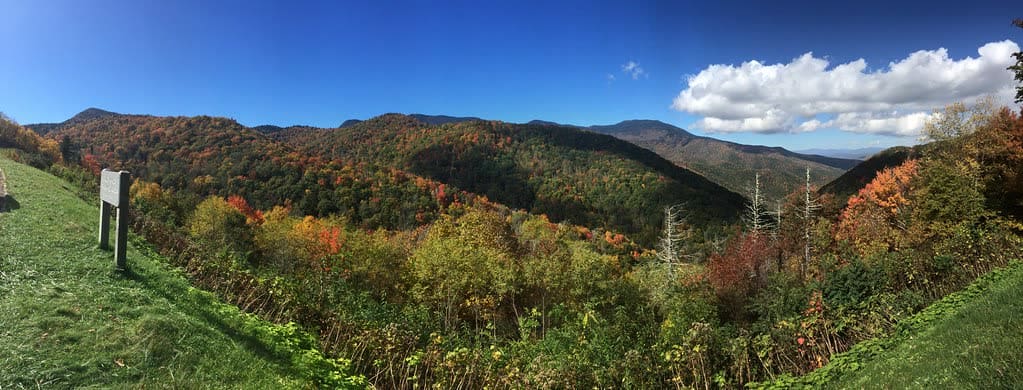
 Fall is the most popular season for Jeep tours in the Asheville area—and it’s easy to see why. The Blue Ridge Mountains burst into color with a patchwork of red, gold, orange, and rust. People travel from all over the country to catch “peak week,” and the views? Unreal.
Highlights include:
- Colorful foliage from late September through early November
- Local harvest festivals and craft fairs
- Cool, refreshing air perfect for Jeep rides with the windows down
That window is exactly when our Fall Foliage Tour runs.
Why ride in fall? You haven’t truly experienced autumn until you’ve seen the leaves change in the Smokies from the open view of a Jeep.
Winter: Quiet Roads and Clear Views
Best for: Peace-seekers, off-season travelers, and mountain dreamers.
Winter may be Asheville’s most underrated season. Yes, it’s chilly, but the crowds thin out, the air gets clearer, and the views go for miles. Plus, there’s something cozy about bundling up and taking a scenic ride along snow-dusted ridges.
Winter perks:
- Unobstructed views (no leaves = more visibility!)
- Serene, less-traveled roads
- Snowy mountain backdrops for photo ops
Why ride in winter? If you want a more peaceful, personal tour experience, winter is the perfect time. And don’t worry—our Jeeps are climate-controlled, so you’ll stay toasty even as you roll through frosty scenery.
So…When’s the Best Time to Ride?
Here’s the honest answer: There’s no wrong time.
Every season in Asheville brings its own kind of beauty—and we design our Jeep tours to highlight the best of what each one has to offer. Whether it’s spring’s fresh blooms, summer’s green majesty, fall’s vivid colors, or winter’s quiet majesty, we’ll make sure your experience is unforgettable.
Plan Your Perfect Season with Asheville Play
No matter when you decide to visit, we’ll be ready with:
- Comfortable, climate-controlled Jeeps
- Local guides who know the roads and the stories
- Scenic routes tailored to the season’s highlights
Departures daily from downtown Asheville
Book your seat early—especially for fall foliage season!
Choose Your Season and Book a Jeep Tour
Why Asheville has no single peak weekend for fall color
Peak color around Asheville is not a date. It is a wave that moves downhill over about six weeks. Biologists at Appalachian State University built the region’s fall color map on one rule of thumb: for every 1,000 feet of elevation gained, peak color arrives roughly one week earlier. They call it an approximation, not a measured constant.
Mount Mitchell reaches 6,684 feet, the highest point east of the Mississippi River. Asheville Regional Airport, where the region’s weather is officially recorded, sits at 2,118 feet — over 4,500 feet of separation inside an hour’s drive. So if you arrive to bare ridges above a still-green town, you have not missed it. You are looking at the wrong elevation.
Asheville fall colors by elevation: the typical windows
These are typical windows, not a prediction for any particular season.
- Above 5,000 feet — late September. Patchy color starts on the highest ground while everything below is still green, per NC State University’s College of Natural Resources.
- 3,000 to 5,000 feet — mid-October. Two credentialed forecasters draw this band differently, and the gap is worth knowing rather than averaging away: Howard Neufeld gives October 12–20 for 3,000–4,000 feet, Robert Bardon of NC State mid-October for 4,000–5,000 feet.
- Asheville itself, around 2,100 feet — the end of October. Town is among the last places to turn, not the first.
- Below 2,000 feet — into early November. Great Smoky Mountains National Park reports the same from the other end: its best displays below 4,000 feet run mid-October to early November.


Weather in Asheville in October: the numbers that matter
October weather in Asheville is mild and drier than most visitors expect. In NOAA’s 1991–2020 climate normals for Asheville Regional Airport, October averages a high of 69.6 °F and a low of 46.2 °F. The figure almost nobody publishes: October is the driest month of the year here, averaging 3.37 inches of precipitation against August’s 5.04 inches. Peak leaf month is also the least rainy.
Red pigment forms after warm, sunny days followed by nights between freezing and 45 °F, according to NC State Extension Forestry. Asheville’s average October night sits at 46.2 °F, just above that band — and the ground above town is colder still, by a reported 10 to 25 degrees. Pack a layer you would not think you needed at the hotel.

Where the current fall color forecast actually lives
If a guide tells you to check Appalachian State University’s fall color report, that guide is out of date. On 27 July 2026 the university posted that Dr. Howard Neufeld, the Fall Color Guy, has retired, and that his forecasts now live on his own site, fallcolorguy.org. The archive is still online, which is why so many articles still send readers there.
His first 2026 report, dated 26 July 2026, declines to name a peak week: “It’s way too early to say what is going to happen in October.” Anyone publishing a specific 2026 peak weekend today has invented it. Weekly reports run through September and October — that is when the real call gets made.
Choosing your week: crowds, shoulder season and winter access
October is the busiest month on the Blue Ridge Parkway by a wide margin. The National Park Service says it historically welcomes nearly 2 million visitors in October alone, and to expect heavy traffic and full parking lots. It also supplies the best crowd advice going: there are over 200 formal scenic overlooks, so “if one overlook is full of visitors and cars, just keep going, another one is not too far away.” If town is still green, a run up the Parkway gains elevation faster than the calendar moves — and a weekday beats a weekend in the same week.

Winter is not a closed season, but it is an unpredictable one. The Parkway has no calendar winter closure — the motor road stays open, and the Park Service closes sections in real time for snow and ice, sometimes preemptively ahead of a forecast storm. No typical closing dates are published, so a same-morning check is the only reliable one. Facilities run on fixed dates instead: the Pisgah Inn publishes a season of April 1 to October 31.

Common questions about the best time to visit Asheville
What is the best month to visit Asheville, NC?
October, if you are coming for fall colors — the most popular month, and in NOAA’s 1991–2020 normals also the driest, averaging 3.37 inches of rain with highs near 69.6 °F. For warm-weather hiking with fewer cars on the mountain, April averages a high of 69.4 °F, May 76.3 °F and September 78.7 °F.
What is the rainiest month in Asheville, NC?
August. In NOAA’s 1991–2020 climate normals for Asheville Regional Airport, August averages 5.04 inches of precipitation, the wettest of the twelve months, with June at 4.79 and July at 4.67 inches. The driest is October, at 3.37 inches — part of why leaf season here is usually dry.
When do fall colors peak in Asheville?
There is no single peak date, because peak moves down the mountain over several weeks. In a typical year, ground above 5,000 feet turns in late September, the 3,000-to-5,000-foot band peaks around mid-October, Asheville itself at roughly 2,100 feet turns at the end of October, and the foothills hold color into early November.
Should you book early or late in leaf season?
Early. Howard Neufeld, who has tracked these mountains for close to twenty years, reports never seeing peak arrive more than a few days ahead of the long-term average, while warm weather commonly delays it three to five days and occasionally two weeks. Arriving early is also the fixable mistake: you drive uphill.
Is the Blue Ridge Parkway open near Asheville in the fall?
Out of Asheville, yes, in both directions — the Park Service’s road status table shows the Parkway open from Mount Mitchell south past Asheville toward the Smokies. The closed stretch sits north of Mount Mitchell, where Hurricane Helene damage remains and work is targeted for late 2026. The table is re-stamped daily at 8 a.m.


